

 Available in US
Content
The Button That Sells You Certainty at a Discount
The first cash-out I ever refused cost me £340 of paper money and taught me everything I needed to know about the feature. I had a top-10 on Tommy Fleetwood at a links event in 2019, watched the offer hit 6.8 times my stake on Saturday evening, decided I knew better, and watched him bogey 16, 17 and 18 on Sunday morning into a missed top-20. That sting still informs how I read every cash-out screen seven years on.
Cash-out is not a strategy. It is a tool, and like every tool a bookmaker hands you for free, it has a price attached. The number on your screen is your original implied payout multiplied by the current implied probability, then shaved by the live margin layer. Sometimes that maths is in your favour. More often, the haircut is steep enough that the rational answer is to do nothing.
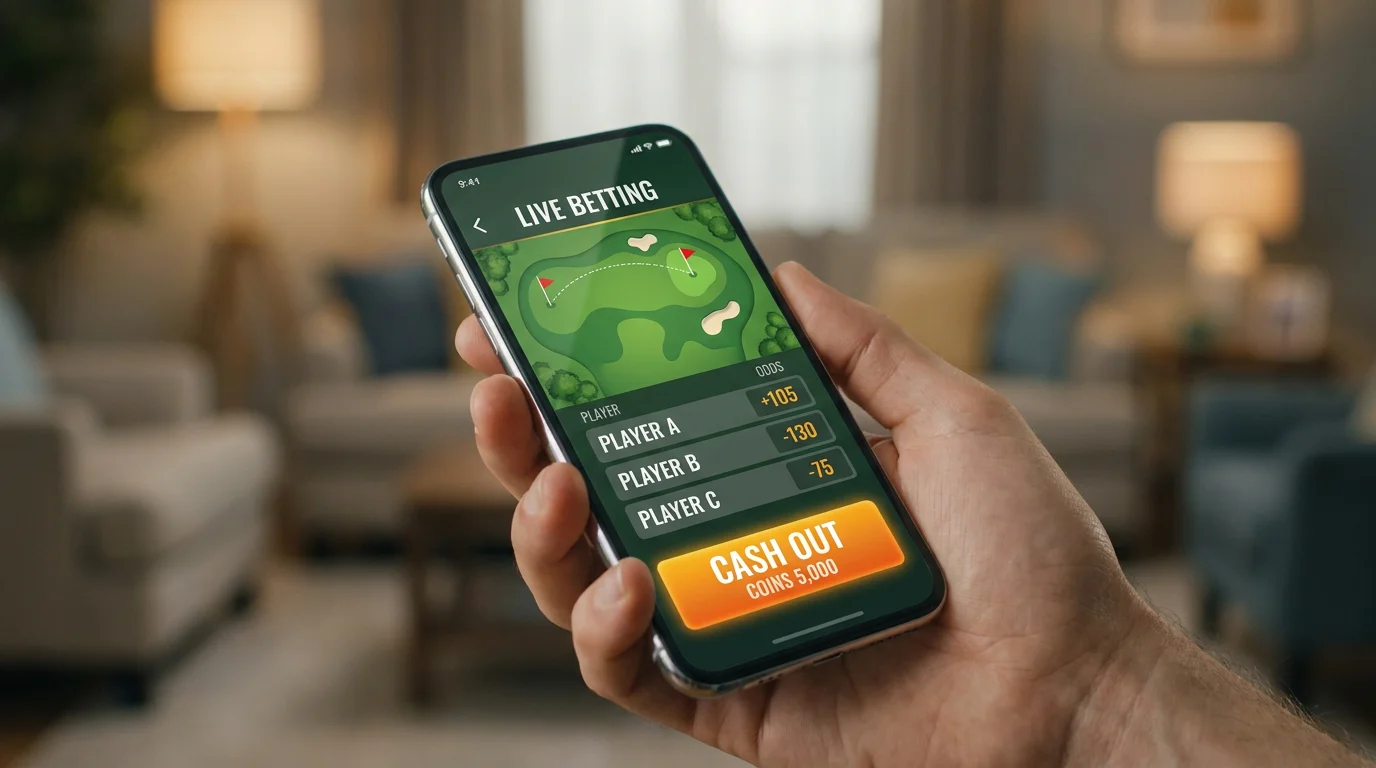
The global sports-betting market sits at roughly $108.92 billion in 2024 and is forecast to push past $198 billion by 2030, with live in-play the lead segment driving that climb. UK trading desks know cash-out is the single biggest reason a casual punter opens their app a second time during a four-hour golf round. That is useful context, because it explains why the feature is so visually loud, and why the maths quietly favours the house.
The Formula Behind the Number on Your Screen
A mate asked me to explain why his £20 ticket on Rory McIlroy at +650 was offering him about £73 to settle after the opening round at Augusta in 2025, when his potential payout was £150. He thought the book was cheating him. It was not — it was just doing maths he had not been shown.
The rough formula is this: cash-out value equals your stake multiplied by the ratio of original decimal odds to current decimal odds, then minus the live margin layer (typically four to eight per cent on golf, wider when weather is unstable).

Walk through that McIlroy ticket. Pre-tournament he was +650, decimal 7.50. After Augusta’s opening round he drifted to +1200, decimal 13.00, before the eventual playoff win. The bare-bones recalculation on a £20 stake: 20 × (7.50 / 13.00) = £11.54. Subtract the live margin, and you would see roughly £10.80 in the app. So my mate’s £73 figure was not what he thought it was — he was either reading a different ticket or the price had moved back in his favour by the time he checked.
Note the asymmetry, because this is the part most punters miss. When your selection shortens, cash-out climbs above your stake, but the margin layer still bites. When your selection drifts, cash-out collapses well below stake in a hurry. That asymmetry is by design: the bookmaker is risk-flat as soon as you accept the offer, and the cost of being risk-flat in their direction is buried in the spread.
When the Maths Says Take It
What’s the actual decision rule? I’ve used the same three-condition test for seven years, and it has saved me more headaches than any other piece of process in my notebook.
Condition one: your edge from your pre-bet model has fully closed. The price now reflects everything your model knew and a bit more besides. Condition two: variance from here is asymmetric — there is far more downside in the remaining holes than upside left in your ticket. Condition three: the cash-out figure, expressed as a fraction of your bankroll, matters more to your overall variance than the implied probability gives back.
All three need to be true. Two out of three is the bookmaker’s profit margin in disguise.
This is also why the between-holes pause is your decision window — it is the only moment the live price is stable enough to read without latency rejection. A worked example from my own card: I had a top-10 on Justin Rose at the 2025 Masters at 8/1. By Saturday evening he was T6 with a four-shot cushion on T11. The cash-out was 6.2 times my stake. My model said his probability of holding top-10 was about 78 per cent. True odds from that probability: 1/0.78, or 1.28 decimal, so an honest payout would have been 7.8 times stake. The 6.2 times on offer was a 21 per cent haircut. I let it ride and won, but it was close, and on a different day with the forecast turning I would have taken the lower number and walked.
When Cash-Out Is Just a Discipline Failure in a Costume
Pamela Maldonado, who covers sports betting for ESPN, framed the underlying psychology more crisply than anyone in the industry: “Golf betting is a slow-burn panic. Throwing darts at the board and hoping for a bullseye is a good way to run out of funds before the weekend.” That panic is exactly what cash-out monetises.
Three patterns I watch for in my own tickets and in friends who ask me to look over theirs.

The first is taking 80p in the pound on a clearly winning ticket because Saturday afternoon got nervy. The maths is fine, the player is fine, but the punter is tired. Bookmakers price this state of mind — they know exactly how a Saturday evening offer reads when you have spent the day refreshing a leaderboard.
The second is taking 30p in the pound on a losing ticket “to recover something” when waiting another two holes would either settle it the same way or shift the price materially. Loss-aversion makes 30p feel like a win. It is not.
The third, the one I am hardest on, is letting the bookmaker name your variance for you. The whole point of placing a thoughtful bet is to own your variance until the maths says otherwise. If your reason for taking the cash-out is “I just don’t want to watch the rest,” that is a bankroll problem dressed up as a decision. The fix is to stake smaller, not to settle early.
Partial Cash-Out: Locking the Stake, Riding the Profit
The one cash-out variant I genuinely use most weeks is partial. The mechanic is simple: settle a chosen fraction of your original stake at the current live price, leave the remainder running to original settlement.
The classic application is on an each-way outright. Your player is T3 entering Sunday on a 5/1 ticket with each-way at 1/5 odds to top five. Partial-cash 50 per cent of the win portion. You have now locked in a meaningful return whatever happens, kept your each-way upside intact for any top-five outcome, and still own half of the headline win-side payout if your player closes out the title.
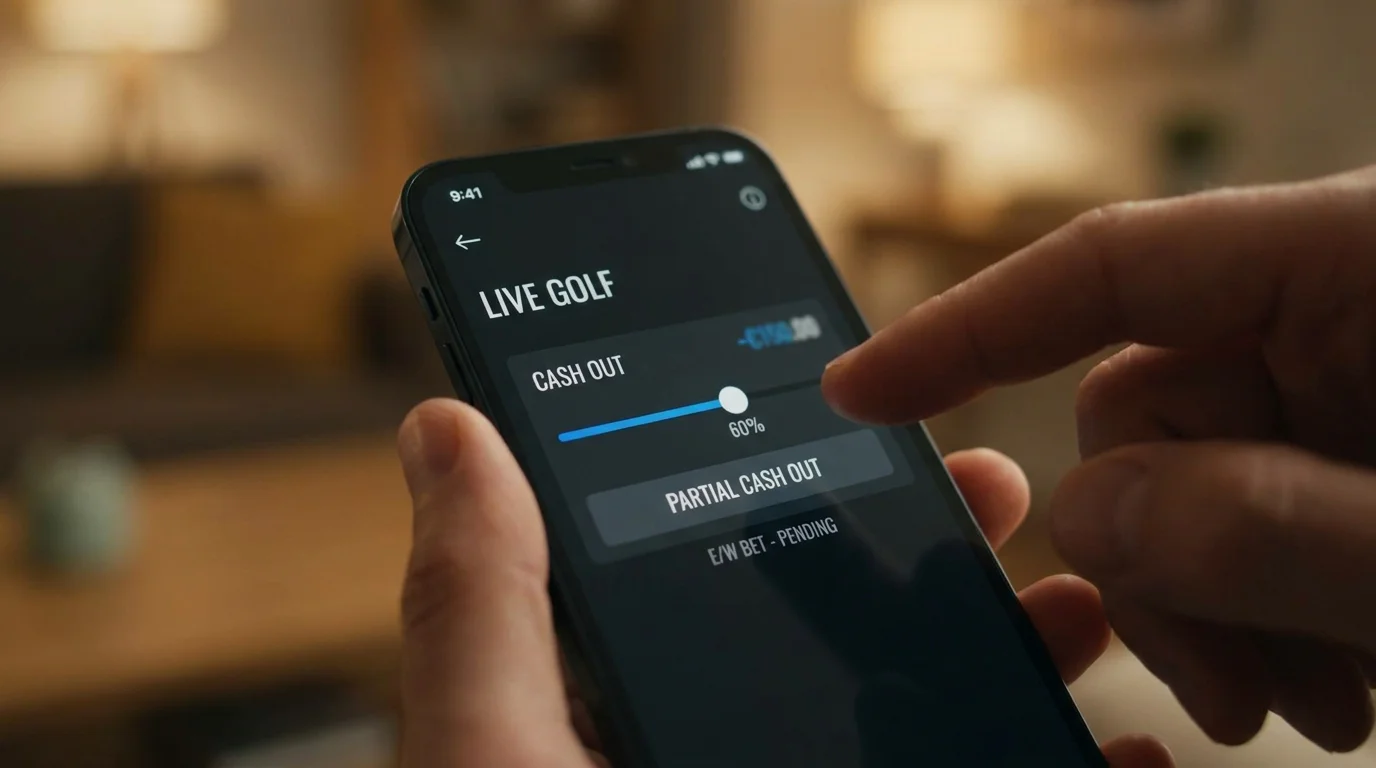
Partial works in golf better than in most other live sports because the event moves in discrete steps. Every shot, every hole resets the price slightly, so you can pick precise moments to part-cash without the line moving on you mid-decision. Compare that with live football, where a corner kick can change a market in two seconds and your part-cash request gets rejected at the worst possible moment.
Worth flagging: not every UK book supports partial on every market. Outright partials are widely available. FRL partials almost never exist. Live 3-ball partials are rare. Before you build a strategy around the feature, check the specific market panel of your operator on a pre-tournament Wednesday, not at 4 pm on Sunday when you actually need it.
Does the cash-out value match the true odds on a live golf bet?
Almost never. The cash-out figure is shaved by the bookmaker’s live margin layer, typically four to eight per cent in golf and wider during weather instability. The number on your screen is your true implied value minus that haircut, which compounds over a season of tickets into the gap between a profitable bettor and a recreational one.
Can I cash out a winning each-way golf bet partially?
Yes on most UK books, though not on every market. Outright each-way partial cash-out is standard. FRL and 3-ball partials are rare. Check the specific market panel before placing the original bet rather than discovering the option does not exist when you actually want it.
Is cash-out available during a weather suspension in a live golf market?
Generally no. When markets are suspended, cash-out is suspended with them. Operators re-enable it once the round resumes and the live price stabilises, which can take ten to thirty minutes after the all-clear depending on how much repricing the trading desk needs to do.
