

 Available in US
Content
- Why In-Play Golf Lives in Four Hours, Not Four Months
- Live Versus Pre-Tournament: Two Different Sports
- The Between-Holes Window: Where the Real Trade Happens
- How a Book Actually Recalculates a Price
- Cash Out Mechanics on a Live Golf Card
- Building a Live Bet Builder That Holds Together
- Feeds, Latency and the Numbers You Cannot Trust
- Suspensions, Voids and the Rules That Save Your Slip
- Quick answers on in-play timing and freezes
Why In-Play Golf Lives in Four Hours, Not Four Months
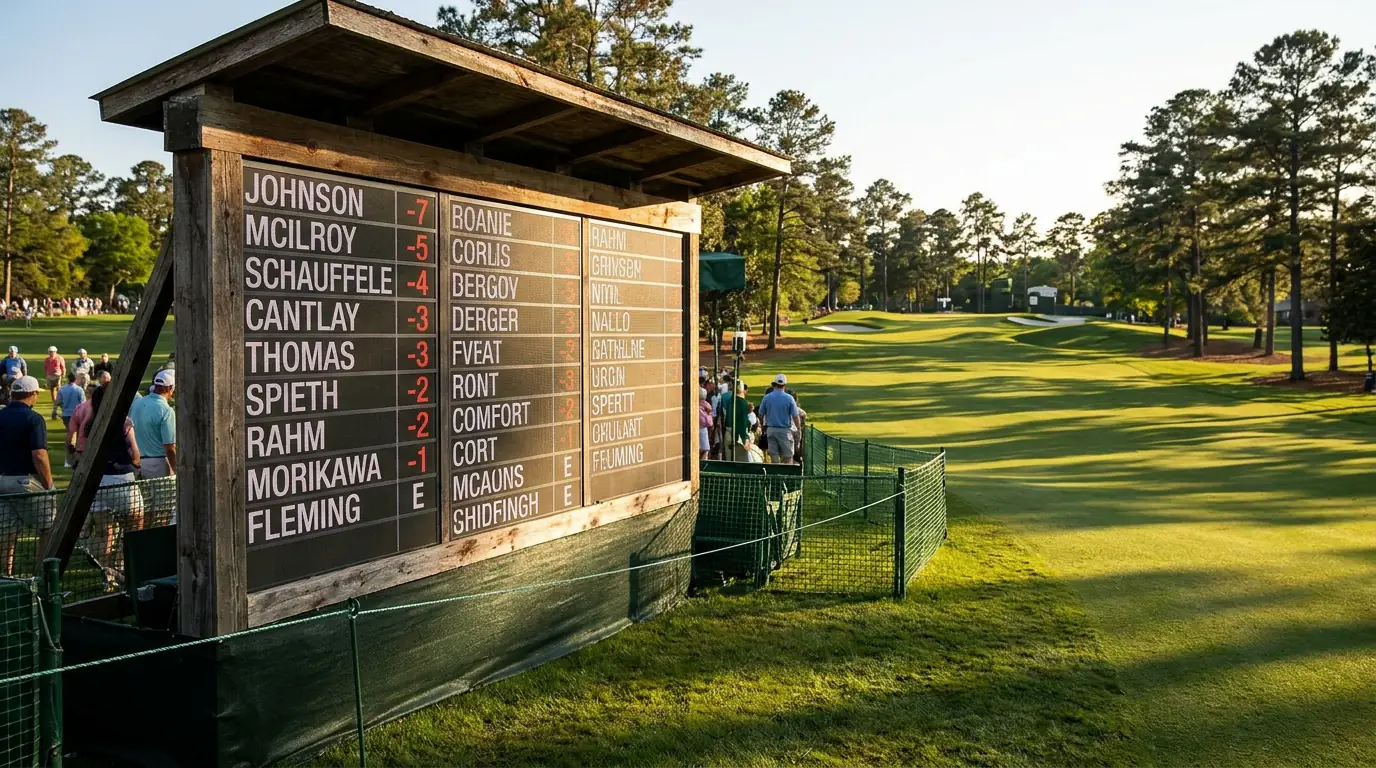
I still remember the Thursday afternoon at Augusta in April 2025 when Rory McIlroy walked off the first green at +650 and, by the time I refreshed my screen at the eleventh tee, the same outright sat at +1200. He had not lost the tournament. He had opened with a 72, hit the same fairway nine other professionals hit, and the entire field had shifted underneath him. Pre-tournament odds belong to the news cycle; in-play golf betting UK markets belong to the next thirty seconds.
That is the only thing you need to internalise before reading the rest of this piece. Ante-post golf lives for weeks — fields get announced, withdrawals trickle in, weather forecasts firm up. In-play golf lives for four hours of moving water, with roughly seventeen workable intervals between the holes a leading group will play in a single round. The decisions you make in that window have almost nothing in common with the decision to back a player on a Tuesday morning.
Live and in-play betting is, by volume, the largest single segment of the global sports-betting market — interactivity and reaction to the unfolding event are exactly why. In the UK specifically, live football leads the live-betting mix at about 5% of bettors overall and 9% among men, with live horse racing at roughly 3% and 5%. Live golf sits behind both, and that is part of what makes the markets interesting: the books carry the format, but the action is thin enough that mispricings linger longer than they would in a peak Saturday football coupon. The price you see at 14:42 might still be there at 14:47. That gap is the whole sport.
Live Versus Pre-Tournament: Two Different Sports
Two prices on the same player are not two versions of the same bet. They are two different products with different inputs, different margins and different shelf-lives, and treating them interchangeably is the fastest way I know to bleed a bankroll over a single tournament week.
Take the McIlroy 2025 Masters card as a working example. The pre-tournament price of +650 was built from course history, current form, weather forecast for a Georgia spring, field strength and implied probability around roughly 13%. After his opening 72, with the leader at six under and McIlroy seven shots back of the lead, the book had every reason to fade him — and yet the in-play price drifted only to +1200, implying about 7.7%. The market never wrote him off. By Sunday evening he had completed the career Grand Slam by beating Justin Rose in a playoff, the sixth man in history to do it. The pre-tournament backer collected at +650. Anyone who chased the +1200 on Friday morning collected at +1200. Same outcome, very different process.
The pre-tournament book is a beauty contest between sixty-odd contenders and an aggregated stake from a long booking window. The in-play book is a constant rebuild after each hole: leaderboard input, shot quality input, weather input, time-remaining input. The first market drifts in days; the second drifts in minutes. Pre-tournament is patience. In-play is a stopwatch.
The practical consequence: your edge does not transfer. If your read on McIlroy was that Augusta’s right-to-left dogleg sequence suited his draw — that is a pre-tournament thesis. The live thesis on day one was something narrower: he is not driving badly enough to justify a 7.7% implied; either pile in or stand aside, but do not buy “+1200 because +650 felt cheap.” Reuse the wrong frame and you are paying for two products with one piece of analysis.
The Between-Holes Window: Where the Real Trade Happens
The between-holes window is the only piece of timing in live golf that matters, and I have lost count of the bettors who do not realise it exists. On the DP World Tour and PGA Tour, a leading group plays a hole in roughly twelve to fifteen minutes — tee shot, walk, approach, walk, putt, walk to the next tee. From the moment the last putt of a hole drops to the moment the first player in the next group strikes, you have a window. That window is when books re-price, when cash-out values stabilise, when freezes lift and the new menu lands on your screen.
If you are betting live golf, you should be reading the round in those windows, not during shots. During a shot, the book is freezing legs, blocking cash-outs and waiting for the result to settle. Trying to fire a stake at that moment is like trying to buy a stock during a circuit breaker — the price you see is decorative.
The window has a rhythm. The first ninety seconds after a hole concludes are the messiest: the book is digesting the strokes-gained delta from the hole that just happened, the new leaderboard order is settling, and price changes tend to be coarse. The next two to three minutes are where most accurate in-play decisions get made — leaderboard is fresh, the next shot is still being prepared, and the book has done its math. The final stretch before the next tee shot is when freezes return and certain markets close.
That timing also tells you which markets behave how. Outright odds drift slowly through a round because they aggregate every hole. Hole-by-hole props snap to the next interval — the next tee shot is the entire trade. Three-ball markets reset between groups. Top-finish markets move only on whole-number changes — a player going from tenth to ninth on the leaderboard is a discrete event, and that is the only moment the price moves meaningfully.
Read those rhythms wrong and you will spend a tournament chasing prices that were correct two minutes ago. Read them right and you start to see the round as a sequence of small marketplaces, each opening and closing on its own clock.

How a Book Actually Recalculates a Price
I sat next to a trader at an industry briefing in late 2024 and watched him work an in-play golf card for ninety minutes. The image most punters have — some lone analyst tapping a single number into a terminal — is wrong. What I saw was a model with around two dozen live inputs continuously updating an implied-probability matrix, and a human checking edge cases and overriding when the model produced something the floor manager did not believe.
The base of any live golf price is implied probability. A +650 outright means the book is willing to pay you out at a rate that implies you have about a 13.3% chance of winning, plus a margin to cover their book. When something happens to that player — a bogey, an eagle, a withdrawal, a weather hold — the model recalculates the probability and the price moves accordingly. The fast part is the model. The slow part is the human checking it. The reason live golf prices sometimes lag the broadcast for thirty seconds is that the model has updated, but the trader is still deciding whether to publish.
Pamela Maldonado at ESPN put the bettor side of this equation about as cleanly as I have seen anyone put it: “Golf betting is a slow-burn panic. Throwing darts at the board and hoping for a bullseye is a good way to run out of funds before the weekend. And if you’re putting the same amount on everything, stop right now — that’s the equivalent of using a putter from the fairway.” Translate that into in-play terms and it reads: the model does the panic for you; your job is to know which prices have already absorbed the news and which have not.

Triggers That Force a Re-Price
From what I have watched on the trader side and reverse-engineered from my own logs, the triggers cluster into a short list. Leaderboard rank changes are the largest — every position shift among the top fifteen forces updates across outright, top-five, top-ten, top-twenty and make-the-cut markets simultaneously. Distance off the tee on a long par-5 is another. PGA Tour driving distance averaged 303 to 304 yards in the 2025 season, with leaders like Aldrich Potgieter pushing 327 yards-plus and the touring average rising five to seven yards year on year. When a player who carries 320 hits a perfect drive on a reachable par-5, the book is already pricing in a one-in-three eagle scenario before the second shot is even teed.
Other triggers I have logged: a player missing the green on the wrong side at a known difficult pin, a wind reading changing by three miles per hour at a links hole, a playing partner snapping a six-iron into a hazard (correlation effect — group morale matters more than you would think), and the obvious one, an injury time-out or rules official walking onto a green. Each one ticks a different sub-model, and each tick moves a different cluster of markets.
Cash Out Mechanics on a Live Golf Card
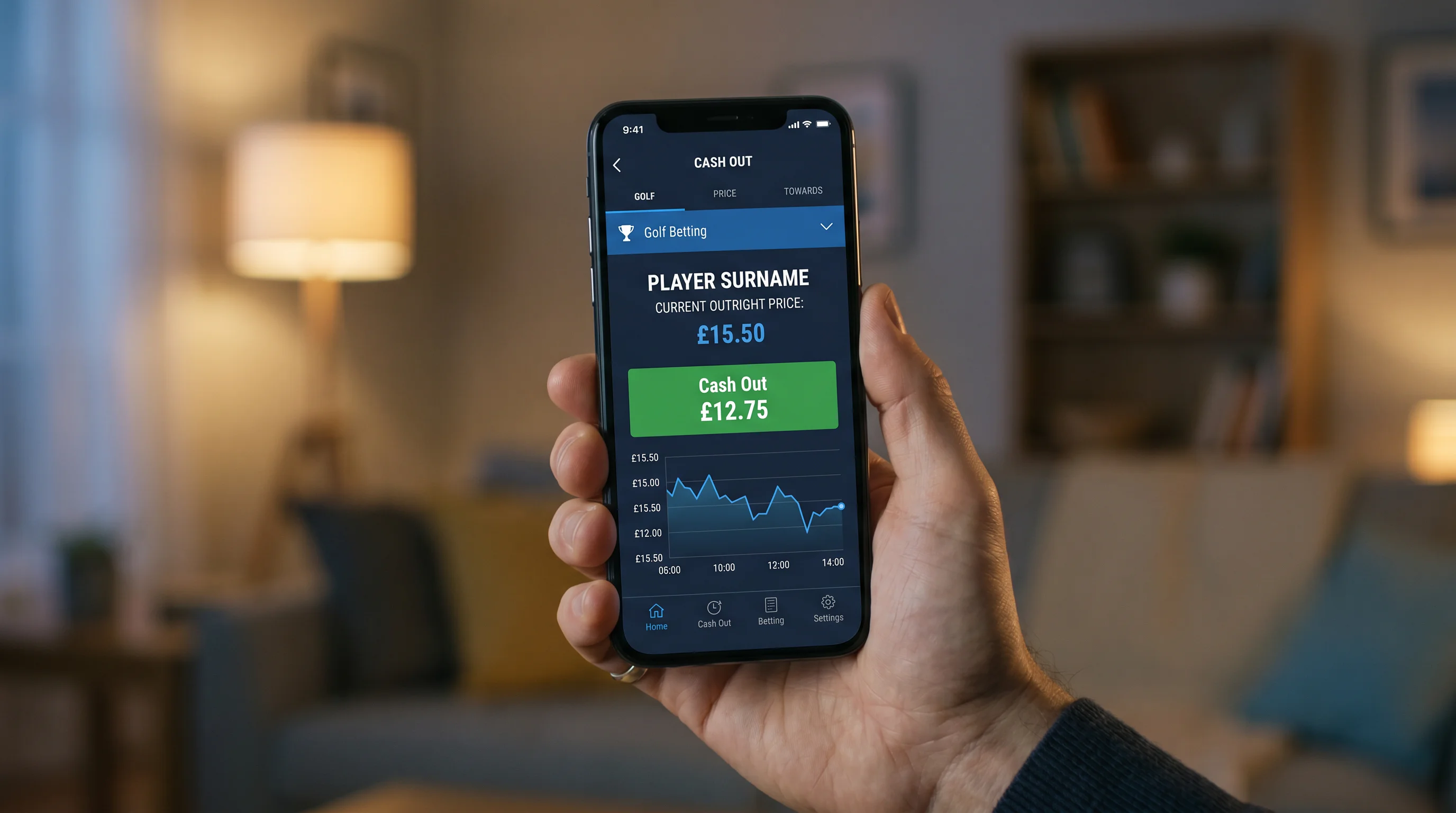
The cash-out button is a derivative. That sentence is the most useful one I can give you. The price you see when you click “cash out” is not your bet’s market value; it is the book’s hedge price, minus their margin, minus a small additional buffer for the time the market will spend frozen while they process you. On a golf bet that has four days to run, those three subtractions are not small.
Here is the working example I use in my own notes. You back a player at +800 pre-tournament for a ten-pound stake. By the end of round one, that player sits in solo second; the live outright is now +350. Naive cash-out math says your bet should pay roughly your stake times the new implied probability ratio — somewhere around twenty-five pounds. The button will quote you nineteen or twenty. The gap is the book’s margin compounded with the time-decay buffer.
The longer the tournament has to run, the wider that gap gets. A Friday morning cash-out is the most punishing — fifty-four holes of variance still ahead, and the book is pricing every weather front and Sunday choke into the haircut. A Sunday-afternoon cash-out with three holes to play is the tightest, because the book’s own exposure is collapsing into a known result.
Which is why I treat cash-out as a tool with three legitimate uses and a dozen illegitimate ones. Legitimate: locking in a result when a leader has a four-shot lead with five holes to play and you want to deload the variance. Locking in a partial book-balance when a tournament-changing weather front is on the radar. Hedging a correlated leg in a bet builder that has already paid for itself. Illegitimate: cashing out at the first sign of nerves on a Thursday afternoon for a player you backed at +1500. Illegitimate: cashing out an each-way bet just because the win leg looks cold and forgetting you still have a top-five leg live. Illegitimate: cashing out before a known volatility event — a known players-only par-5, a known weather risk, a known leaderboard inflection — when the book is actively pricing against that event happening.
If you want to push deeper on the maths, I have written out the full cash-out calculus on a four-day card in its own piece, including the formula I use to sanity-check whether a button price is fair before I press it. For the purposes of in-play mechanics, the only thing you need to remember is that the button is a hedge, not a mirror.
Building a Live Bet Builder That Holds Together
The bet builder is the most over-sold tool in the UK live golf product. I want to be careful here because the marketing language around builders has become almost detached from the mathematics underneath. The maths are simple: when you combine legs, you multiply the implied probabilities and you stack the book’s margin on each one. On a golf card, where individual leg margins can already run high on the proppy stuff, three legs in a builder is enough to give the house a take that no flat single would ever justify.
That said, there is a sane way to use a live builder. The trick is correlation. Two legs that move together — top-five finish plus to win the par-5 stretch, for example — concentrate variance without flattening the price as much as the book pretends. The book applies the same independence assumption to every builder unless its product team has specifically corrected for the obvious correlations, and most products have not.
What I avoid in a live builder: stacking three round-leader props on three different rounds, because round-leader markets have wildly different liquidity and the price you get is the worst of three. Stacking a player to win with the same player to make the cut, because the second leg is almost automatic if the first is live, and the book hates pricing that honestly. Stacking weather-dependent legs in a tournament without a settled forecast — you are buying a multi-variable bet at single-variable margins.
The version of a live builder I will use, sparingly: one in-play hole-by-hole prop on a specific player I have read well off the tee, combined with a top-twenty finish for the same player, settled by the end of the round. Two legs, observable correlation, manageable variance, and a clear settlement window.
Feeds, Latency and the Numbers You Cannot Trust
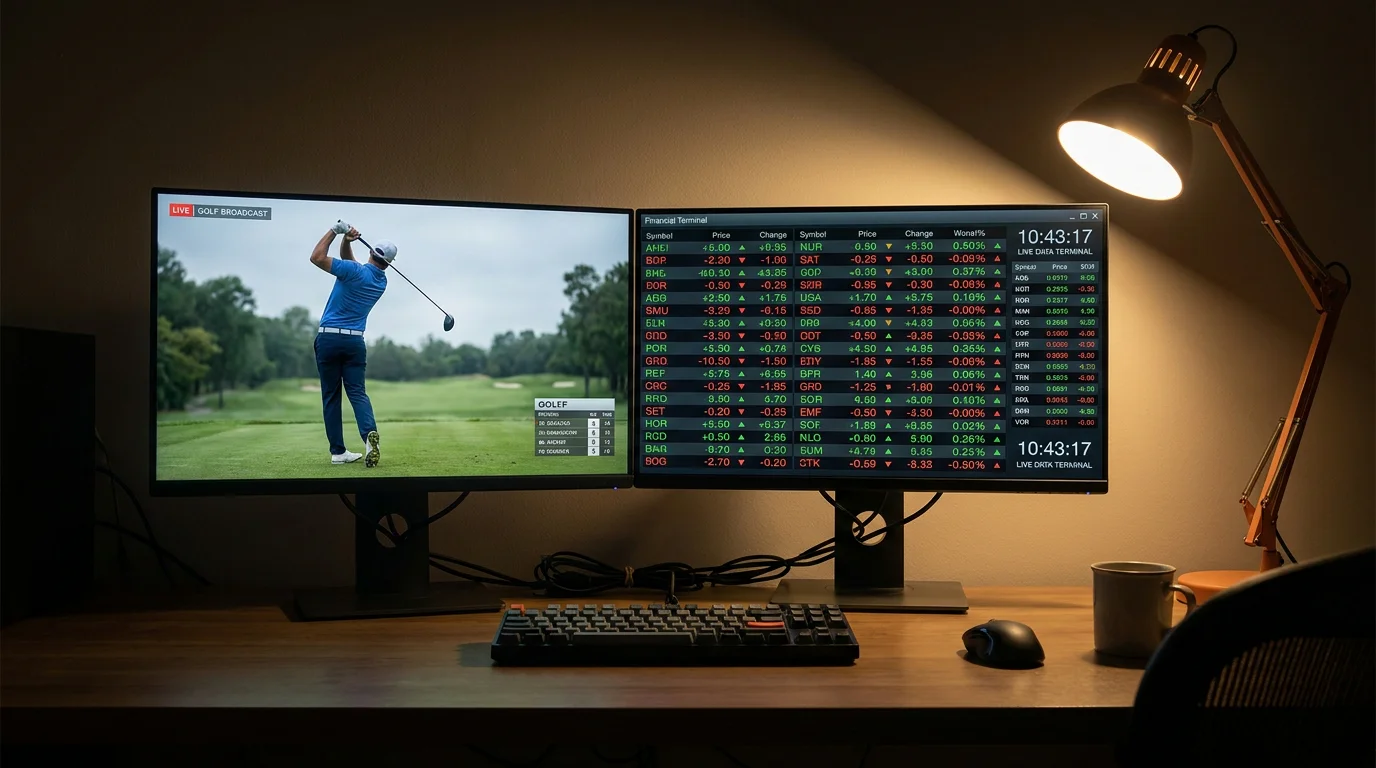
Your television is lying to you. Not maliciously, but structurally. The standard TV broadcast of a major has a six to ten-second delay from the actual shot. The data feed the book is using — ShotLink on the PGA Tour, the DP World Tour’s equivalent — runs ahead of the broadcast by a few seconds because it is collected on the ground and pushed straight to the trading desks. By the time you see a putt drop on your screen, the price has already moved.
That latency gap is the single most exploited misconception in live betting, and the books have closed almost all of it. Modern in-play golf products freeze prices the moment a player addresses the ball on a putt of meaningful consequence — five feet for birdie on the last, anything over twenty feet that could change the lead. The freeze lifts when the data feed confirms the shot result, not when the broadcast shows it. If you have ever clicked “back” on a price and seen “this selection is suspended” pop up, that is the freeze doing its job.
The practical takeaway: the price moves you see during a shot are almost always retrospective. Watch the shot result, give the book ninety seconds to publish a stable post-shot price, and trade in that window. Anyone who tells you they “fade the TV” is, in 2026, either trading with a non-UK book on a thin product or fooling themselves about how late the publication actually was.
Suspensions, Voids and the Rules That Save Your Slip
Most of the live bets I have seen go badly were not bad reads. They were bad rule reads. The published rules of every UK-licensed book cover suspension, withdrawal, weather voids and tournament reduction — and almost no one reads them until the lightning siren goes off on a Friday afternoon.
The headline cases are well known. If a tournament is shortened from 72 holes to 54 by weather, most UK books pay outright bets if 54 holes have been completed and the R&A or PGA Tour has declared an official result. Bets on rounds that never started typically void. Bets on individual hole-by-hole props mid-suspension behave differently from book to book: some void, some carry forward and settle when the hole resumes, some honour the position at the moment of suspension. The detail lives in the small print and it is worth reading once, slowly, before the tournament.
Withdrawals are the messier case. A player who tees off and then withdraws mid-round is treated differently from a player who withdraws before the first tee shot. Outright bets on a player who never struck a shot are almost always voided. Outright bets on a player who hit one shot and then withdrew typically stand and lose — and most UK books are aligned on that, but not all. Each-way bets layer additional complexity, particularly when dead-heat reductions interact with a partial withdrawal of the field. None of this is exotic, but every word of it matters when £200 of stake is sitting in a settled-pending bucket on a Sunday evening.
The pattern I follow before placing a stake on any market I have not traded before, with a book I have not used for that market, is to spend three minutes on the operator’s published golf rules page. The categories I scan: tournament reduction (54 to 72 holes), suspension by weather, withdrawal during play, withdrawal before play, dead-heat reduction, settlement currency and the specific definition the operator uses for “official result.” Three minutes, once per market, once per operator. The cost of skipping that read is occasionally enormous, and the cost of doing it is essentially nothing. This is the cheapest discipline on the entire trading day.

Quick answers on in-play timing and freezes
How long is the typical between-holes window for in-play golf odds?
Roughly twelve to fifteen minutes on the PGA Tour and DP World Tour for a leading group. The first ninety seconds after a hole concludes are the messiest, the next two to three minutes are the cleanest window for accurate trades, and freezes return as the next tee shot approaches.
Why do live golf odds sometimes freeze mid-hole?
Books freeze prices the moment a player addresses a putt or shot of meaningful consequence — birdies to take the lead, twenty-foot eagles, anything that would force a multi-market re-price. The freeze lifts when the data feed confirms the shot result, which is usually a few seconds ahead of the TV broadcast.
What is the difference between live golf odds in the UK and the in-play markets on US-licensed apps?
UK markets are regulated by the UK Gambling Commission, settle in pounds, and follow UK-specific rules on each-way fractions, dead heats and weather voids. US-licensed apps operate state by state under different regulators, offer different bet types — same-game parlays sit closer to UK bet builders — and apply different rules on player withdrawals and tournament reductions.
