
 Available in US
Content
The Quiet Alternative to the Each-Way Lottery
If you watched me place bets at any major in 2025 and asked which market I returned to most often, the honest answer would not be outright winner or first round leader. It would be top-10 finish. Mark Darbon, chief executive of The R&A, opened his five-year strategy announcement with the observation that “golf is in a strong position and these new figures show that participation continues to boom around the world, especially among younger audiences.” Growing participation drives growing betting interest, and the top-finish market is one of the cleanest ways the new betting interest gets channelled — broad enough to be readable, narrow enough to actually pay.
Top-finish markets are the place-only view of the outright pool. You are betting that your player will finish in the top 5, top 10, or top 20 of the official tournament leaderboard. There is no win-or-bust, no playoff drama, just a finish-position threshold. The trade-off is honest: lower headline prices than each-way, but no dead-heat haircut as severe, and no requirement to also win for a meaningful payout.
What follows is the structural maths of why top-finish often pays better than each-way on the same selection, the trade-off between the three available bands, the live-entry windows that matter most, and why the dead-heat impact is the variable that decides between “value bet” and “trap.”
How Top-Finish Replaces Each-Way
The traditional each-way bet on a 50/1 outright pays the win leg at 50/1 if the player wins, and the place leg at 1/5 of 50/1 (so 10/1) if the player finishes in the top 5 at most UK books, or top 6/7/8 at majors depending on the operator’s each-way terms.

The top-10 finish market on the same player typically prices at 5/1 to 7/1 depending on the player’s ranking and form. Compare the place leg: 10/1 each-way on a top-5 finish, against 7/1 (say) on a top-10 finish. The headline number is lower on top-10, but the band is wider (10 places vs 5), and the dead-heat haircut on top-10 is materially milder because the price band is wider.
The conversion question is whether your expected probability of a top-10 finish is more than twice your expected probability of a top-5 finish. For most players in the 30/1 to 80/1 outright range, the probability of top-10 is roughly two times the probability of top-5 — which means the top-10 market pays about the same expected value as the place portion of an each-way top-5. The difference is the win leg, which the top-10 punter skips entirely.
For punters whose model says “this player is more likely to be top-10 than to actually win,” the top-finish market is structurally better than each-way. For punters who genuinely think their selection can win, the each-way is the right play because the win leg pays at full odds. The decision is not “which is better in general” but “which fits the actual probability distribution I have in mind.”
Top-5 vs Top-10 vs Top-20: The Three Bands and Their Trade-Offs
The three standard top-finish bands at most UK operators are top-5, top-10, and top-20. Some books offer top-30 and top-40 at the larger events, but those are less common and carry wider margins.
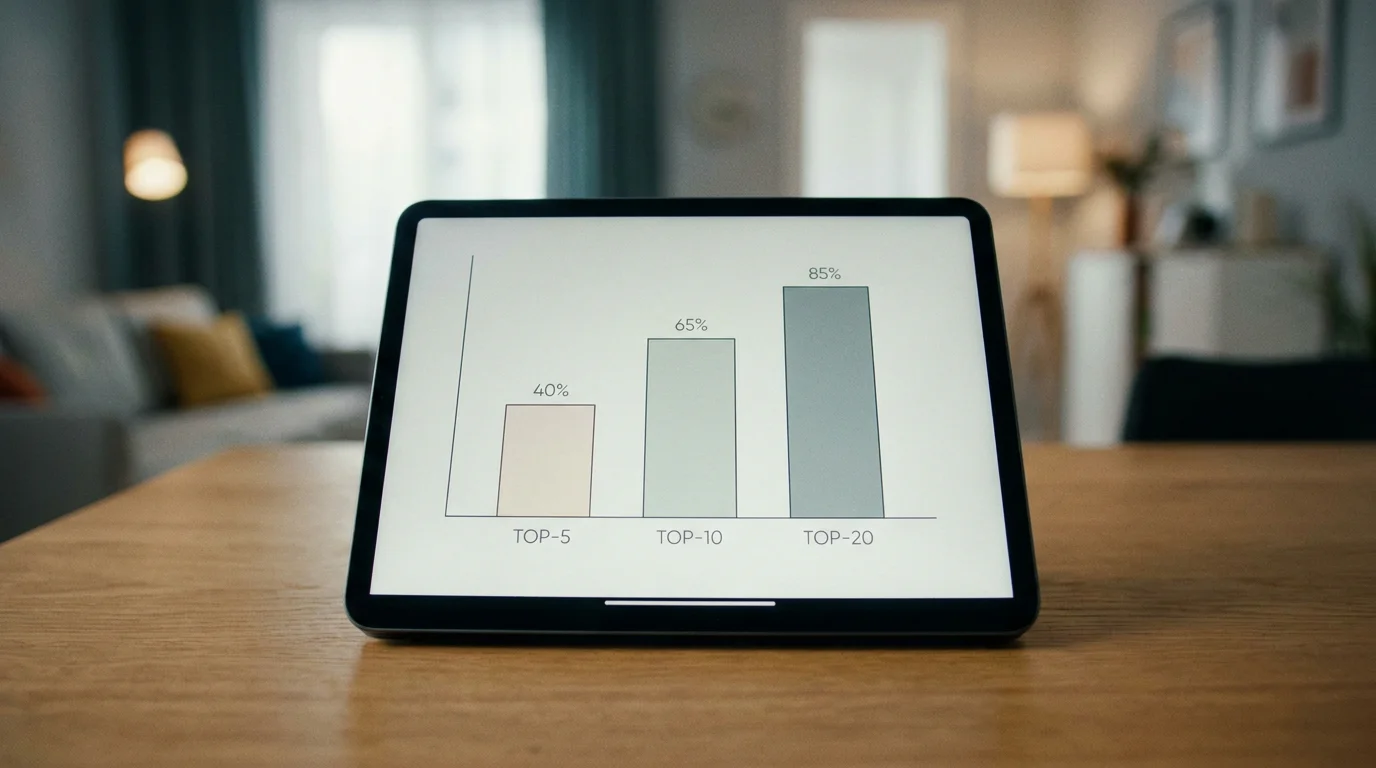
Top-5 finish is the highest-headline band — typical prices on a 30/1 outright are 6/1 to 8/1 for top-5. The band is narrow enough that probabilities are largely intact (a 30/1 player has roughly a 12-15 per cent probability of top-5 against a 3-4 per cent probability of outright winning). The dead-heat exposure is moderate — ties on the cut-off between 5th and 6th happen at roughly 20 per cent of tournaments, with 2-4 players sharing the position.
Top-10 is the band I personally play most. Prices on a 30/1 outright run 5/2 to 4/1. The band is wide enough that the probability is meaningfully different from top-5 (roughly 22-28 per cent for a 30/1 player), and dead-heat ties at 10th/11th are common but typically involve fewer players than the deeper bands.
Top-20 is the band I play least. Prices on a 30/1 outright run 4/5 to evens. The probability of top-20 for a 30/1 player is roughly 35-45 per cent, so the headline price reflects honest probability — but dead-heat ties at 20th regularly involve 5-10 players sharing the position, producing place-stake reductions of 70-85 per cent and turning the actual settled value into a fraction of the headline.
Strokes Gained metrics drive the expected probabilities. Scottie Scheffler in 2025, leading the PGA Tour in SG: Approach, SG: Tee-to-Green, and Greens in Regulation with a birdie-or-better rate of 25.78 per cent, carried top-10 implied probability above 50 per cent at most events. His top-10 price was rarely above 4/5 at any tournament — honest pricing, no value, because the model was correctly identifying him as a near-certain top-10 finisher.
Live Top-Finish After the Cut
Is “top 10 finish” available live across all four rounds? At most large UK operators, yes — the market opens pre-tournament, stays live through Thursday and Friday, suspends briefly during the cut decision, and re-opens on Saturday morning for the weekend rounds.
The most valuable live entry windows for top-finish are Friday evening (after the cut is confirmed and the field is now 70-80 players rather than 156) and Saturday evening (with one round remaining and the leaderboard largely settled into bands).
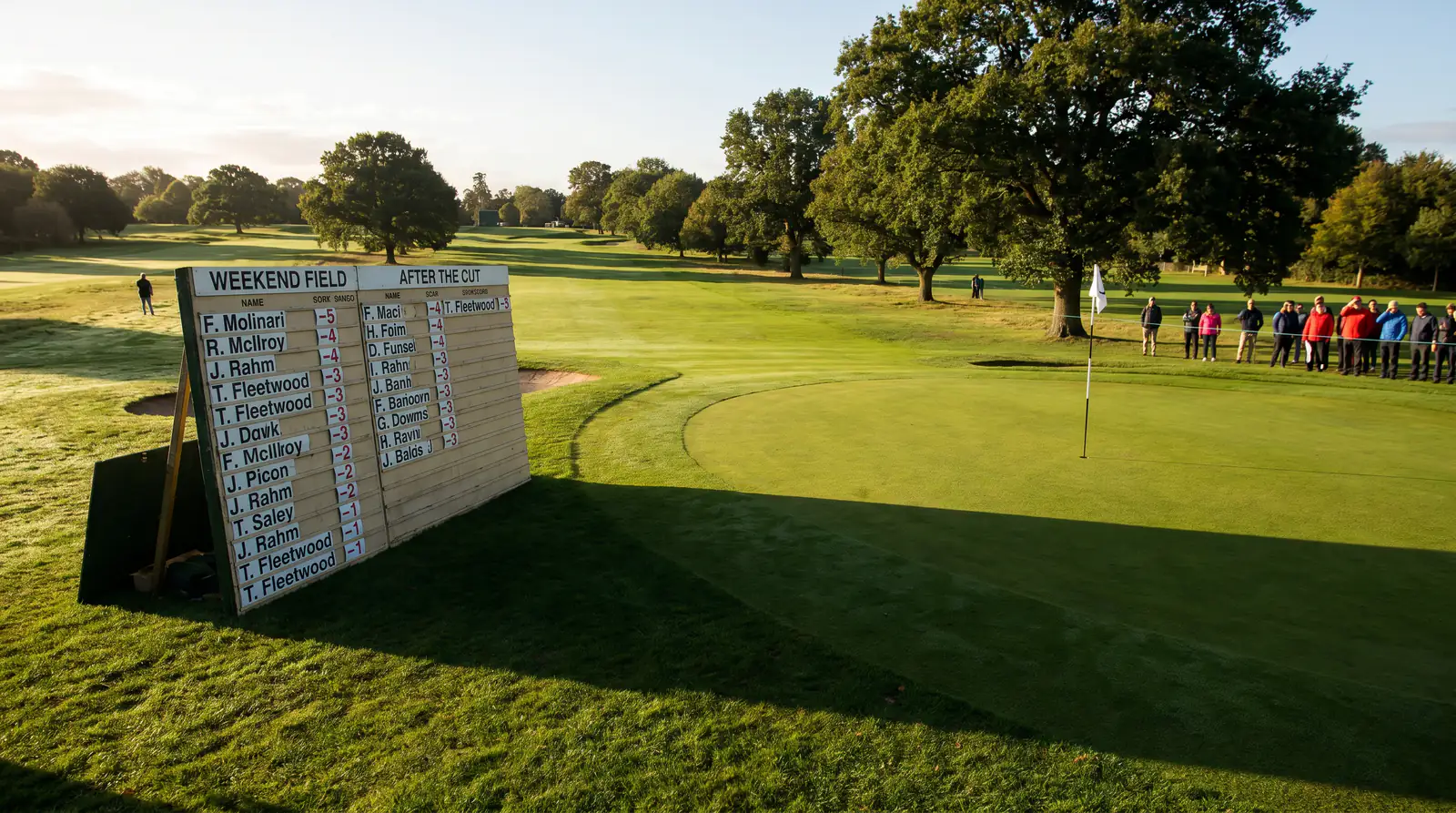
The 2025 Open at Royal Portrush gave a clear demonstration. Scottie Scheffler won at -17, taking $3.1 million from the $17 million prize fund, and the cut line guaranteed $38,900 to every player who survived 36 holes. A live top-10 entry at Friday evening’s close on any player sitting at -4 or better had a true probability of roughly 70-78 per cent of holding through Sunday at most majors. The live price often ran 11/10 to 6/5 — a margin layer of 15-20 per cent against the true probability of around 75 per cent.
The window I have learned to be careful with is mid-Saturday. The price moves are erratic because the model is rebalancing for the upcoming Saturday afternoon scoring conditions and the public is reacting to leaderboard moves in real time. Saturday afternoon prices tend to overcorrect on a bogey or birdie, then settle by Saturday evening to a more honest number. Entries placed at the moment of overcorrection can be excellent, but the discipline to wait for the overcorrection rather than chase it is rare in casual punters.
Dead-Heat Impact: The Variable That Decides Value
Dead-heat ties are the single biggest factor in the actual settled value of top-finish bets, and the impact is heavily band-dependent.
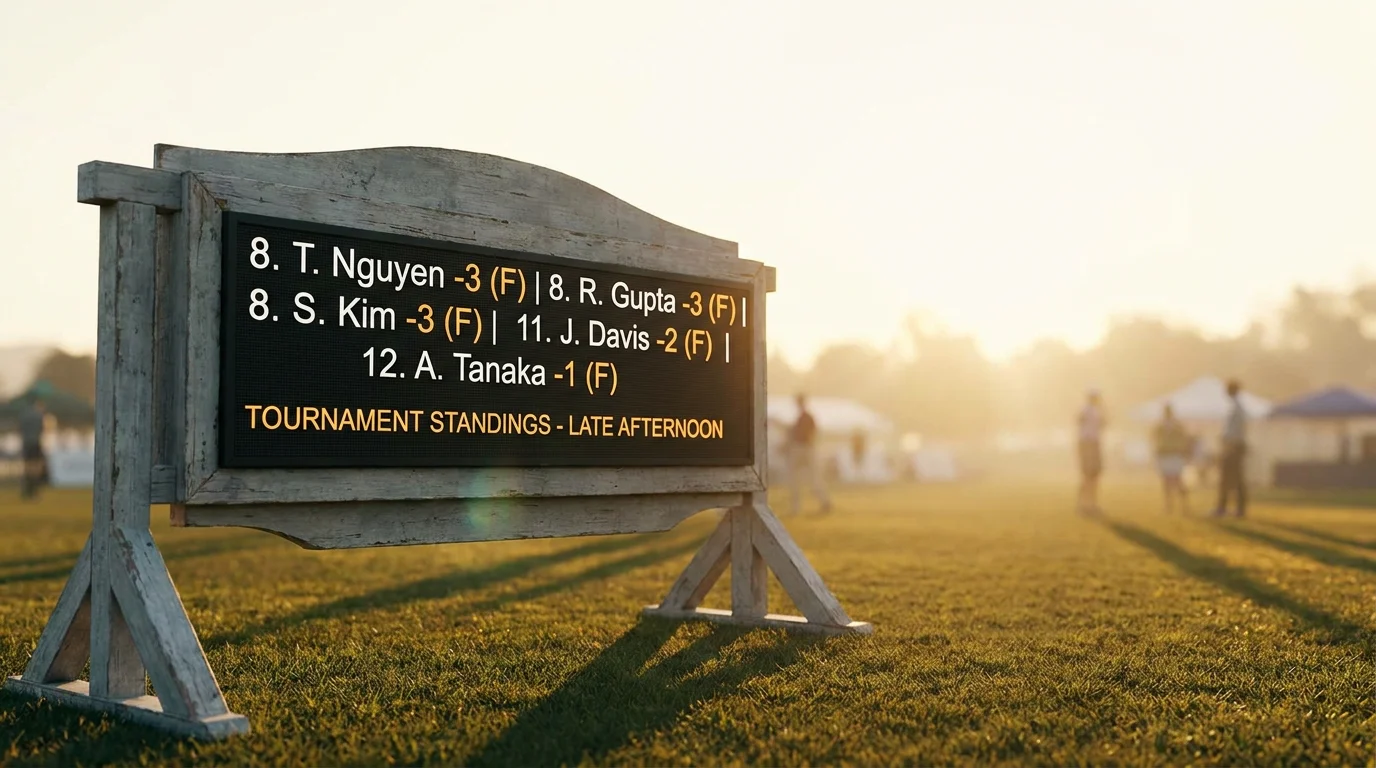
Top-5 ties typically involve 2-4 players at the cut position. The dead-heat haircut on a 4-player tie at the 5th position (sharing 5th, 6th, 7th, and 8th places, with only the 5th position inside the band) is settled stake × (1/4) — a 75 per cent reduction. This is painful but happens at roughly 15-20 per cent of tournaments.
Top-10 ties typically involve 2-5 players at the 10th position. A 3-player tie sharing 10th/11th/12th (with the 10th position inside the band) settles at stake × (1/3) — a 67 per cent reduction. Happens at roughly 25 per cent of tournaments.
Top-20 ties typically involve 5-10 players at the 20th position. A 7-player tie sharing 20th through 26th (with only the 20th position inside the band) settles at stake × (1/7) — an 86 per cent reduction. Happens at more than 50 per cent of tournaments, often at exactly the 20th-position cliff.
This is where bet builders combine top-finish with other legs in a way that compounds the variance — a bet builder containing a top-20 finish and an additional positive-correlated leg often produces lower expected value than placing the two legs separately, because the dead-heat impact on the top-20 leg is multiplied by the parlay’s margin layer.
The honest expected-value calculation requires factoring the dead-heat probability into the headline price before placing the bet. For top-5, multiply the headline price by 0.85. For top-10, multiply by 0.80. For top-20, multiply by 0.55. The adjusted prices are the realistic break-even numbers, and they tell you why top-20 is structurally a worse trade than the headline price suggests.
Why does the top-20 finish often have a lower margin than top-5?
Because the dead-heat impact is much higher on top-20. Operators run a tighter headline margin on top-20 because they know dead-heat reductions will reduce actual payouts by 70-85 per cent on roughly half of all tournaments, which absorbs much of the implied value into settlement haircuts rather than into the displayed margin.
Is ‘top 10 finish’ available live across all four rounds?
At most large UK operators, yes. The market opens pre-tournament, stays live through Thursday and Friday, suspends briefly during the cut decision, and re-opens on Saturday morning for the weekend rounds. The highest-value live entry windows are Friday evening after the cut and Saturday evening with one round remaining.
