

 Available in US
Content
The Market That Shrinks the Card to 18 Names
The top British player market is the only outright-style bet I place where I can actually name every selection in the field by heart, picture their swing, and recall their last three results. Compare that with the full outright board on a major — 156 names, half of whom I would struggle to identify by tee box if pressed. The compactness is the entire appeal. Twelve to twenty-two British names, a clear hierarchy, and a single binary question: which one finishes highest by Sunday evening?

The market has grown noticeably over the past three seasons, and one structural reason for that growth is the underlying interest in British golf at the participation level. England Golf membership rose from 730,602 in 2024 to 750,071 in 2025, a 2.66 per cent increase, with the iGolf independent-golfer programme up 34 per cent and the children’s iGolf segment up 487 per cent over the same window. More UK golfers means more punters watching British pros play, and operators have responded by listing the top-British market at more events than they did five years ago.
What follows is who actually qualifies as British under bookmaker terms, how the market is priced against the much larger outright board, and why live entry during the round itself often pays better than pre-tournament money on the same names.
Who Counts as British, According to the Operators
The definition of “British” varies slightly between operators and is worth reading before you place. The default UK book interpretation includes players representing England, Scotland, Wales, and Northern Ireland — the four home nations under the historic Great Britain and Ireland banner used at the Walker Cup and the Curtis Cup. Northern Irish players (Rory McIlroy, Tom McKibbin, Darren Clarke in his playing days) are counted as British under this definition.
Does Northern Irish residency count for “top British player”? At every major UK operator I have tracked, yes. The historic golfing convention treats Great Britain and Northern Ireland together for team-event purposes, and the betting markets follow that convention. A handful of operators use a stricter “GB only” definition that excludes Northern Ireland, but this is rare and clearly disclosed in the market description when it applies.
Irish Republic players (Shane Lowry, Padraig Harrington in the past) are not British and not included in the top-British market. Confusion arises occasionally because broadcasters use “British and Irish” as a shorthand, but the betting term is specifically British.
Players with British residency but non-British competitive nationality (rare, but it happens with Commonwealth-born professionals) are not included — the operative test is the nationality flag the player carries on the World Golf Rankings, not their tax address.
The market at a major typically lists 18-22 British names; at a regular PGA Tour event it might be 8-12; at a DP World Tour event in continental Europe it can be 25-30 because more British pros enter. The number changes the maths of the bet materially.
Pricing the Domestic Pool Against the Full Field
The top-British market is priced from the outright market with the non-British names removed and the probabilities renormalised. A player priced at 50/1 outright (implied 2 per cent) might be priced at 6/1 top-British (implied 14.3 per cent) if the British pool contains 14 names with implied outright probabilities summing to about 14 per cent.
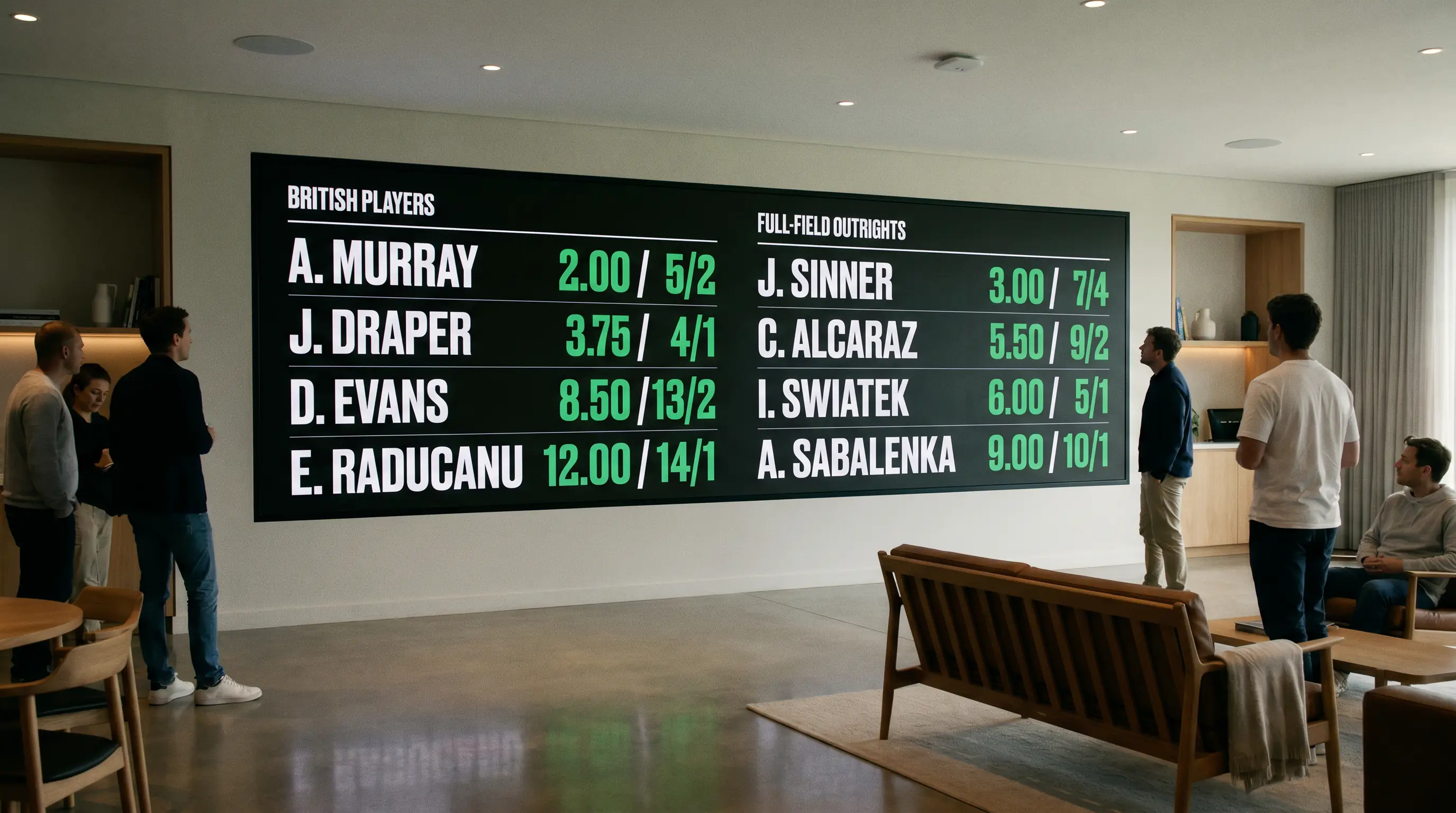
The conversion is rough — the actual top-British model uses individual head-to-head probability calculations across the 12-22 British names rather than a simple renormalisation — but the intuition is right. Pull the foreign players out, and the surviving British names get repriced proportionally upward.
The margin layer on top-British markets is typically 6-10 per cent total, which is wider than the underlying outright market because the smaller field forces a higher per-name margin to absorb trading-desk exposure. The trade-off is that the smaller field makes the market readable — you can actually evaluate the relative probabilities of 18 names in an evening; you cannot do the same for 156.
Where the market gets interesting is at The Open Championship. The home Open intensifies this market because public-side money piles onto McIlroy, Fitzpatrick, Hatton, and Fleetwood disproportionately, and the trading desk widens the margin to compensate. By Thursday morning at The Open, the top-British market typically carries 11-13 per cent margin against 4-6 per cent on a regular Tour event.
The reverse case — a DP World Tour event in continental Europe with a deep British contingent — often produces a tighter, more honest top-British market with 5-7 per cent margin, because the public money is spread across more names and the trading desk’s exposure is naturally balanced.
Live Top-British During the Round
Live top-British markets behave more like live outrights than live three-balls. The price updates after every hole completed by any player in the British pool, with the model running the same Bayesian update on each player’s tournament-winning probability and renormalising across the British names.
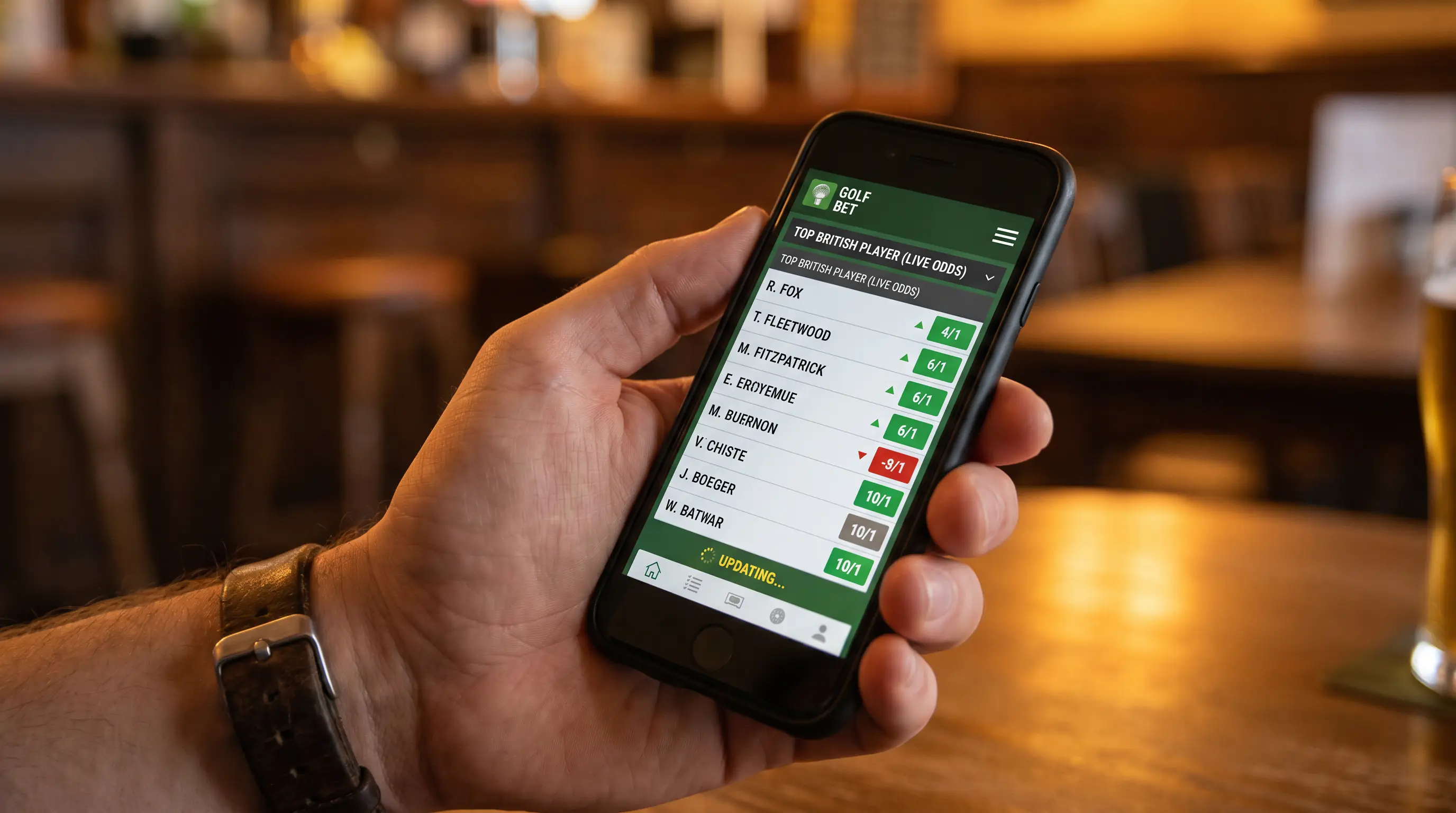
The 2025 Masters provided a useful live case study. Rory McIlroy opened at +650 to win outright (implied 13.3 per cent) and was top-British favourite at roughly 5/2 (implied 28.6 per cent) — the top-British number was higher because the British pool’s total implied probability was around 45 per cent and McIlroy was the dominant player within it. After his stumbling opening round, his outright drifted to +1200 (7.7 per cent) and his top-British live price drifted to 9/2 (18.2 per cent). His pool share had collapsed because Fitzpatrick and Hatton played steady opening rounds and gained on him.
The live top-British price moves on three signals: the player’s own scoring, the relative scoring of the next two British names, and the implied movement in the rest of the British pool. A 4-under round by your selection while every other British name shoots even par compresses your implied probability by 15-25 percentage points in a single round.
The disciplined entry windows for live top-British are after the first round (the pool has been revalued on actual play), and after Saturday’s round (the cut has removed weaker British names and the live pool is now meaningfully smaller). The window I personally avoid is mid-Friday morning — the model is still working through the cut implications and the price moves are erratic.
Historical Payouts: What the Last Five Years Tell Us
I keep a running record of top-British outcomes at the four majors over the past five seasons. The winning prices across those 20 events ranged from 3/1 (a clear favourite who delivered) to 33/1 (a deep-pool surprise at a DP World Tour-strong year), with a median winning price of about 7/1.
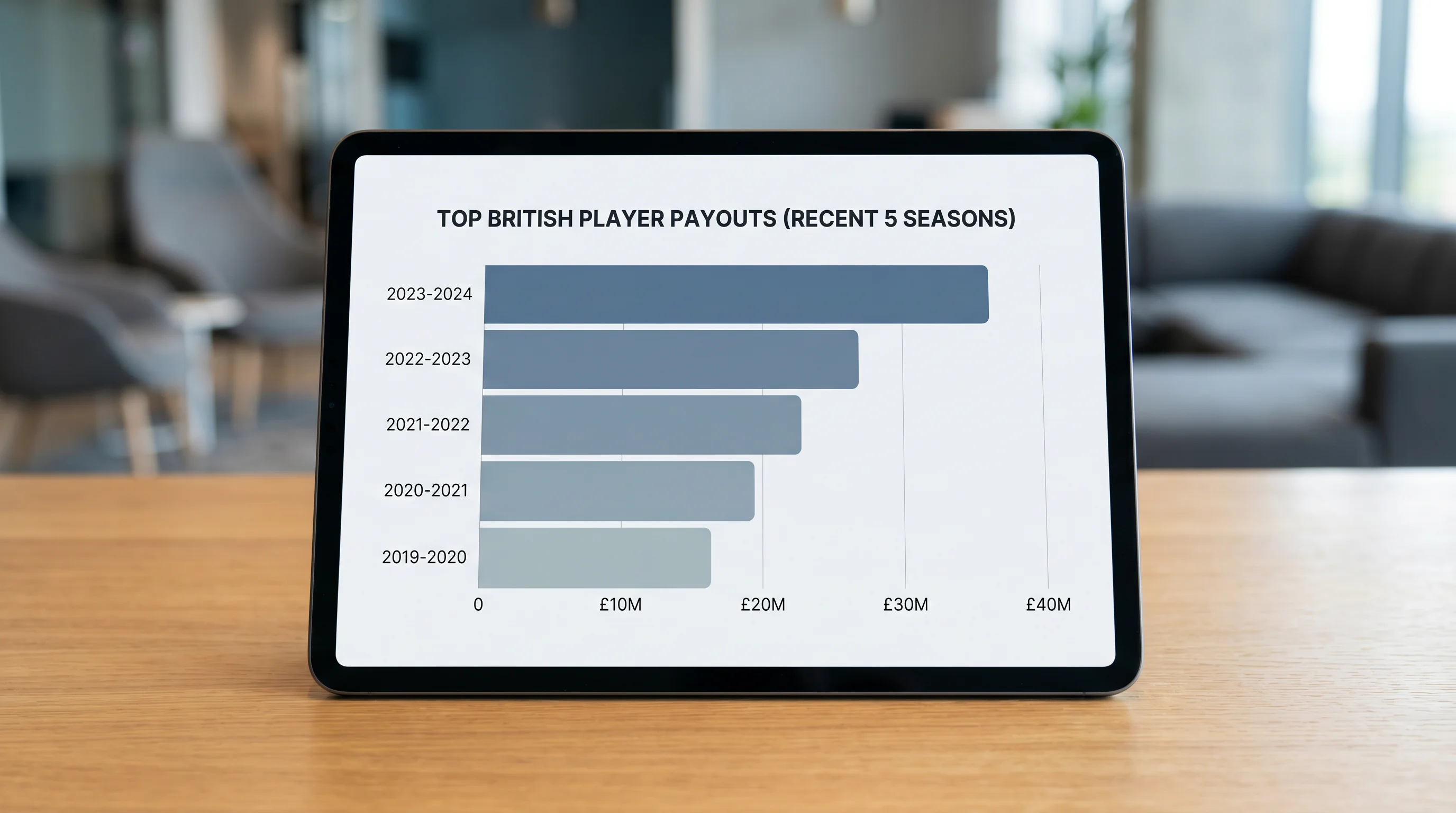
The pattern in the data is that the favourite top-British price wins around 35 per cent of the time, the second favourite wins around 22 per cent, the third favourite wins around 14 per cent, and the field’s combined remainder wins around 29 per cent. That distribution is interesting because it implies the market is reasonably efficient at the top of the pool but undervalues the tail — players priced at 12/1 to 25/1 in the British pool win at roughly the rate suggested by the prices, while the 25/1+ longshots win slightly more often than implied.
The value across five seasons, in my records, has sat in the third and fourth British names — players priced at 10/1 to 18/1 who carry meaningful outright credentials and benefit from a single good round to climb the British leaderboard. The favourite at 3/1 to 4/1 is honest pricing; the longshots at 33/1+ are honest pricing; the middle of the pool is where the model can be a half-step behind.
Are top-British-player markets settled at dead-heat divisions? Yes, the standard dead-heat rules apply. A two-way British tie at the top of the pool settles each ticket at half stake at the original odds. A three-way tie settles at one-third stake. The dead-heat impact on top-British is typically smaller than on top-finish markets because the pool is much smaller and ties at the very top of a 12-22-name pool are rarer than ties in a top-20 market on a full field.
Does Northern Irish residency count for ‘top British player’?
At every major UK operator I have tracked, yes. Northern Irish players are included in the British pool under the historic Great Britain and Ireland golfing convention. A small minority of operators use a stricter GB-only definition; this is clearly disclosed in the market description when it applies.
Are top-British-player markets settled at dead-heat divisions?
Yes, standard dead-heat rules apply. A two-way tie at the top of the British pool settles each ticket at half stake at the original odds; a three-way tie settles at one-third stake. Ties are less common than in top-finish markets because the pool is smaller.
