

 Available in US
Content
The Number on Your Screen Is the End of a Calculation, Not the Start
I once sat behind a friend’s shoulder in a Manchester sportsbook back office for a Saturday afternoon at Wentworth — strictly observational, no involvement, just watching a live golf desk work. What struck me was that the trader was never reading the price. He was reading two columns: implied probability, and margin. The price was an output, calculated on the fly, and he barely glanced at it.
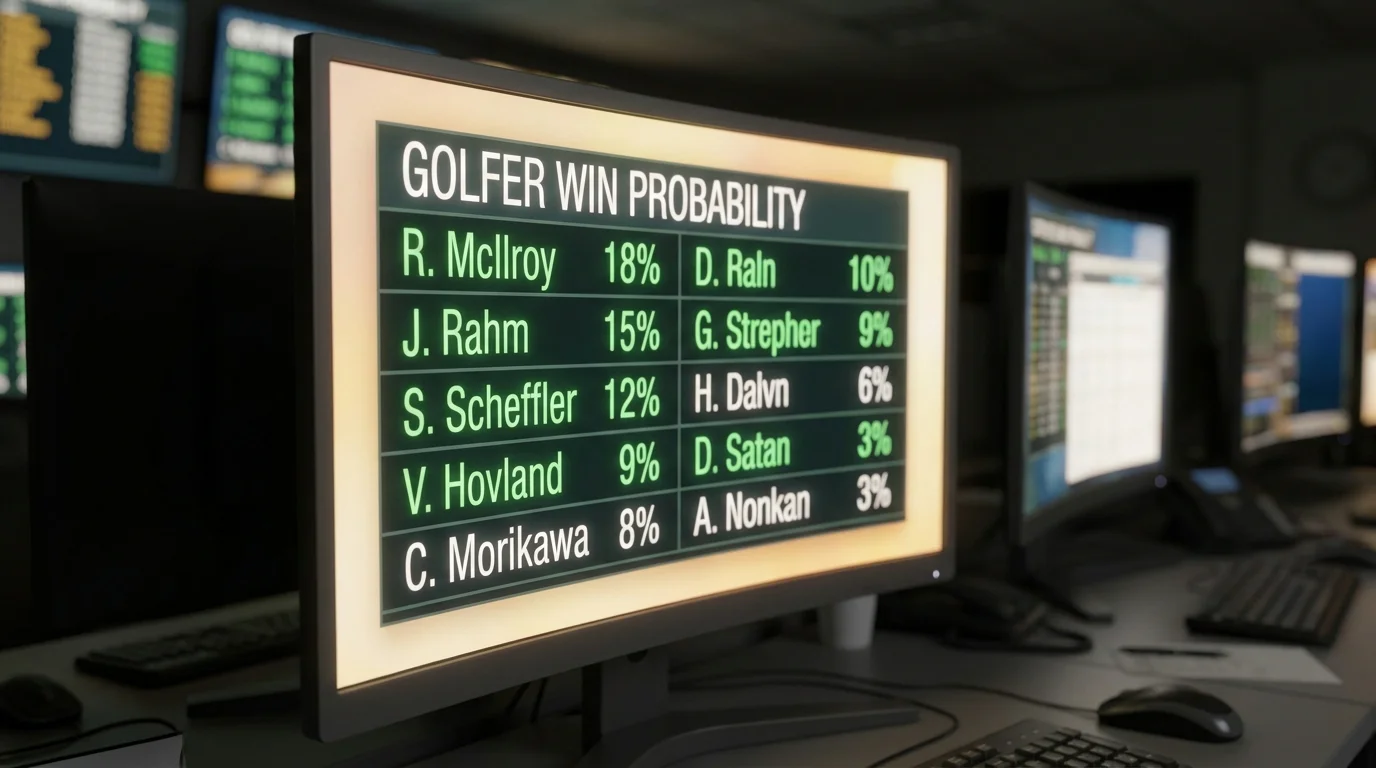
Live golf odds are not “set” by bookmakers in any meaningful sense. They are recalculated, hole by hole and sometimes shot by shot, from a model that takes a player’s pre-tournament probability of winning, conditions it on what has just happened, then divides by the bookmaker’s margin to arrive at the public price. The interesting work — and the place where punters can find edge — happens in the recalculation, not in the displayed number.
Your job as a live bettor is not to outguess the price. It is to spot the moments when the model has not yet fully ingested an event, when the price still reflects yesterday’s information, and when the implied probability the book is offering is materially different from the implied probability you can derive from what you just watched on the broadcast.
Implied Probability vs Displayed Price
The conversion is the simplest piece of maths in betting and the most under-used. Decimal odds convert to implied probability by dividing one by the decimal odds. So 7.50 (the +650 McIlroy outright at the 2025 Masters) implies a 13.3 per cent probability of winning before the bookmaker’s margin is applied. After the live margin layer of around four to eight per cent is shaved off, the punter sees a price that translates to roughly 12.5 per cent true probability.
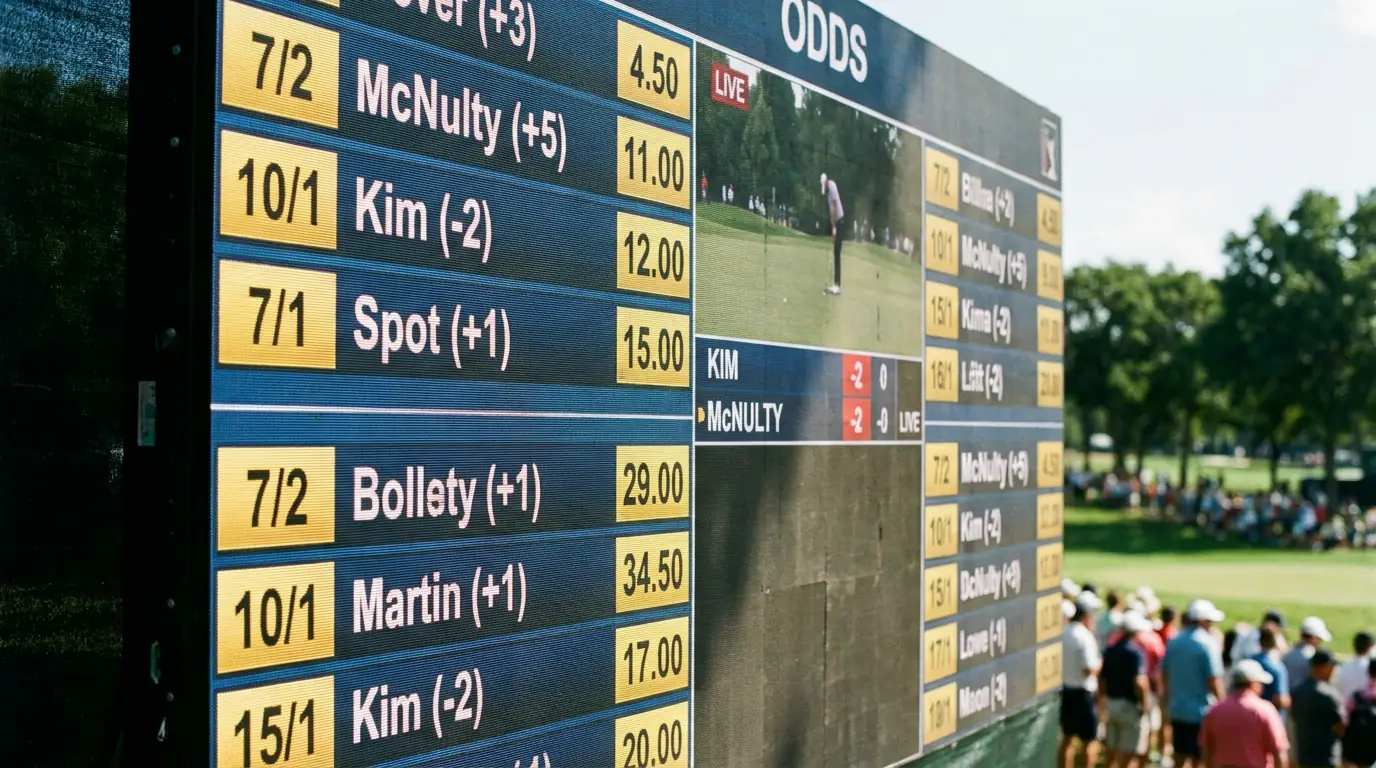
The reverse direction is what the trading desk actually does. The model spits out a probability — say, McIlroy is 18 per cent to win after the first round. The desk converts that back to decimal odds (1 / 0.18 = 5.56), then adds the margin layer (multiply by roughly 0.92 to 0.96 depending on volatility), arriving at a displayed price of approximately 5.20 decimal, or +420 in American.
This is why two operators can show wildly different prices on the same player at the same moment. They are not disagreeing about the player. They are disagreeing about the underlying probability — different models, different inputs, different staleness — and the displayed price is just where each one lands after they apply their own margin. The savvy live punter shops the implied probability, not the price.
Overround and Margin: Where the Book’s Cut Hides
Add up the implied probabilities for every selection in a market and you get a number bigger than 100 per cent. That excess is the overround, and it is the bookmaker’s profit margin in arithmetic form. A pre-tournament outright market on a major typically runs an overround of 130-150 per cent (a margin layer of roughly four per cent per name across a 156-player field). Live, that overround widens.
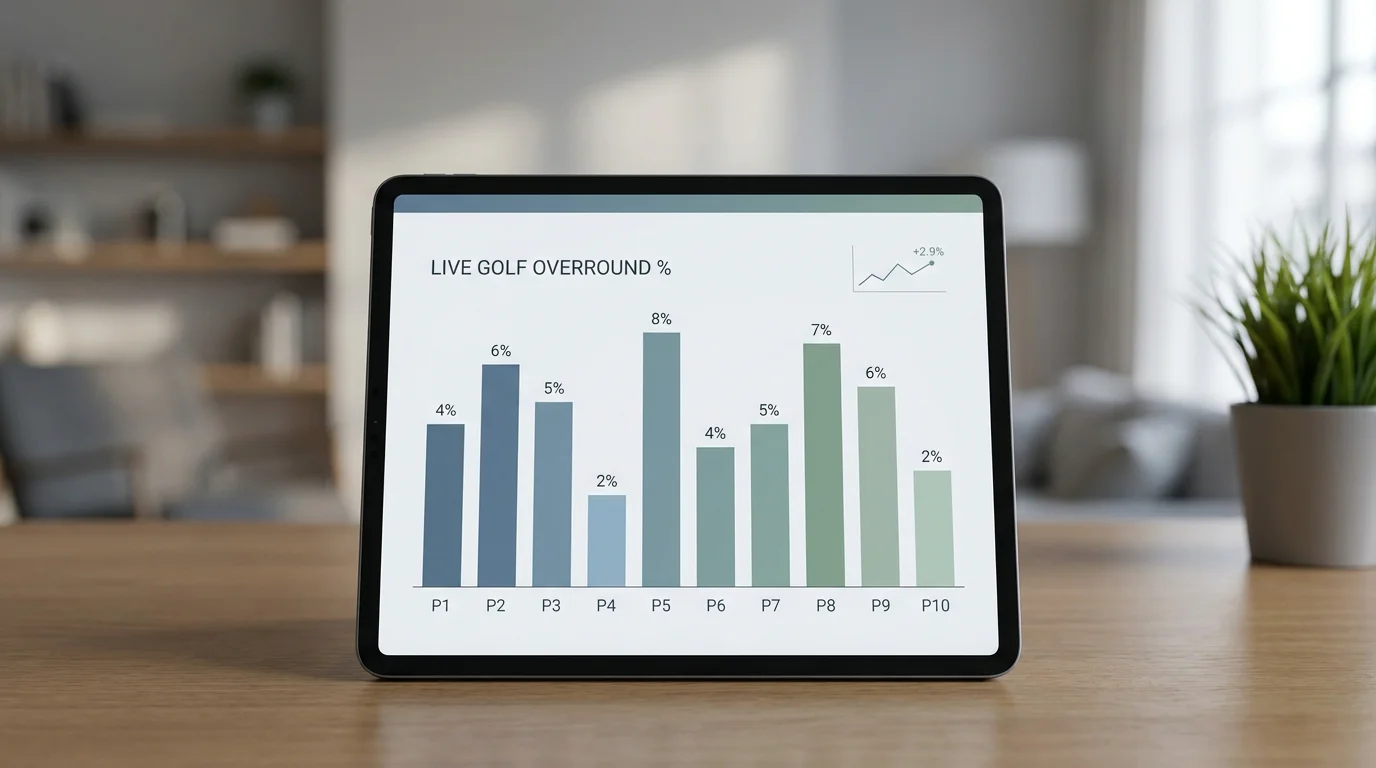
How much does the overround typically widen for live golf compared with pre-tournament? In my notes from the 2025 season, mid-round overrounds on outright markets ran 140-165 per cent at most UK books. By Sunday’s back nine on a tight leaderboard, it climbed to 170-180 per cent at some operators. The widening is not arbitrary — it is the trading desk pricing in their own uncertainty about the next 30 minutes of action.
Practically, that means a player priced at 4.0 decimal pre-tournament (a 25 per cent implied probability after margin) might be priced at 3.50 live (28.6 per cent implied) when a fair price reflecting the true probability would be 3.30 (30.3 per cent implied). The book has eaten the value of the move into the spread, which is why chasing a live shortening is usually wrong unless you are confident the price still has further to go.
The wider the overround, the more selectively a live bettor needs to play. On a 180 per cent overround, every individual selection carries a margin haircut of roughly 1.15 per cent on each name. Cumulatively, that eats edge fast.
The Inputs the Model Actually Uses
What goes into the recalculation? Five categories of input, weighted differently by different desks. Strokes Gained metrics first — most live golf desks weight SG: Approach, SG: Putting, and SG: Tee-to-Green as the core driver, because those numbers compress the previous 13 to 25 rounds of a player’s form into a single comparable figure. Scottie Scheffler led the PGA Tour in 2025 in SG: Approach, SG: Tee-to-Green, and Greens in Regulation, with a birdie-or-better rate of 25.78 per cent — those four numbers alone explain why his outright price was rarely available above +400 at any major.

Course form is the second input — a player’s history at the specific venue and at “venue-similar” tracks. Third is recent form, weighted heavier than historic. Fourth is environmental — wind, temperature, green firmness, pin sheet — which gets a weight on live setups but is often a constant for the whole round. Fifth is matchup-specific: who the player is paired with, what their tee time is, what the wave bias has looked like in earlier groups.
The trader’s job in the between-holes window is to update the model with the just-completed hole result and let the new outputs flow into the front-end. The “model” is rarely a single equation — it is usually a Bayesian update on prior probabilities, with the prior being whatever the desk had at 6 am that morning. New data shifts the posterior. The price moves to match.
A Walk-Through on the 2025 Masters Opening Round
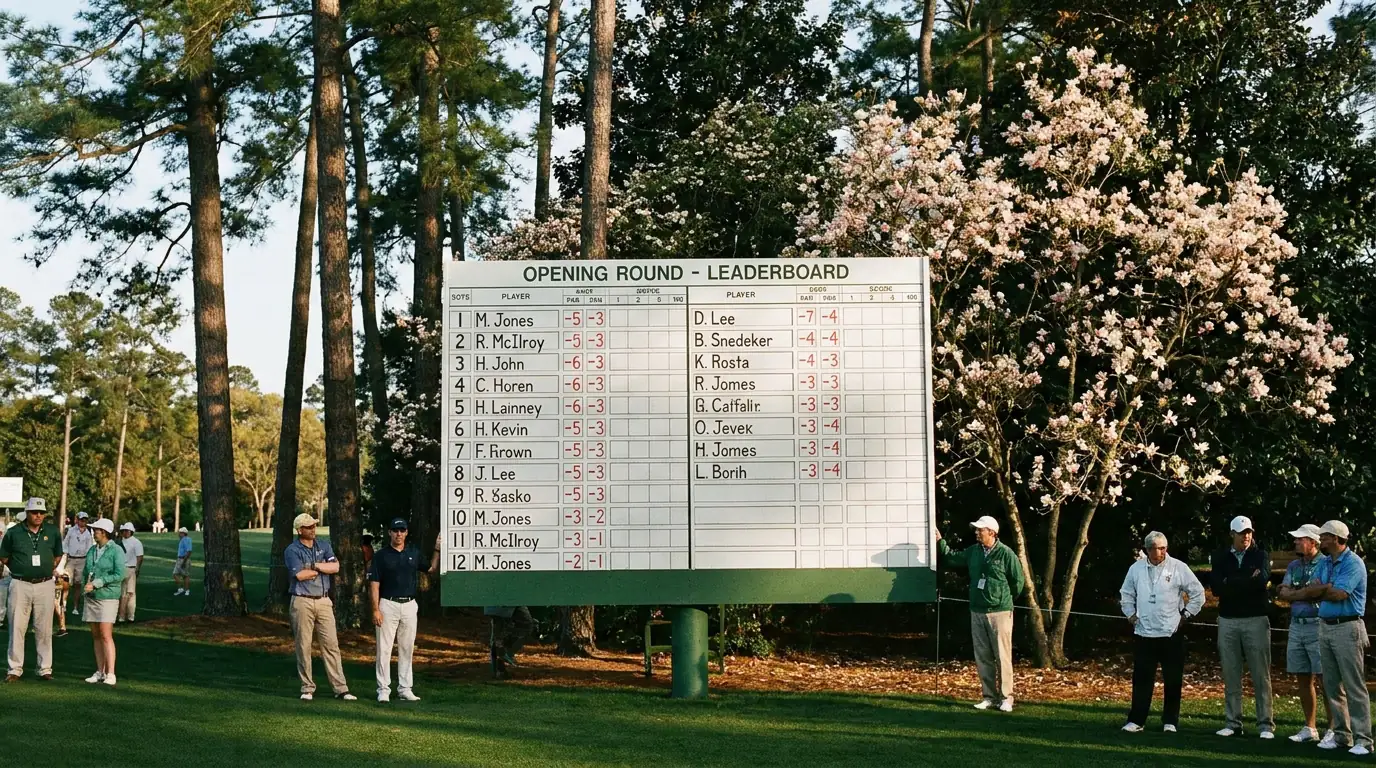
Rory McIlroy at the 2025 Masters is the cleanest live-odds case study of the year. Pre-tournament he sat at +650 (decimal 7.50, implied 13.3 per cent). After a stumbling opening round, the line drifted out to +1200 (decimal 13.00, implied 7.7 per cent). After Friday he climbed back. By Sunday afternoon he was the favourite to complete the career Grand Slam, and he duly did in a playoff against Justin Rose.
What happened to the model in those 48 hours? After the opening round, the desk’s prior on McIlroy’s winning probability collapsed from 13 per cent to 7-8 per cent, because the leaderboard had moved on without him. Strokes Gained as the model’s first input said his ball-striking was still elite, but the actual scoreboard said he needed to make up four shots over three rounds against a field of in-form players. The trader’s job was to weight the two signals — SG numbers (still elite) against scoreboard reality (four shots back) — and the answer was to widen the price.
The lesson is that prices move on facts, but they move further on perceived likelihood. A four-shot deficit on Friday morning at Augusta is not a four-shot deficit by Sunday. The model knew that. The public, on the whole, did not. And that gap is where the next 24 hours of profitable live betting lived.
How much does the overround typically widen for live golf vs pre-tournament?
Pre-tournament outright overrounds on majors run 130-150 per cent. Live overrounds widen to 140-165 per cent through Saturday, and 170-180 per cent on a tight Sunday back nine. The widening reflects trading-desk uncertainty about the next 30 minutes of action, not malice.
Why do live golf prices sometimes round to ugly fractions like 17/4?
Because the underlying decimal price after margin is something like 5.27, and 17/4 (decimal 5.25) is the closest standard fraction. UK books typically round to standard fractions to keep tickets readable; the slight rounding is usually in the bookmaker’s favour by a fraction of a per cent.
