

 Available in US
Content
The Walk-Off That Costs You Twice
One of my regular Saturday-morning rituals during DP World Tour events is to check the WD column on the official tournament page before I open a live ticket. The reason is a £50 outright on Brooks Koepka at a 2022 event in Spain — placed Wednesday, ruled dead on Thursday afternoon when he withdrew citing a wrist injury before teeing off. Some operators refunded the stake. Mine treated it as a losing ticket because the start sheet had been published. The dispute took six weeks to resolve. I won, eventually, but the lesson landed before the refund did.

The withdrawal rule is one of those quiet operator clauses that almost no one reads until they need to. The UK remote betting market is worth about £2.6 billion annually in gross gambling yield, and the share that flows through golf is small but the rule variations across books are wider here than almost anywhere else in sports betting. The headline split is between pre-tee-off and post-tee-off withdrawals, and the consequences for outright, each-way, and live wagers diverge meaningfully from there.
What complicates things further is that “withdrawal” itself is not a single event. A player can withdraw before tee-off, before completing a round, after the cut but before Saturday, or on Sunday morning. Each of those scenarios is handled differently, and the differences are buried in your operator’s golf-specific terms.
Before Tee-Off vs After: The Operative Distinction
The single most important question on a withdrawal: did the player tee off in round one? If yes, the bet is live and the various settlement rules apply. If no, the bet is almost always voided and the stake refunded.

“Tee off” is interpreted as striking the first tee shot of round one. A player who shows up to the practice green, declares unfit, and signs out before stepping onto the first tee is treated as a non-runner. A player who hits their opening drive and then withdraws on the second hole is treated as a starter who failed to complete. The difference is one shot, but it changes everything about how your ticket settles.
Pre-tee-off withdrawals are the cleanest scenario for punters. UK operators uniformly refund stake on outright wagers, each-way wagers, FRL, top-finish, and head-to-head matchups when the player did not start. The refund typically credits within 24 hours of the official withdrawal being recorded by the tour.
Post-tee-off withdrawals are where the rules fan out. Outright and top-finish bets become losing bets — your selection cannot now win or finish in the requested band, so the ticket is settled as a loss. Each-way bets are settled on the win portion as a loss and on the place portion the same way (it cannot now place). Head-to-head matchups settle to whoever was nearest the lead at the moment of withdrawal — some operators settle to the opponent immediately, others wait for the round to complete.
Outright vs Each-Way Treatment: Where the Rules Diverge
Each-way wagers in golf are the trickiest withdrawal case, because the bet has two distinct legs (win and place) and a withdrawal mid-tournament can leave one leg theoretically alive when the other is dead.
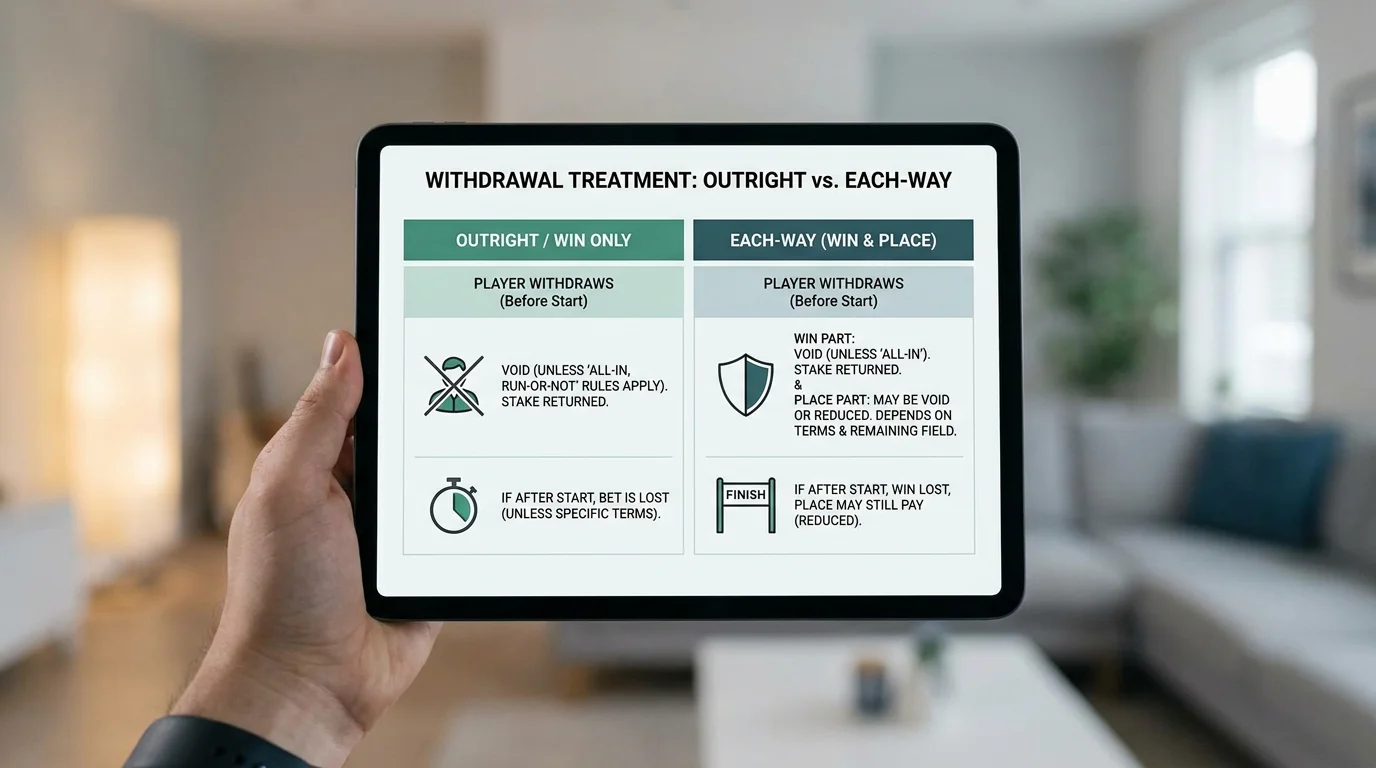
The standard UK operator interpretation is that a withdrawal at any point after tee-off settles both legs as losing. The reasoning: each-way places typically reference the official tournament leaderboard, and a player who withdraws is not listed on that leaderboard at all. Some operators (the more punter-friendly ones) will settle the place portion on the player’s standing at the moment of withdrawal if they were within the each-way places. This is rare and worth checking before placing the bet, not after.
Top-finish markets (top-5, top-10, top-20) work the same way — withdrawal means losing settlement unless the operator’s specific terms grant a “best efforts” credit for a player who was clearly within the requested finish band at the moment of withdrawal.
This is also where the related dead-heat treatment becomes relevant. If a withdrawal occurs late in the tournament and the field tightens around the cut for top-finish places, the dead-heat formula may apply to the players who actually finished in the requested band. The withdrawn player simply does not feature.
For three-ball and head-to-head matchups, a mid-round withdrawal triggers an immediate settlement at most books. If your selection withdrew, your bet is a loser. If their opponent withdrew, your bet wins and settles at full odds. A few operators wait for the round to complete before settling, which can be agonising if your player is leading by three at the moment the opponent walks off.
Rule 4 Style Deductions: A Horse Racing Concept Borrowed Sparingly
How does Rule 4 work for golf in the UK? Honestly: rarely, and only at a handful of operators. Rule 4 is a horse racing concept that applies deductions to remaining selections when a horse is declared a non-runner late, on the logic that the favourite leaving the race makes every other selection more likely to win and the original odds therefore overstated the true probability.

In golf, Rule 4 style deductions appear in two narrow circumstances. First, on outright markets where a clear pre-tournament favourite withdraws after the market has been priced but before tee-off, some operators apply a small deduction (typically 5-15p in the pound depending on the withdrawn player’s implied probability) to every other selection. This is rare in mainstream UK books and more common at the smaller specialists.
Second, on head-to-head matchups where one of the two players withdraws, no Rule 4 deduction applies because the bet is voided and stake refunded — there is no remaining live selection to deduct against.
The cleanest read on Rule 4 in golf: if your operator does not explicitly mention it in their golf-specific terms, they do not apply it. Treat its absence as the default. If it is mentioned, the deduction is typically modest and only applies when a clear favourite walks off pre-tournament. Mid-tournament walk-offs do not trigger it because the prices have already moved to reflect the live state of play.
Live Bet Handling: Hole-by-Hole and Mid-Round Withdrawals
Live wagers are the cleanest scenario in the entire withdrawal landscape. The rule of thumb across UK operators: live wagers placed before the moment of withdrawal stand or fail on the action that has already occurred; live wagers placed on holes the player did not actually complete are voided and refunded.
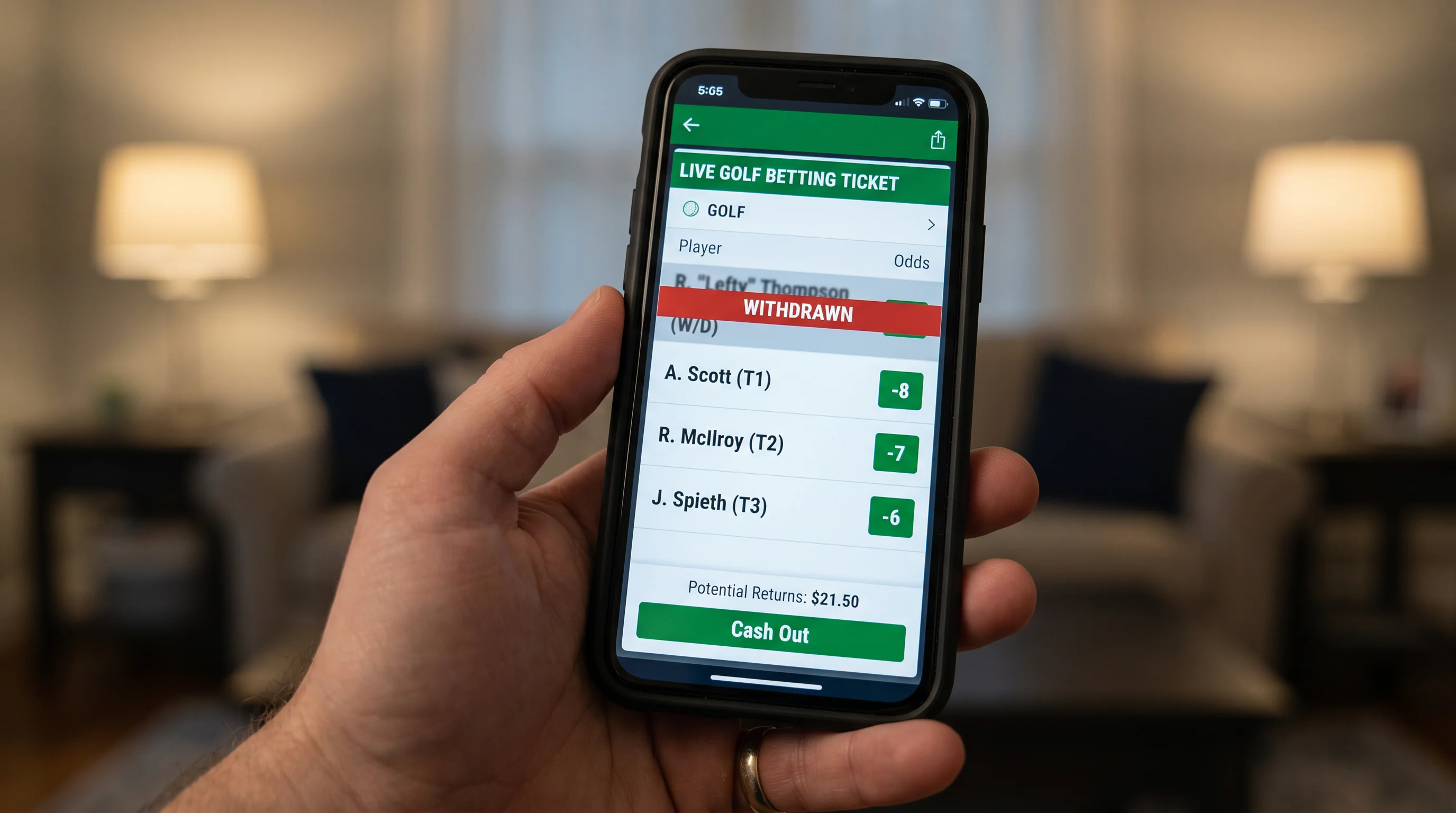
A worked example. The 2025 Open at Royal Portrush had a cut line guaranteeing a minimum payout of $38,900 to every player who survived 36 holes. Imagine you placed a live wager on player X to birdie hole 14 in round three, then player X withdrew on hole 13 with an injury. Most UK operators would void the wager on hole 14 (it never happened) and stake-refund. A wager on a hole the player had completed (a successful birdie on hole 12, settled before the walk-off) stands as a winner.
Where it gets messy is multi-leg live wagers — bet builders, accumulators, parlays that include the withdrawn player as one leg. Most operators treat the withdrawn leg as void and recalculate the remaining legs as a reduced parlay. A few treat the entire ticket as a loser. This is one of those details you find out only when you look at a ticket after the fact, which is too late.
Make-the-cut bets withdrawn during round three (after the cut has been made) generally settle as winners — the player did make the cut, even if they did not finish the tournament. The withdrawal itself is not retroactive to Friday’s cut decision.
Does a withdrawal during round 3 void my make-the-cut bet?
No, the make-the-cut bet has already settled positively at the moment the cut was confirmed on Friday evening. A round-3 withdrawal does not retroactively unmake the cut. The bet pays.
How does Rule 4 work for golf in the UK?
Rarely. A few operators apply a small deduction (5-15p in the pound) to remaining selections when a clear pre-tournament favourite withdraws before tee-off. The deduction is not standard across UK golf markets, so check your operator’s specific terms; if it is not mentioned, it does not apply.
