

 Available in US
Content
The Outright in Miniature
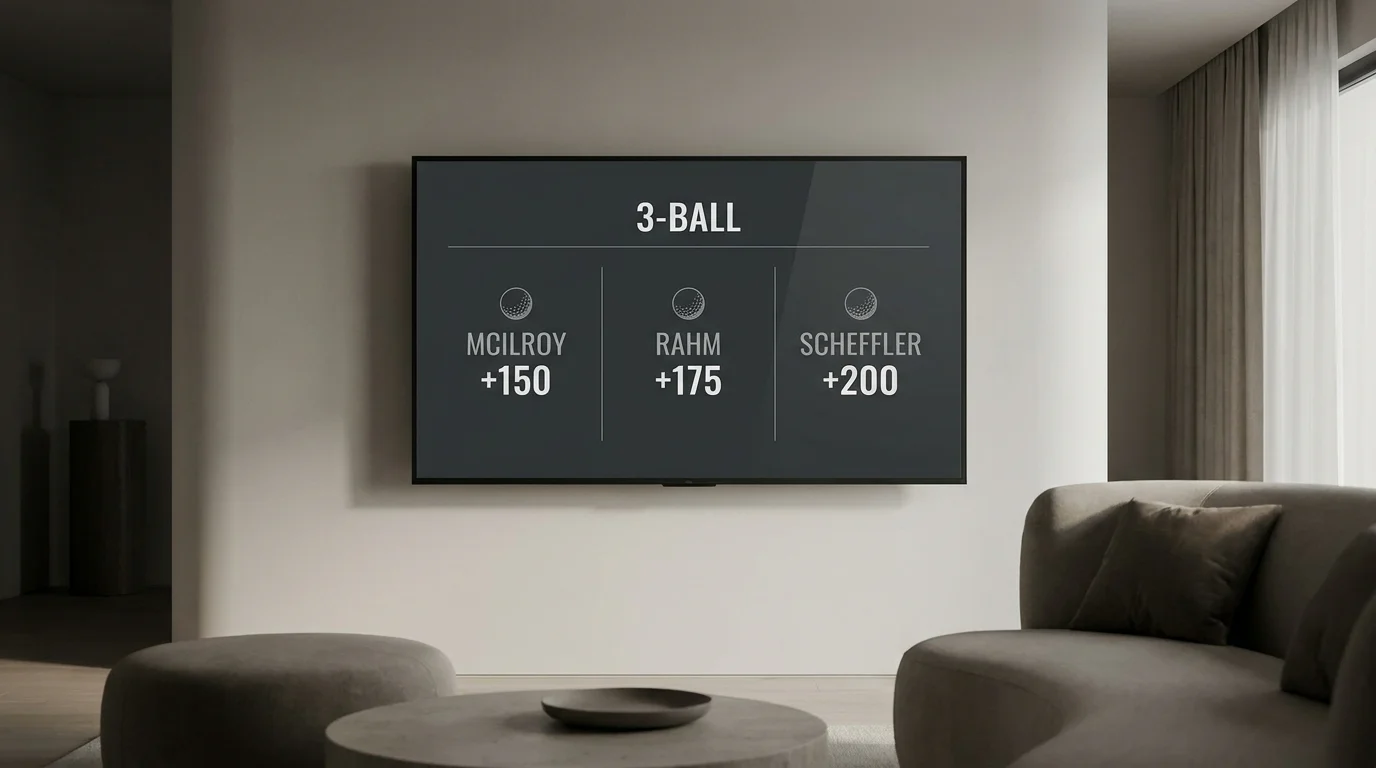
My favourite Saturday 3-ball ticket of the 2025 season cost me £20 to place and could have paid £180. Three players in a group, one a clear ball-striking favourite, one a struggling veteran, one a young qualifier riding a hot week of putting. The favourite priced at evens, the veteran at 7/2, the qualifier at 9/2. I had the qualifier on a Strokes Gained: Putting read after the previous evening’s stats dump, and he duly shot 67 to finish the group at -5 against the other two at +1 and -1.
3-ball is the outright market in miniature. You are not guessing the tournament winner — you are guessing one of three players to score lowest in a single 18-hole round. The compactness is what gives the market its liquidity even deep into a Saturday afternoon, when outright markets have firmed up to 12 names and prices have stopped moving meaningfully. 3-ball is still alive when the outright board has settled.

It is also the only market in UK golf betting where I would describe the price discovery as genuinely competitive across operators. Every UK book runs 3-ball on every featured group at every major and most regular Tour events, which means real shopping is possible, and the spread between best and worst price on the same group is often 10-15 per cent.
How Books Price the Three-Player Group
The 3-ball model is the simplest live golf model in the bookmaker’s toolkit. Take each player’s expected score for the round (a function of their pre-round Strokes Gained baseline, the current weather, and the specific holes they will play), simulate the round 10,000 times under reasonable variance assumptions, count how often each player wins outright, and convert those probabilities to prices with the margin layer applied.
The model leans heavily on driving distance and approach play as the two dominant inputs. The 2025 PGA Tour average driving distance was 303 to 304 yards, with leaders like Aldrich Potgieter pushing 327+ and the tour average growing 5-7 yards year on year. That distribution matters because a group containing two 305-yard hitters and a 285-yard hitter on a long par-5-heavy course is not really three equal probabilities — the distance edge in a single round is worth roughly 0.5-0.8 strokes against the shorter hitter.
Tie handling is the other input that shapes the price. Most UK 3-ball markets settle on a tie as a “void on tie” (stake refund) for the tied players, with the lone non-tied player settling normally. A few operators (rare these days) apply dead-heat to 3-ball ties, splitting the win-stake among tied players. The default is dead-heat-free, and that is what most prices assume.
The margin layer on 3-ball is typically 4-5 per cent total across the three names, which is tighter than outright (4-8 per cent per name across the field). The market design forces tighter pricing because the three prices have to sum to a probability slightly over 100 per cent and the punter can immediately see if a book is gouging.
Weekday vs Weekend: Why the Margin Widens
Why do weekend 3-balls usually have a wider implied margin than Thursday? The simple answer is liquidity. Thursday 3-balls trade thinly during the round itself because most pre-tournament money has gone into outrights, FRLs, and pre-decided 3-balls. The trading desk holds tight margins on Thursday because their exposure is balanced and the model is fresh.

By Saturday and Sunday, the calculus shifts. Weekend leaders are paired with each other, weekend 3-balls become the highest-volume group bets of the week, and the margin layer expands to 5-7 per cent total to absorb the extra public-side risk. The exposure is no longer balanced, and the trading desk widens the spread to compensate.
This also intersects with field condition. Weekday 3-balls feature 50-60 active groups across the field; weekend 3-balls feature 30-35 groups, and the books push more punters through fewer markets. The volume concentration is what allows them to widen.
The practical implication for the disciplined punter is that Thursday and Friday 3-balls are systematically better value than Saturday and Sunday, assuming you can read the matchups equally well. If you cannot, the wider Sunday margin is the cost of placing a bet you should not be placing — the spread is signalling that the book is uncertain too.
BetVictor’s Extended Window: A Factual Variation Worth Knowing
One UK operator-specific detail worth mentioning, strictly as a market fact rather than a recommendation: BetVictor keeps 3-ball markets open through the full 18 holes of a round at most events, while several other UK operators close 3-ball markets after the front nine (closing at the turn). The “close-at-turn” approach is the default for most books because it reduces trading-desk exposure during the back-nine swing, when one bogey can flip a group.
For a punter who reads back-nine action well, the extended window is a structural difference between operators that affects which markets you can actually trade. It is not a value judgement on the operator — every UK book has its own approach to this — but it is a factual mechanic that shapes when 3-ball trading can happen.
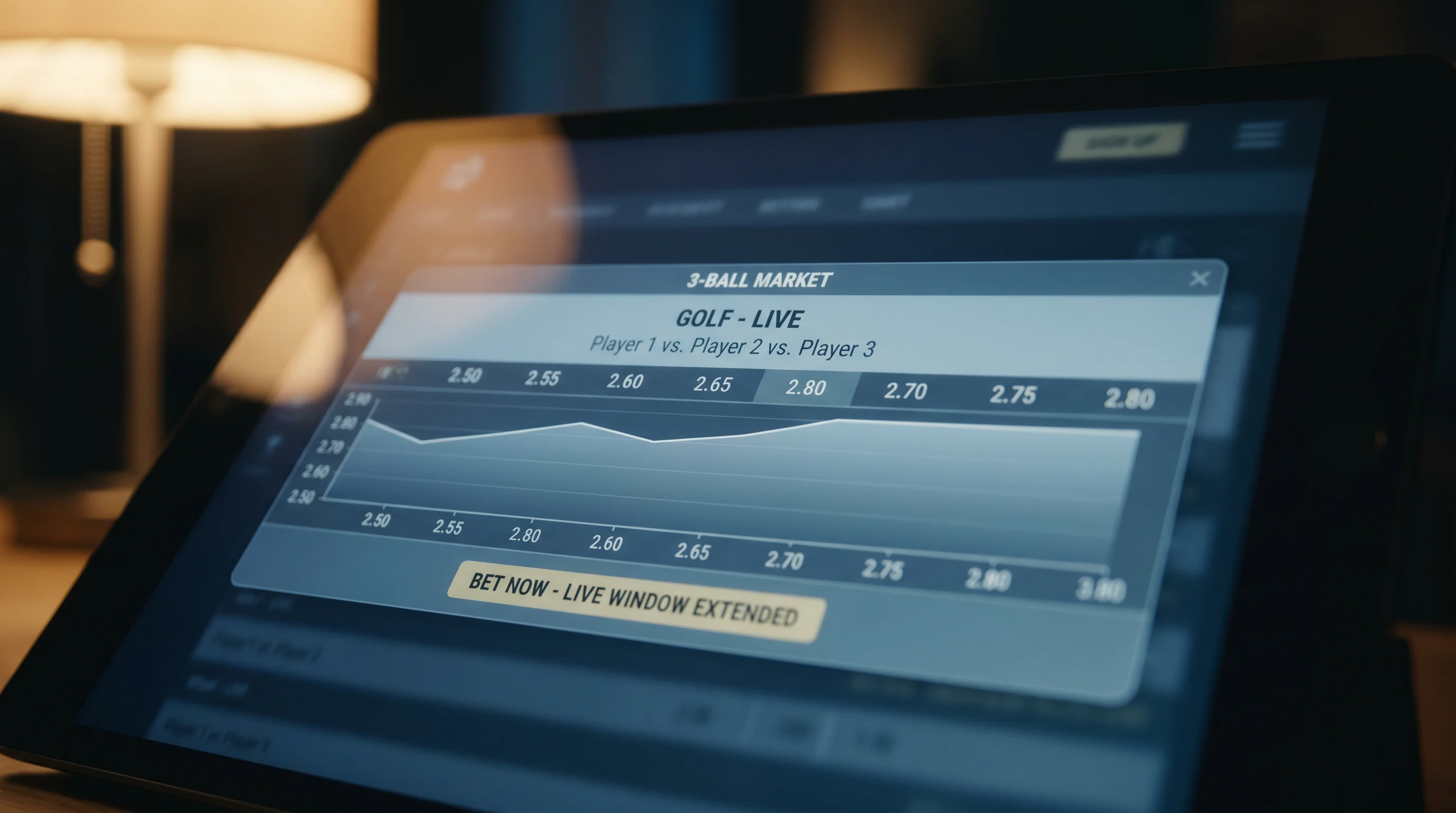
The trade-off works both ways. An extended window gives the punter more entry points, but it also means the margin tends to widen further into the round as the trading desk absorbs more uncertainty. A back-nine entry at minute 90 of a round will typically carry a 6-8 per cent total margin even at the more competitive books, against the 4-5 per cent you would see at tee-off.
The disciplined approach is to know each operator’s window rules for 3-ball before round one starts. Trying to find an extended-window market mid-round on a book that closes at the turn is a frustrating way to discover the rule.
Live 3-Ball Decision Points: When to Act
Live 3-ball is one of the most readable live markets in golf because the variables compress fast. Three players, 18 (or fewer) holes remaining, and a leaderboard within the group that updates after every shot. The decision points are well-defined.

The most reliable entry points in my notes are after the third hole (model has now ingested three holes of actual play and any tee-time draw bias has been resolved), after the front nine (clear group dynamic emerges), and after a triple-bogey-or-worse from one player (the group is now effectively a 2-ball, which the trading desk takes 30-60 seconds to fully reprice).
The closely related head-to-head market is the natural alternative when one of the three has clearly dropped out of contention — many operators offer “remaining two” matchups specifically to handle this scenario, and the head-to-head pricing can be more efficient because the model has fewer variables to weigh.
The Open 2025 at Royal Portrush, with a $17 million purse and a cut line that guaranteed $38,900 to everyone who survived, ran 3-ball markets across the full field on Thursday and Friday — and the spread between best and worst price on the same group at the same moment was often 12-15 per cent across the major UK books. That dispersion is the punter’s friend, and it is worth more than any single edge from a sharp read.
Does BetVictor’s full-round 3-ball window add edge over standard close-at-turn books?
It adds optionality rather than direct edge. The extended window gives you more potential entry points mid-round, but the margin typically widens deeper into the round as the trading desk absorbs uncertainty. The real value is for punters who specifically read back-nine action well and want the option to enter then.
Why do weekend 3-balls usually have a wider implied margin than Thursday?
Volume concentration and trading-desk exposure. Weekend groups attract higher betting volumes through fewer active markets, so the book widens the spread to 5-7 per cent total to absorb the public-side risk, against 4-5 per cent on Thursday’s more balanced book.
