

 Available in US
Content
The Rule That Catches Out More Punters Than Any Other
A 2024 fourball at a Rolex Series event in Italy got washed out on Friday afternoon. I had a make-the-cut on a player I rated highly, who had just opened with a 68. Three of my mates had outright tickets on the leader. We all assumed the same thing — play would resume Saturday and the bets would live or die on the eventual outcome. Three of us were right. One of us had picked an operator whose void rule kicked in after a 36-hole reduction, and his ticket was killed at no fault of his own. That afternoon was the first time I read every operator’s void rule in detail.

Void thresholds in UK golf are not standardised. Some operators void only if the tournament does not complete 36 holes. Others require 54. A few specify “the official result” — which delegates the decision to the tour and can leave bets in limbo for days. This variation matters more for live than for pre-tournament, because live bets are typically already settled to the just-completed hole and the question of what happens to the remainder of the wager is where the rule kicks in.
Live football is the dominant in-play format in the UK at five per cent of the adult sample, with live horse racing on three. Live golf sits below both, which means it gets less editorial attention and less standardisation in operator terms. The void rules reflect that — they vary widely, they are written tersely, and you only discover the differences when something actually goes wrong.
The Standard Thresholds by Number of Rounds Completed
Most UK operators treat golf bets along the following lines, though always check the specific terms of the operator you actually use.

If 72 holes are completed, all bets stand at the official result. If 54 holes are completed and the tournament is declared official, most operators settle outright bets, top-finish bets, and head-to-head bets to the 54-hole result. Three-ball and FRL bets, having been settled hole-by-hole or round-by-round, are typically already resolved.
If only 36 holes are completed, the rules diverge sharply. Some operators (a minority) will settle to the 36-hole leaderboard if the tour declares an official result. The majority void the outright market entirely and refund stakes, while keeping FRL and Thursday/Friday-resolved markets settled to their actual outcomes. Make-the-cut bets are the trickiest — if the field never reaches the cut, most operators void; if the cut is applied based on the 36-hole standings, most operators settle.
If fewer than 36 holes complete, almost every UK operator voids the entire card except markets that were already resolved (first-hole birdie, opening-round leader after suspension if the round was completed, hole-in-one specials that hit before suspension). Refunds typically credit within 48 hours but can take longer at the smaller books.
Where Operator Rules Actually Differ
The UK gambling sector posted a gross gambling yield of £15.6 billion at its highest ever level, according to UKGC chief executive Andrew Rhodes — a number that gives you a sense of the scale at which these standardisation gaps matter. Across that volume, the differences between operator void rules are tiny per ticket and enormous in aggregate.
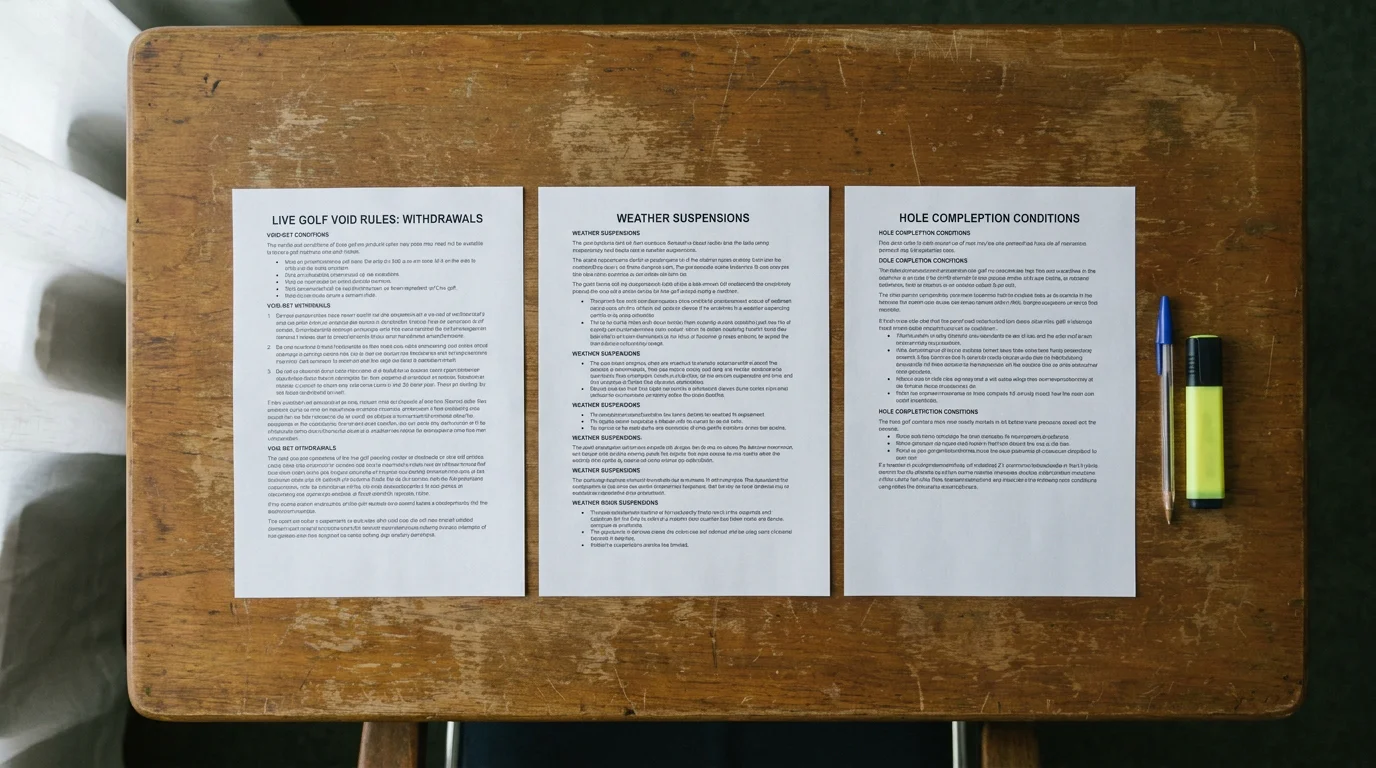
The variations I track in my own notes are the parallel rule for withdrawals, the treatment of weather-shortened cuts, the timing of “official result” declarations, and the handling of carryover markets like Race to Dubai standings when an event is shortened.
The trickiest scenario is the partial-Sunday washout. Imagine the leaders have completed 11 holes of round four when severe weather forces an abandonment. Some operators settle to the position at the moment of abandonment (rough, because no two players are on the same hole). Others wait for the official Monday finish. A few — and this catches people — void all live in-play wagers placed during the abandoned round while leaving the outright market live to Monday’s resolution.
The practical advice: read your chosen operator’s golf-specific terms before the tournament starts, not during the suspension. The terms are clearly written, but they are written in legal English and they vary in ways that are easy to miss at speed. I keep a one-page summary for each book I use, updated each season.
What Happens to Live Markets During a Suspension
The moment officials blow the horn, two things happen on the operator side. First, every active live market for that tournament suspends — no new bets accepted, cash-out frozen, partial cash-out frozen. Second, the trading desk goes into rebuild mode, because the model needs to ingest the partial-round data and reassess every player’s probability under the new condition (which usually means resumed play the next day, with rain-softened greens and altered wind patterns).

Markets re-open in stages. Outright and top-finish markets come back first, usually within 15-30 minutes of the all-clear, because those markets are robust to the disruption. Head-to-head, three-ball, and hole-by-hole props can stay closed for the rest of the round, particularly if the suspension is long enough that the original groupings will not resume in the same configuration.
What happens to a live make-the-cut bet if Friday’s play is washed out and the cut is not made by Saturday morning? This is where the operator’s rule on completion thresholds matters. If the cut is officially applied based on Friday-night standings (some tournaments do this when weather is forecast to wipe out Saturday play in addition), most operators settle. If the cut is delayed and applied after a 36-hole completion on Saturday, the bet stands and settles on the new official cut line.
Live wagers placed during a paused round are usually marked “pending” until officials confirm the round will resume. If the round is abandoned entirely, the pending bets are voided, but already-settled wagers from that round (a birdie on hole 4, for instance, that settled before the horn) generally stand.
Historical Monday Finishes and What They Settled At
The Open 2025 at Royal Portrush is a useful recent reference. Scottie Scheffler won at -17, taking $3.1 million from the $17 million purse, with the cut line guaranteeing a minimum of $38,900 to every player who made it through. The tournament finished on schedule, but in years where The Open has gone to a Monday (1988 at Royal Lytham, 2008 at Royal Birkdale, both delayed by weather), outright tickets settled at original pre-tournament odds, because all 72 holes were completed, just a day later than planned.
The handling at Monday finishes is generally clean if all 72 holes complete. The complications arise when an event becomes a 54-hole tournament because Monday is also lost. The 2010 PGA at Whistling Straits was famously dragged into a Monday finish but completed 72 holes; the 2005 US Open at Pinehurst was once threatened with reduction. In each case, the operative question was whether the relevant governing body declared the result official, and the operator’s rule then followed that declaration.

The lesson is that Monday finishes themselves rarely cause settlement problems. Reduced tournaments do. Saturday-then-Monday-then-cancelled events are the worst case, because the operator rules from 36 to 54 holes are where the variance between books is widest.
What happens to a live make-the-cut bet if Friday’s play is washed out?
It depends on whether the cut is applied at all, and at how many holes. If the cut is officially declared on Friday-night standings or after a 36-hole completion on Saturday, the bet settles on the official cut line. If the field never reaches the cut, most operators void the bet.
Does a Monday finish at The Open settle outright bets at original odds?
Yes, if all 72 holes are completed on the Monday. The delay does not affect the bet, only the timing of settlement. The complication arises only if the Monday is also lost and the tournament is reduced to 54 holes, where operator rules diverge.
