
 Available in US
Content
The Word That Halves Your Payout Without Telling You
I had a top-5 each-way on a player at a 2023 PGA Tour event in Texas at 18/1, watched him finish tied seventh, and felt nothing. The ticket was a loser, the maths was clean, the world was fair. The following week I had a top-10 each-way on a different player at 25/1, watched him finish T6 alongside four other players sharing T6, opened my account expecting £100 in winnings, and found £30. That was the day I properly learned how dead-heat rules work.
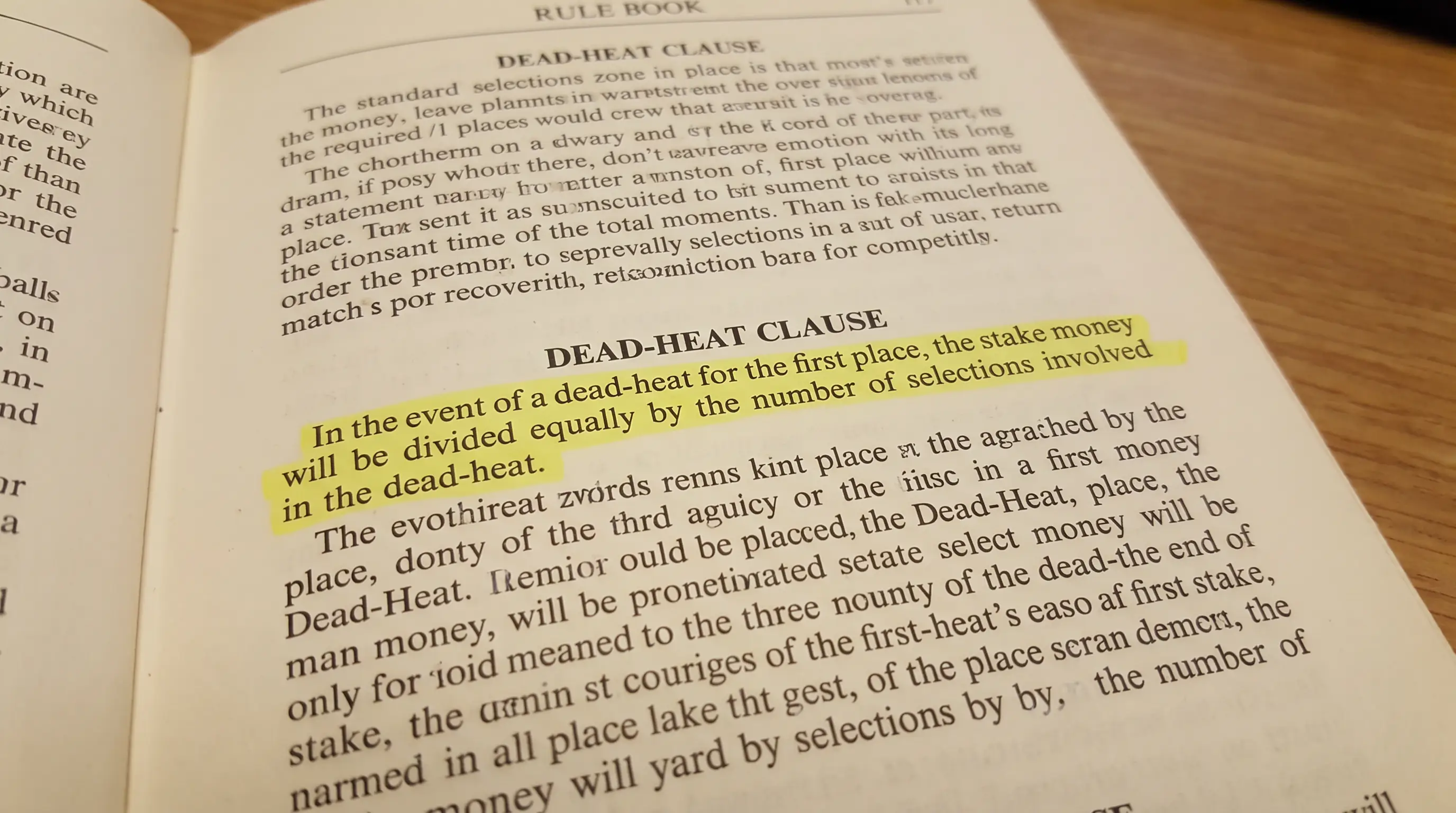
Dead heat is the most under-explained rule in UK golf betting. It does not “split the winnings” — that is the misconception that catches people out. It splits the stake before payout, which means a 25/1 each-way looking generous in theory becomes a 5/1 each-way in practice when five players share the finishing position you needed. The 80 per cent value collapse is invisible in the bet slip and only appears on the settlement screen.
What follows is the formula every UK punter should know before placing another each-way ticket, plus the worked examples that show why the rule eats top-20 markets harder than top-5, and where on the course tournament structure makes dead heats more likely.
The Formula, Explained Once Clearly
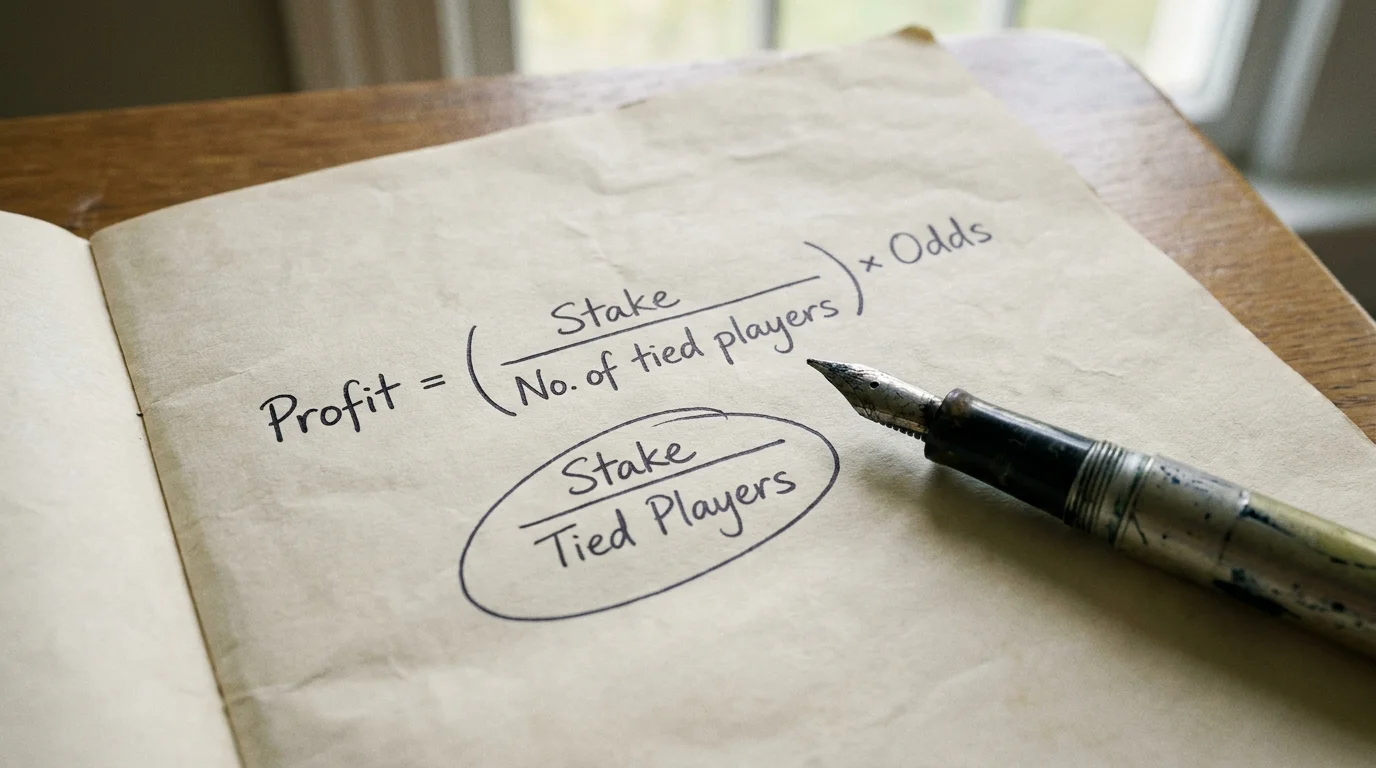
Dead-heat reduction applies to the place portion of an each-way bet when more players finish in the requested band than there are payout slots available. The formula is one of the cleanest in betting: settled stake equals original stake multiplied by (places available / players sharing the finishing position).
Worked. A top-5 each-way bet requires the player to finish in positions 1 through 5. If your player finishes T4 with two others (three players sharing T4), there is no dead heat at this position — positions 4, 5, and 6 are all “T4,” but position 6 is outside your top-5 band. Wait, that is wrong. Let me reframe.
If three players share T4, they occupy positions 4, 5, and 6. Two of those positions (4 and 5) are inside the top-5 band. So the formula becomes: settled stake = original stake × (2/3). You lose one-third of your place stake. The payout odds remain the original each-way fraction.
The bigger the cluster of tied players, the worse the haircut. Five players sharing T4 means positions 4, 5, 6, 7, and 8 are all “T4.” Two positions are inside top-5, so settled stake = original × (2/5) — a 60 per cent loss on the place portion.
The win portion is unaffected by dead heat unless multiple players actually tie for the win, which is vanishingly rare in stroke-play golf and triggers a playoff anyway.
Worked Example: Top-5 Each-Way at The Open
The 2025 Open at Royal Portrush had a $17 million purse with Scottie Scheffler taking $3.1 million at -17, and the cut line guaranteed a $38,900 minimum for everyone who survived 36 holes. The payout structure that year had top-5 stretching across positions 1 through 5 with no ties — clean settlement for anyone holding a top-5 each-way.
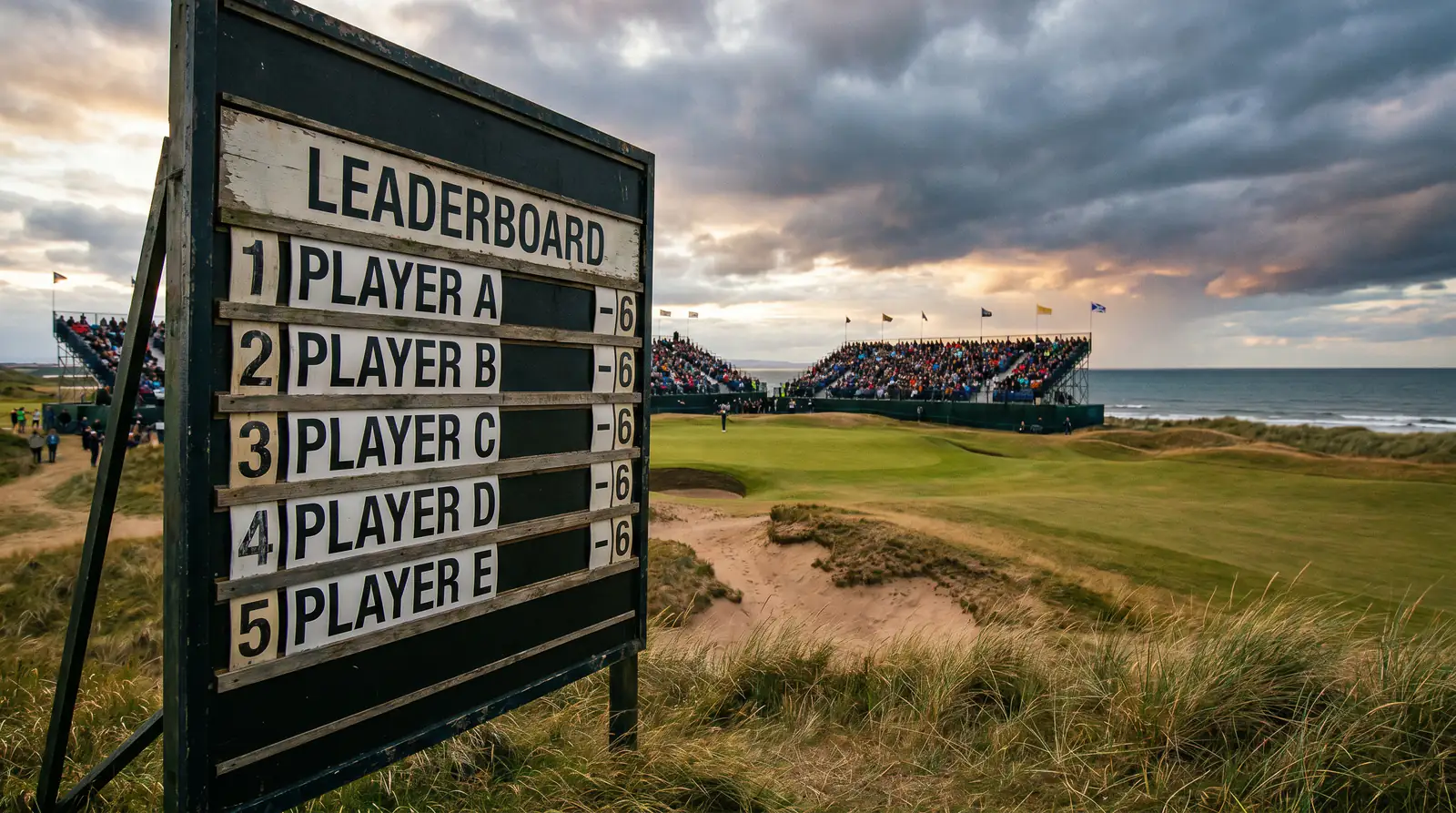
Now imagine a counterfactual where four players had tied at T3. Positions 3, 4, 5, and 6 would all read “T3.” Your top-5 each-way needs positions 1-5, so three of the four T3 players are inside your band. Dead-heat reduction: original stake × (3/4). You lose 25 per cent of your place stake.
Numbers on a £10 each-way at 25/1. Without dead heat, the place portion (1/5 odds) pays £10 × (25/5 + 1) = £60 returns (including stake back), so £50 profit on the place leg. With the 25 per cent dead-heat reduction, the settled place stake becomes £7.50, and the return becomes £7.50 × 6 = £45 — so £37.50 profit. The dead heat just cost you £12.50 on a £10 stake, and that is on a relatively mild three-into-four tie.
For a five-into-five dead heat (five players tied for T1, sharing positions 1-5), the reduction is 5/5 = no haircut, because all positions inside your band are filled. The pathological case is more players tied than positions available.
Worked Example: Top-20 Each-Way, Where the Maths Punishes
Top-20 each-way looks like the safer bet on paper — wider place band, more shots at hitting. The dead-heat formula reveals why it is often worse value.
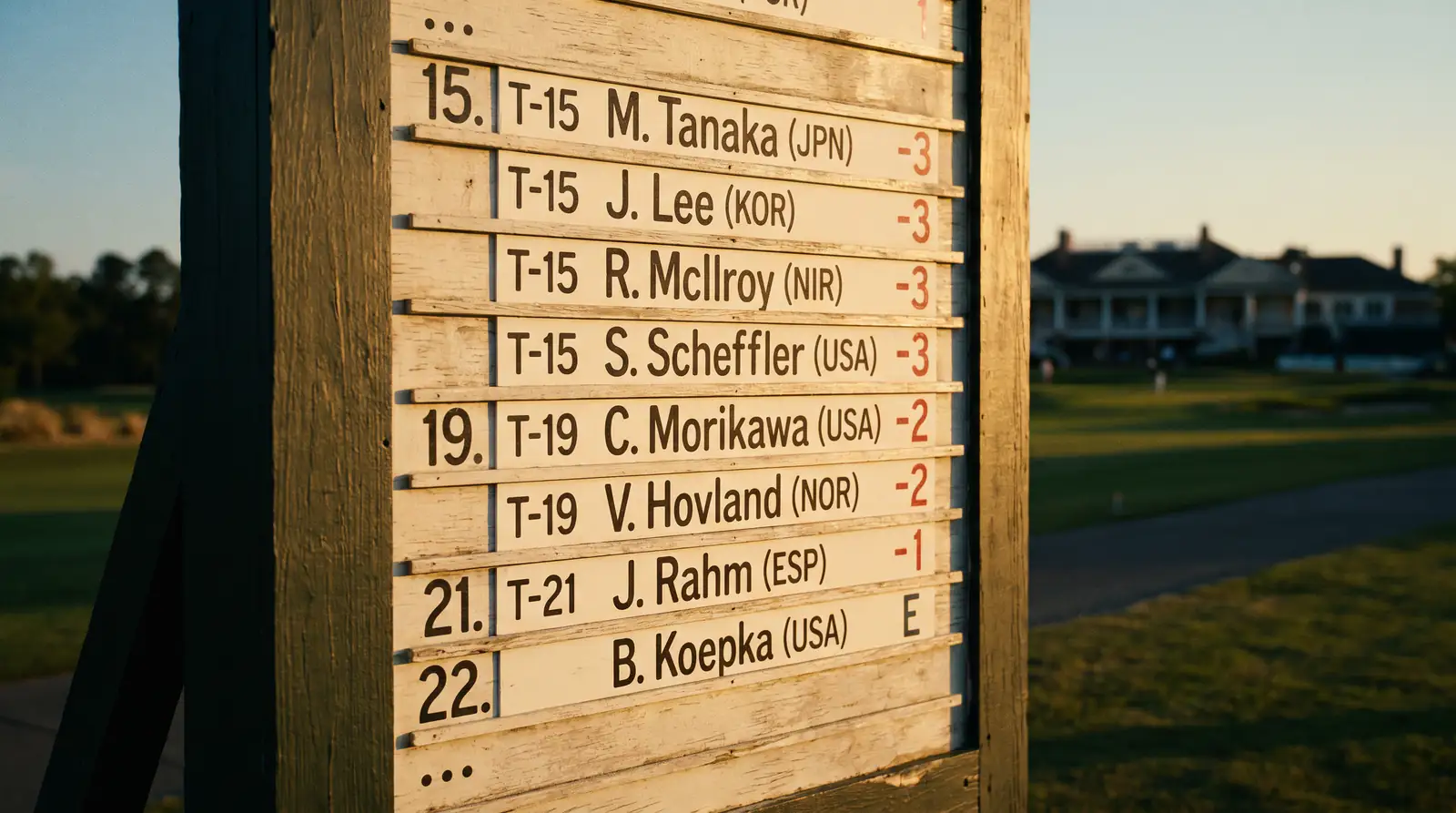
A top-20 finish requires positions 1 through 20. The 20th position is where dead heats cluster most heavily in tournament golf, because the gap between 20th and 21st on the leaderboard is often a single shot, and seven, eight, or even ten players can share T20.
Imagine six players tied at T20, occupying positions 20, 21, 22, 23, 24, and 25. Only one of those positions (20 itself) is inside your top-20 band. The formula: settled stake = original × (1/6). You lose 83 per cent of your place stake.
On a £10 each-way at 50/1 with top-20 paying 1/4 odds, the unbroken-tie settlement would be £10 × (50/4 + 1) = £135 returns, £125 profit. With the 1/6 dead-heat reduction, the settled place stake becomes £1.67, returns become £1.67 × 13.5 = £22.50, profit £12.50. The tie reduced your headline profit by 90 per cent. The win portion (separately staked at £10) is still a loser at this finishing position, so this is your entire return.
The reason top-20 looks attractive and pays poorly is exactly this dynamic. Books happily offer wider top-finish markets because the dead-heat formula does most of their work for them.
Where Dead Heat Hurts Most: Tournament Structure and Course Type
Dead heats are not random — they cluster around the cut line, the leaderboard’s natural breakpoints, and the trailing places of any wide-band each-way market. The reason is the score distribution at a tournament: scores bunch around the median and stretch out at the tails. The first 30 positions on most tournament leaderboards are tightly clustered, and any one-shot or two-shot threshold catches multiple players at once.

For context, the odds of a hole-in-one for a PGA Tour pro are around 1 in 3,000 per par-3, which makes the ace special at any tournament a long-shot lottery. Dead heats are the opposite end of the variance spectrum — not “almost never happens” but “happens at almost every event somewhere on the board.” Knowing where they cluster is the difference between buying a 25/1 and buying an effective 5/1.
Links tournaments tend to produce slightly more dead heats than parkland events at the top of the board, because the variance of links scoring spreads the leaders but compresses the chasing pack. Parkland tournaments at no-cut events compress the field tighter overall, making dead heats more likely deep into the top-30 and top-40 bands.
The top-10 finish market deserves its own look precisely because it sits in the middle of this dead-heat sensitivity curve — wide enough to attract clusters at the cut between 10th and 11th, narrow enough that the reduction haircut still bites hard when it lands.
The practical takeaway: if you are going to play top-finish each-way, do it on top-5 or top-10 rather than top-20 in 95 per cent of cases. The headline odds look smaller, but the dead-heat-adjusted expected value is materially better.
Why does a dead heat ruin the value of a top-20 each-way more than a top-5?
Because the leaderboard naturally bunches at the trailing positions of any wide-band market. Five to ten players sharing T20 is common at most tournaments, and only one or two of those positions are inside the top-20 band, producing reductions of 70-85 per cent on the place stake.
Are dead heats more common at links or parkland tournaments?
Slightly more at links events at the top of the board, because links scoring variance spreads leaders but compresses the chasing pack. Parkland no-cut events produce more dead heats deeper in the field at top-30 and top-40 bands.
