

 Available in US
Content
Half the Outcome Is Decided Before a Ball Is Struck
Thursday morning at Augusta 2025, I was tracking a player at 80/1 in the first round leader market. By noon UK time, he was 12/1. He had not hit a ball yet. The reason for the price collapse was simple: the morning wave had teed off, scoring conditions were genuinely benign, and the afternoon wave (where my player was teeing) was looking at a slightly worsening forecast. The market had repriced his probability by 85 per cent on weather information alone.

FRL is the only outright-style market in golf where half the outcome is already determined by the time the first tee shot of round one is struck. The tee-time draw, the morning-vs-afternoon split, the wind forecast across that six-hour window — all of it shapes the implied probability before anyone has actually played a competitive shot. Once play starts, the volatility compounds.
It is also the market with the widest spread between sharp pre-tournament prices and crowd-driven public prices, because the public reads FRL like it reads outright (favourite-to-win) and most of the real edge sits in the wave-bias signal that the casual punter does not have time to evaluate at 8 am on Thursday. Below is how I treat the market, what I look at, and where the value tends to hide.
Why FRL Prices Move So Hard, So Fast
The pre-tournament FRL market is priced from a model that takes each player’s pre-tournament outright probability, multiplied by a “round-one strong” adjustment for recent form on opening rounds, and weighted by the implied scoring conditions during their specific tee-time window.

That last variable is the volatile one. A player priced at 50/1 to win outright (implied 2 per cent) might be priced at 40/1 for FRL (implied 2.5 per cent) if their tee time falls in the calmer wave, or at 60/1 (implied 1.6 per cent) if they are drawn into the rough side of the conditions. The whole field is being repriced on a single variable that itself moves with the forecast.
Add the secondary volatility: live FRL during round one rebalances after every group’s completed hole. If the morning leader is sitting at -5 through 12 holes and your afternoon player is teeing off, your live FRL price is being squeezed by every birdie the morning leader makes. Two birdies in the closing three holes for the morning leader can drift your afternoon player from 25/1 to 50/1 inside 40 minutes, even before your selection hits a shot.
This is a feature of the market, not a bug. The volatility is what makes FRL interesting. It is also why the market punishes lazy reads: a punter who picks an FRL selection on outright form alone, without consulting the tee-time draw and the wind forecast, is paying full margin for half a decision.
Wave and Draw Bias: The Variable That Actually Decides It
Tee-time waves split most professional tournaments into morning starters and afternoon starters in round one, then they reverse for round two. The morning-afternoon split is where wave bias lives.

Wave bias means the scoring conditions are not equal between the two waves. At seaside links events, the morning wave often tees off in calmer wind that builds through the afternoon. At Augusta, the morning often plays softer greens that dry out by 1 pm. At desert events, the afternoon plays into stronger wind and lower humidity. None of this is secret — it is on the forecast every UK punter can pull up — but the FRL market does not always price it efficiently.
How heavily does wave bias affect FRL pricing at The Open? In my notes from the last five seasons, the morning-afternoon split at The Open has carried an average swing of 0.8 strokes per round between waves. Translated into FRL implied probability, that is a 30-40 per cent difference in expected leaderboard position between two otherwise-identical players in opposite waves.
This is also why wind direction defines the draw bias on links more than on any other course type. The prevailing wind for The Open’s host venue can flip the morning-afternoon advantage from one year to the next, and the FRL market is sometimes still pricing the previous year’s bias when the forecast says otherwise.
The disciplined FRL bettor checks three things before reading a single price: the tee-time draw, the wind forecast across each wave’s window, and the historical wave bias for the host course. If those three sources line up against the price you are seeing, you have a clean read.
FRL vs Outright: Where the Value Actually Hides
The price relationship between FRL and outright tells you what the market thinks of a player’s specific Thursday probability. A player priced at 100/1 outright and 30/1 for FRL is being signalled as a one-day specialist — the model rates their probability of leading after Thursday much higher than their probability of winning the whole thing. The opposite (200/1 outright, 200/1 FRL) signals a consistent long-shot.
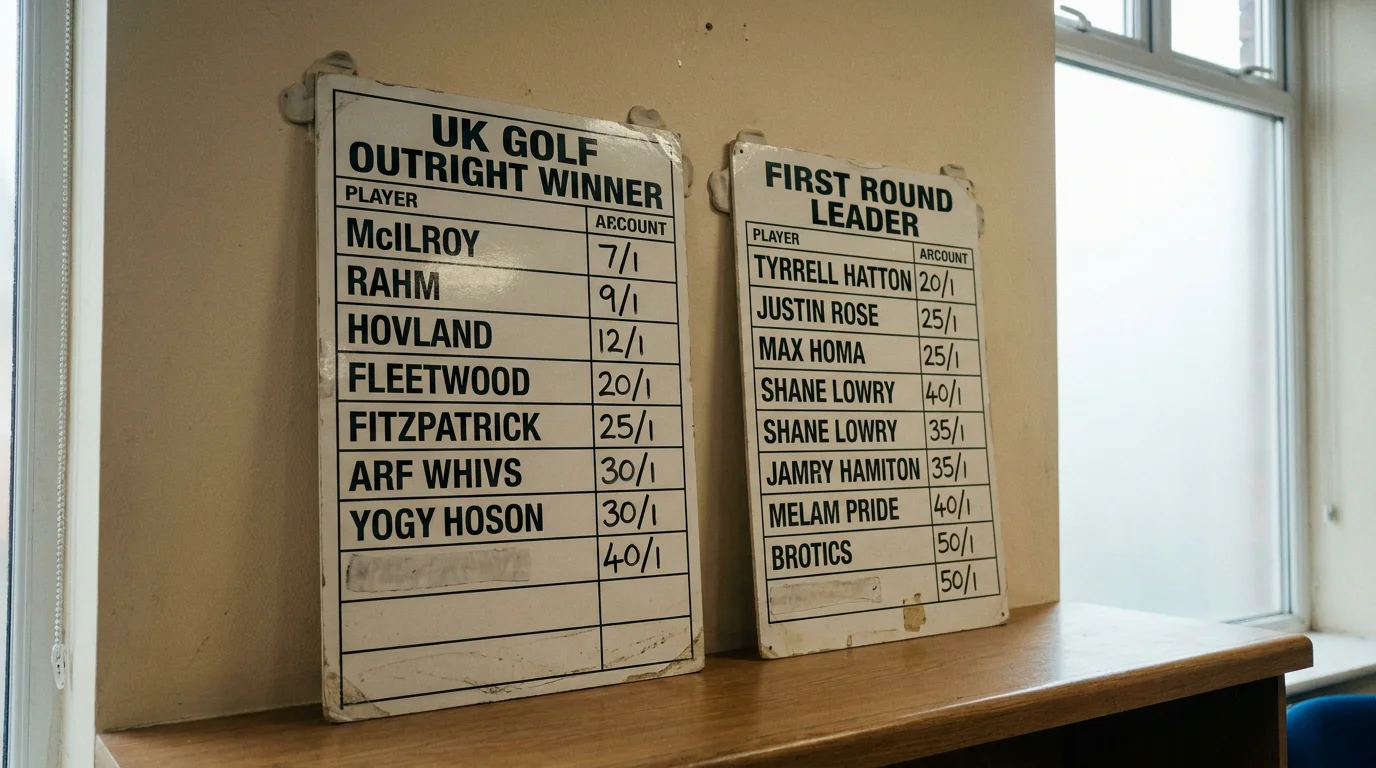
Scottie Scheffler in 2025 had a birdie-or-better rate of 25.78 per cent leading the PGA Tour, and that number does most of the FRL-vs-outright maths for you. A player who makes a birdie or better on more than a quarter of their holes is a real FRL threat at any event with benign Thursday scoring conditions, because the FRL is essentially won by the player who maximises birdie production in a single round.
The value, in my notes, tends to hide in two places. First, in mid-tier players (30/1 to 80/1 outright) drawn into the friendlier wave with strong recent opening-round Strokes Gained: Approach numbers. Second, in lower-tier players (150/1+ outright) who have specific course-history success and are drawn into the better wave at that venue.
The traps are the obvious favourites priced too short on FRL because the public reads “best player = best FRL price.” A 6/1 FRL price on a clear pre-tournament favourite is rarely value, because a 6/1 implied probability of 14 per cent is generous given the round-one variance the favourite faces against 155 other players all having a shot at one good round.
ESPN’s Pamela Maldonado put the underlying discipline problem more bluntly than I have ever managed: “If you’re putting the same amount on everything, stop right now — that’s the equivalent of using a putter from the fairway.” FRL especially punishes flat-stake betting, because the variance of a one-round market is huge and the edge cases (a 100/1 hitting in a windy wave) require disciplined sizing to convert into long-term profit.
Live FRL During Round One: The Decision Window That Closes Quickly
Live FRL exists, though not at every UK operator and not at every tournament. Where it exists, the market is one of the fastest-moving in golf, because every made birdie in the morning wave reprices every afternoon-wave selection in real time.

Rory McIlroy’s first round at the 2025 Masters is the clean recent example. Pre-tournament he was +650 to win outright. After his opening round (which left him in the chasing pack rather than the lead), the outright drifted to +1200, and the FRL settled to another player. McIlroy’s live FRL price during the round itself moved from 25/1 at tee-off to 80/1 by the time he reached the back nine — a story of compounding mispricing across 15 holes that mirrored exactly the model’s deteriorating prior.
The live FRL window closes hole-by-hole. By the time the afternoon wave finishes nine holes, the FRL outcome is roughly 70 per cent determined, and the live prices contract sharply on the actual current leader. A live FRL position taken at the right moment (after a leader stumble or before a clear chasing-pack birdie run) can pay 5-10 times the closing price, but the window for the trade is typically less than 90 minutes mid-round.
Is the FRL market available live or only pre-tournament?
Both, at most major UK operators. Pre-tournament FRL prices open early in the week and stay live until the first tee shot of round one. Live FRL is available during the round itself at the larger books, with prices recalculating after every completed hole.
How heavily does wave bias affect FRL pricing at The Open?
Significantly. The morning-afternoon split at recent Opens has averaged a 0.8-stroke difference between waves, which translates to a 30-40 per cent difference in expected FRL probability for otherwise-identical players. The market does not always price this efficiently, especially when the forecast shifts overnight.
