

 Available in US
Content
The Market That Strips Out 154 Distractions
I keep a single Google Sheet that tracks my long-term head-to-head record across UK operators, broken down by tour, by round, and by pre-tournament vs live entry. The number that fell out of seven years of entries: H2H is the only market in golf where my long-run ROI is reliably positive in any year, on any tour. Outrights are too variance-heavy. Each-ways get eaten by dead heat. Three-balls are good but volatile. H2H pays the most disciplined version of “I have a stronger read on these two players than the market does.”

The cleanliness of the market is the reason. Head-to-head removes the 154 other players in the field and asks a single binary question: lower score over the requested period, A or B? There is no leaderboard variance dragging the price around, no cut to worry about, no field-strength adjustment to make. Just two players, one number each, and a winner.
It is also the market where the average UK punter is most likely to actually beat the line over a season, because the read required is the read that most golf-watching people are good at — comparing two specific players on form, course fit, and recent ball-striking — without needing the whole-field machinery the outright market demands.
Pricing the Duel: Where the Number Comes From
The H2H model is the simplest of all live golf models. Take each player’s expected score for the requested period (round, 18-hole matchup, tournament, weekend, whatever), subtract one from the other to get an expected differential, then assume normal variance around that differential to estimate the probability that A beats B (and equally that B beats A, plus the small chance of a tie).
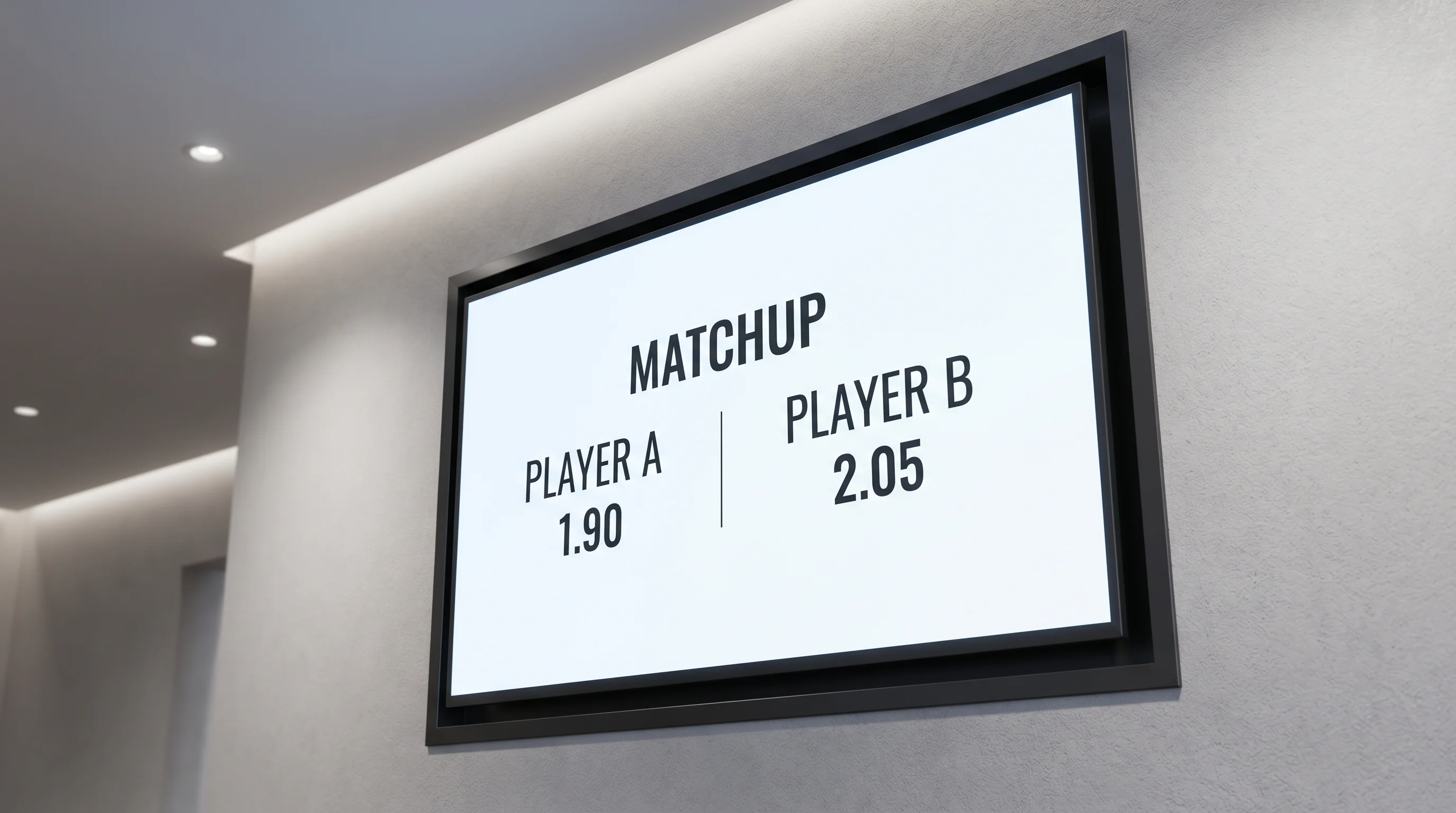
Strokes Gained metrics drive the expected differential. Scottie Scheffler in 2025 led the PGA Tour in SG: Approach, SG: Tee-to-Green, Greens in Regulation, and a birdie-or-better rate of 25.78 per cent. Against an average PGA Tour pro that year, his expected scoring advantage was roughly 1.5 strokes per round — which converts to an H2H probability of 70-75 per cent in his favour over an 18-hole matchup, or odds of around 1.36-1.42 decimal after margin.
Against another elite player (a top-5 in SG: T2G that year), Scheffler’s expected differential collapses to 0.3-0.5 strokes per round, which converts to an H2H probability of 55-60 per cent. That gives a fair price of around 1.66-1.81 decimal. The reason H2H prices on elite-vs-elite matchups cluster between 1.70 and 2.00 decimal is exactly this maths — when the variance is high relative to the expected gap, the implied probability collapses towards 50/50.
Tie handling matters here too. Most UK H2H markets settle ties as “dead-heat” (stake refund) or “void” depending on the operator. A few apply a third option as “tied” at fixed odds (usually 8/1 or 10/1) — this is rarer and confined to specific specialist markets.
Live H2H vs Pre-Tournament: Two Different Animals
Pre-tournament H2H markets are priced from the model alone, with no in-play information factored in. Live H2H markets reprice after every completed hole, with the expected differential updated based on the round so far and the holes remaining.
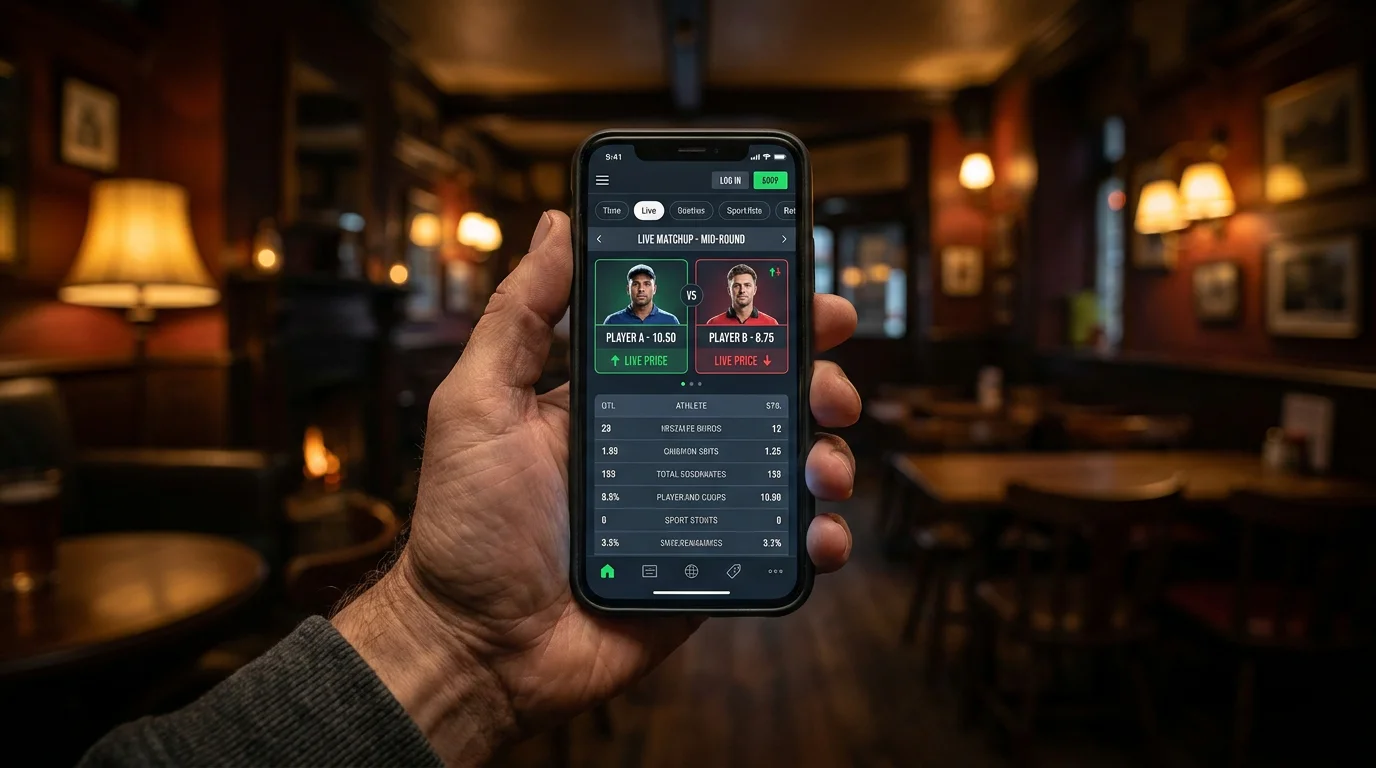
The two markets are not interchangeable. A pre-tournament H2H captures the full-tournament read on form, course fit, and matchup history. A live H2H captures the current-round read on hole-by-hole performance and remaining-holes variance. They reward different skills.
My personal split is roughly 60 per cent pre-tournament, 40 per cent live, on H2H volume. The pre-tournament reads I trust more because they reflect long-cycle work — Strokes Gained baselines, course-history clusters, weather forecasts — that I can do at leisure on Tuesday. Live reads I trust less because the window is short, the variables compress fast, and the temptation to chase a recent shot becomes a discipline problem.
The most reliable live H2H entry point in my notes is after the front nine on Saturday or Sunday. The model has fresh data, the variance over the back nine is large enough that the price still has room to move, and the relevant decision (does player A or player B finish the round lower?) is now bounded by a known number of holes.
The Tiebreak and Playoff Rule: Where Settlement Gets Specific
Does playoff hole count in a UK head-to-head golf settlement? The answer varies by market type. For a full-tournament H2H (player A vs player B over 72 holes), most UK operators include playoff holes in the settlement — the player who wins the overall tournament (including any playoff) is the H2H winner. A few operators settle at the 72-hole leaderboard regardless of playoff, which means a tied 72-hole score voids the H2H. This is exactly where the make-the-cut rule shares the same edge logic — settlement quirks come down to specific operator terms rather than universal standards.
For a single-round H2H (A vs B over 18 holes today), playoff holes are typically not included because the matchup is round-specific. A tied round-score settles as void at most operators.
For a weekend H2H (A vs B over rounds three and four combined), the operative number is the 72-hole leaderboard position. If both players make the cut and finish on the same 72-hole score, most operators void; a few use the round-three score as a tiebreaker, which is genuinely strange and worth flagging in the terms.

The cleanest read on the rule: assume void on tie unless your operator’s golf-specific terms say otherwise, and check the playoff clause specifically for tournament-length H2H markets where playoffs are non-trivial probability events.
Where the Edge Tends to Live in H2H
Seven years of notes tell me the edge in H2H sits in three specific scenarios.
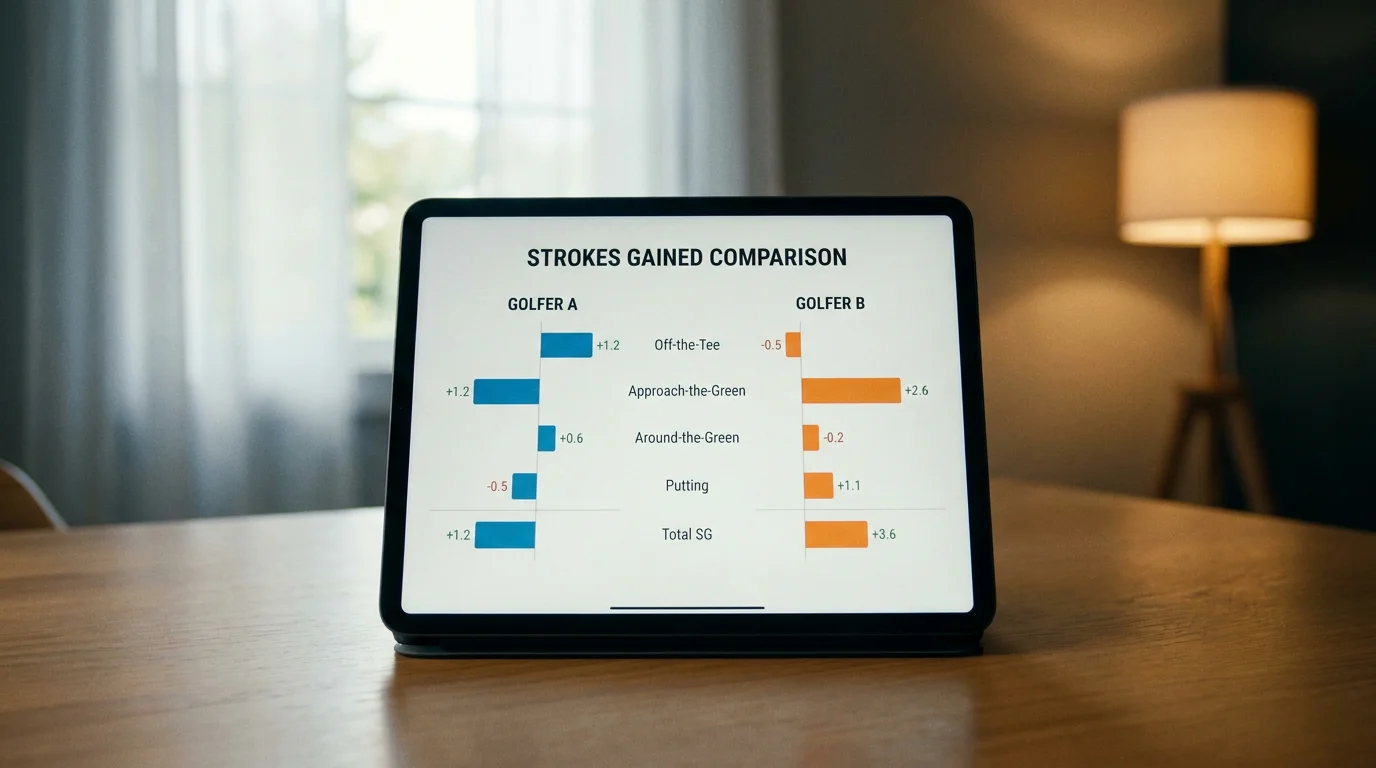
First, in matchups where the two players have meaningfully different driving-distance profiles on a course where distance matters. The 2025 PGA Tour average of 303-304 yards is the baseline; players who are 15+ yards above that baseline on a course with multiple long par-5s or driveable par-4s have an underpriced edge in roughly 60 per cent of matchups I’ve tracked. The model knows the distance numbers but tends to underweight the course-specific conversion.
Second, in early-round H2H lines where one of the two players has a known opening-round-strong or opening-round-weak history that the public-side model has not yet recalibrated against. The pre-tournament price assumes both players hit their season average; the deviation between actual opening-round form and season average is the source of edge.
Third, in DP World Tour H2H lines, which run consistently tighter than PGA Tour lines (margins of 3-4 per cent total vs 5-6 per cent on the PGA). The reason is that DP World Tour matchups attract sharper money and the books price more cautiously. The edge for the punter is that the prices are honest — when you have a sharp read, you get most of the value, where on the PGA the margin layer absorbs more of it.
What none of those three scenarios reward is sentiment. A player you like, a player you watched at the BMW PGA, a player on a good current streak who has lost the favouritism over the past three events — none of those produce H2H edge unless they are backed by a quantifiable difference in expected scoring.
Does playoff hole count in a UK head-to-head golf settlement?
For tournament-length H2H markets at most UK operators, yes — playoff holes are included in the official result. A few operators settle at the 72-hole leaderboard and void on a tie. Single-round and weekend H2H markets typically exclude playoffs and void on ties.
Why are H2H lines tighter on the DP World Tour than on PGA Tour?
DP World Tour H2H markets attract sharper money on average and the operators price more cautiously, holding margins of 3-4 per cent total against 5-6 per cent on PGA Tour markets. The result is that DP World Tour H2H prices are more honest and pay better when the punter has a real read.
