

 Available in US
Content
The Bet That Pays for Survival, Not Victory
My most consistent profitable market over seven seasons is, embarrassingly, the one nobody at a casual betting conversation will admit playing. Make-the-cut. It pays the worst headline price on the card (1.50 to 2.20 decimal on most top-30 players) and demands the least exciting outcome to win — your player just needs to be there on Saturday morning. But it rewards the read I do best, which is form, course fit, and the cold maths of expected scoring over 36 holes.

The UK remote betting market generates around £2.6 billion in gross gambling yield annually, and the share that flows through niche markets like MTC is small. That smallness is what creates the value. Most punters are buying outright lottery tickets at 50/1 — they want the dopamine spike of a £10 ticket worth £500. The MTC punter wants 1.85 paying out 65 per cent of the time. The two ambitions are not the same trade.
This article is about how the market actually works, why Friday afternoon is the highest-value entry window of the week, and how I use MTC alongside other markets as a hedge tool on bigger outright positions. What follows is the maths and the patterns, not a sales pitch for any specific bet.
Cut-Line Mechanics: Where the Number Comes From
The cut at most professional golf tournaments is set at “top 65 and ties” after 36 holes. At majors the rule varies — The Open cuts at top 70 and ties, the US Open at top 60 and ties, Augusta historically at top 50 and ties (subject to a 10-shot rule in some years). The PGA Tour standard is 65 and ties, with the cut line sometimes including additional players if the leader is within a defined shot count of the field tail.

The 2025 Open Championship at Royal Portrush set the cut line at level par, with the official tournament guaranteeing $38,900 to every player who survived 36 holes. Andrew Rhodes, the outgoing chief executive of the UK Gambling Commission, noted that the UK industry’s gross gambling yield hit £15.6 billion at its highest ever level — context for how much money flows through markets like the cut, even where individual ticket sizes are modest.
The MTC market converts the cut threshold into a probability for each player. The model takes the player’s expected 36-hole score (a function of SG: Tee-to-Green over the previous 20 events, course fit, and weather), simulates that score against the expected field distribution, and counts how often the player finishes inside the top 65 (or whatever the relevant threshold is). That probability, divided by the margin layer, is the displayed MTC price.
Top-15 ranked players carry MTC probabilities of 80-92 per cent, displayed at 1.20-1.40 decimal. Mid-tier (positions 30-60 in the world rankings) carry 65-78 per cent, displayed at 1.60-2.00. The interesting band is positions 80-130, where MTC probabilities run 45-60 per cent and prices sit at 2.00-3.00 — that is where the variance edge tends to live.
Live MTC on Friday: The Entry Window That Matters
Friday afternoon is the highest-value MTC entry window of the week for one structural reason: the model knows the round-one score, which compresses the variance materially, but Friday’s round is still in progress and the price still has to incorporate the actual back-nine action.

A player who opens with a 67 (4-under) at a tournament with a cut line projected at +1 has a Friday-afternoon MTC probability that the model is reading as something like 88 per cent. The displayed live price might be 1.15 decimal. By 3 pm UK time on Friday, when the player is on the 10th tee of round two at -3 for the tournament with the projected cut line drifting to +2 because the field is scoring high, that probability has actually risen to 94 per cent but the price often does not move fast enough. Entry at 1.15 with a true probability of 94 per cent (true price 1.06) is genuine 8 per cent edge.
The flip case is equally tradable. A player who opens with a 75 (4-over) at a tournament with a projected cut at +1 has a Friday morning MTC probability around 30-35 per cent, displayed at 2.80-3.30. By Friday afternoon the same player at +5 through 8 holes of round two has a MTC probability collapsing to 8-10 per cent, and the price climbs to 8-10 decimal. The window between morning and mid-afternoon Friday is where the price is most often laggy in both directions.
The discipline is to know what the cut line is actually projecting at the moment of entry, not what it was projected at on Wednesday. The projection moves as the field scores, and a +1 projected cut at Tuesday’s preview becomes a +3 projected cut by Friday lunch when the leaders are scattering birdies and the chasing pack is hanging on.
Cut Rule vs No-Cut Events: Knowing the Schedule
Are no-cut events excluded from this market entirely? Yes — the MTC market does not exist for events that do not have a 36-hole cut. The schedule of no-cut events in 2026 includes the Tour Championship at East Lake, the WGC events that survive, several DP World Tour invitationals, and the LIV calendar. For these events, MTC is simply not offered.

The cut rule itself varies more than most casual punters realise. Top 65 and ties is the PGA Tour default; some DP World Tour events cut at top 65 only (no ties), which means a 65-way tie scenario produces some hard-edge settlements. The Korn Ferry Tour and lower satellite tours often cut at top 60 and ties. Major championships use their own rules (The Open at top 70 and ties is the most generous in modern golf).
The reason this matters for MTC betting is that the model needs the right cut threshold to price the market. A player priced for a top-65-and-ties cut at one operator may be priced for top-60-and-ties at another, producing a 3-5 per cent probability difference for the same player. Always check which cut rule the operator is using for the specific event. The terms are usually clear in the market description, but they vary.
The other rule worth knowing: the “10-shot rule” that applied historically at majors (any player within 10 shots of the lead made the cut). Augusta retained this for decades and dropped it in 2013; The Open still uses it for the cut decision, which can extend the cut beyond the nominal top-70 in years when the leader runs away early.
MTC as a Hedge Tool on Bigger Positions
The most under-used MTC application is as a hedge against an outright or top-finish ticket on the same player. A worked example: I had an each-way top-10 at 35/1 on a player going into the 2025 Memorial. The pre-tournament outright leg was a £20 stake. I supplemented it with a £40 MTC at 1.70 on the same player, locking in a £28 profit on the MTC if he simply made the cut, which would offset any partial loss on the top-10 leg if he finished outside the places.
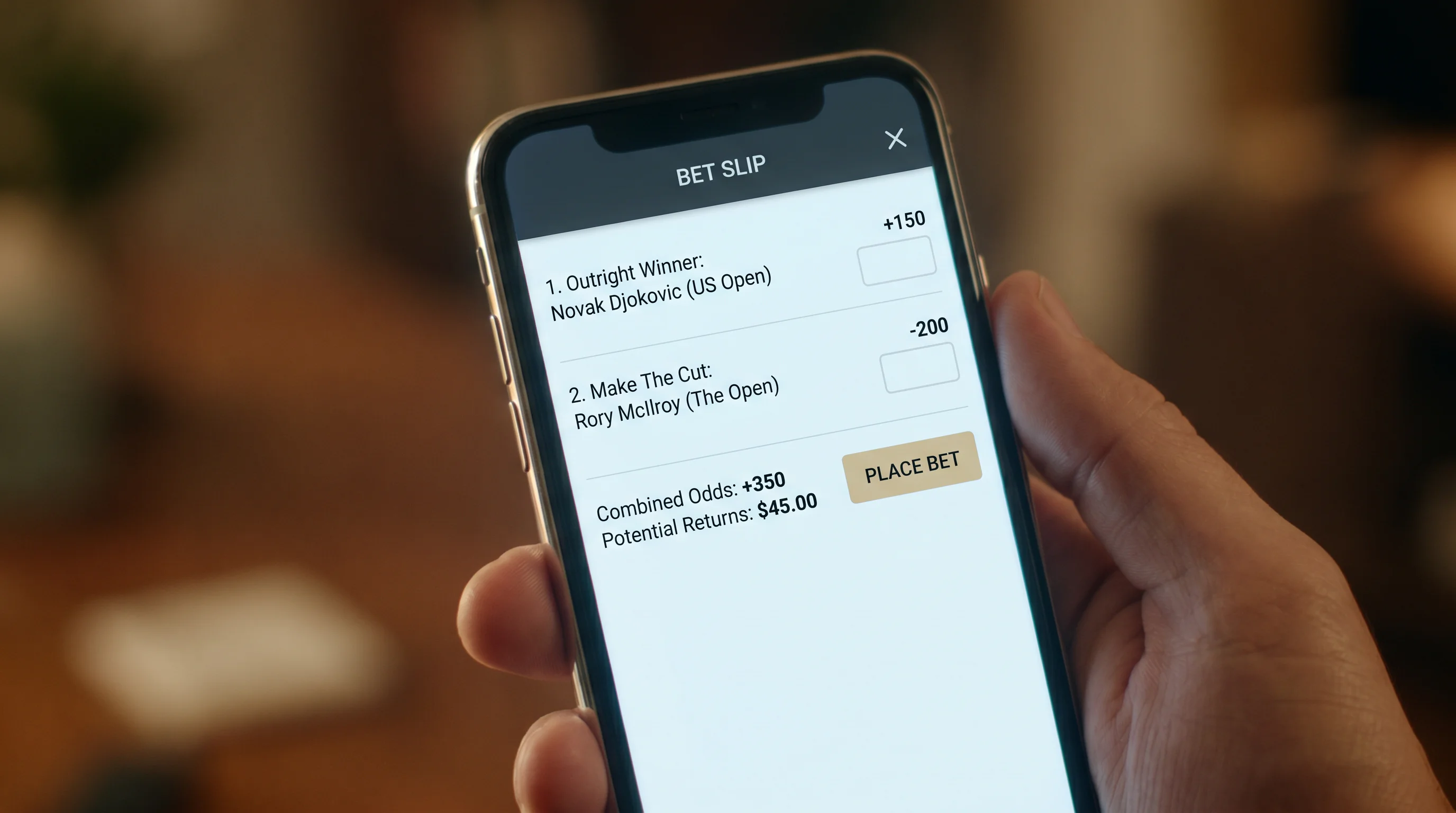
The maths is straightforward. If your read is “this player will make the cut at 75 per cent probability and finish top 10 at 12 per cent probability,” the joint outcome of “made cut but missed top 10” carries roughly 63 per cent probability (the difference). At a £20 outright stake, that outcome costs you £20. The £40 MTC stake at 1.70 returns £68 in that joint outcome — net £28 hedge profit, more than offsetting the outright loss.
This is also why the top-10 market often pairs with MTC as a hedge — the two markets have complementary payouts that, sized correctly, produce positive expected value across the joint outcome space without taking outright lottery-ticket variance.
The hedge only works if the relative pricing is honest. If the MTC market is priced at the operator’s typical 1.85 (implied 54 per cent) when the true probability is 75 per cent, the hedge is profitable in expected value across all four joint outcomes. If the MTC is priced at 1.55 (implied 65 per cent), the hedge breaks even or loses depending on the outright pricing. The maths is sensitive to the input numbers, which is why I keep a spreadsheet rather than estimating in my head.
How does a Monday-cut affect a make-the-cut bet from the previous Friday?
The MTC bet settles when the official cut is declared, regardless of which calendar day that happens to be. If weather pushes the cut decision to Monday morning, the MTC settles Monday on the official cut line. The bet does not become void just because the timing slipped.
Are no-cut events excluded from this market entirely?
Yes. MTC is not offered for events without a 36-hole cut, which includes the Tour Championship, some WGC events, several DP World Tour invitationals, and the LIV calendar. For these tournaments, the alternative bet is usually a top-30 or top-50 finish market.
