

 Available in US
Content
The Feature That Sells the Illusion of Sophistication
The first bet builder ticket I ever lost a meaningful sum on was a four-legger at a 2019 PGA Tour event. A top-10 finish on player A, a top-20 on player B (paired with player A in round one), an opening-round under-par on player A, and a “no hole-in-one this tournament” leg. The combined price was 24/1, the stake was £40, and I felt like a genius pressing place. By Friday evening, three of the four legs had locked in winners, and the fourth (the no-ace leg) collapsed when somebody aced the 16th on a Sunday afternoon. £40 turned into £0 on a hole-in-one I had not anticipated as a meaningful risk.

That ticket taught me what bet builders actually are. They are not magic combination engines that find hidden value. They are correlation pricing engines, where the bookmaker decides which combinations they will accept, sets the margin layer on the combined ticket, and rejects requests that would pay positive expected value to the punter. The UK remote betting market generates about £2.6 billion in gross gambling yield annually, and a sizeable share of that volume flows through bet builders because the format is genuinely fun and the multiplied prices look generous.
What follows is how the correlation maths actually works, where the bookmaker draws the line between acceptable and rejected combinations, why live bet builders behave differently from pre-tournament ones, and what the “request a bet” features at specific operators actually accept.
How Bet Builders Price Correlations
The bet builder model does not multiply individual leg prices. It calculates the joint probability of all selected legs occurring together, factoring in the correlation between them, then applies the combined margin layer.

An uncorrelated multi-leg parlay multiplies the individual implied probabilities. Two legs at 50 per cent probability each, if genuinely independent, have a joint probability of 25 per cent — a fair price of 4.0 decimal. The book applies a margin layer (typically 4-8 per cent per leg, compounded) to arrive at a displayed price of around 3.65 decimal.
A positively correlated parlay has a higher joint probability than the multiplication suggests. “Player X to win the tournament” and “Player X to lead after round one” are positively correlated — if X wins, the probability they led after round one is higher than the base rate of “anyone leading after round one.” The book detects this correlation and tightens the joint price (or rejects the combination entirely if the correlation is too strong to model accurately).
A negatively correlated parlay has a lower joint probability than the multiplication suggests. “Player X to win” and “Player Y to finish top-10 (where Y is not X)” are slightly negatively correlated — if X wins, Y’s top-10 probability shifts marginally. The book widens the joint price slightly, because the combination is harder to hit than the individual legs imply.
The punter’s edge in bet builder construction is finding negatively correlated legs where the book’s correlation model is conservative — typically pairs of players from different parts of the leaderboard, or different finish-position bands on players with different scoring profiles.
Legal vs Illegal Combinations: Where the Book Says No
Why does my builder get rejected when I add an outright leg and a top-10 for the same player? Because the two legs are perfectly positively correlated — if the player wins, they finish top 10 by mathematical necessity. The joint probability is identical to the outright probability, and the book would be effectively paying you twice for the same outcome.

The “illegal” combinations across most UK books include: outright + top-finish on the same player (any band), top-5 + top-10 + top-20 on the same player, head-to-head between two players + outright on either of those players, and multiple FRL selections that include the same player as a leg.
The “legal but priced tight” combinations include: top-10 on player A + top-10 on player B (slightly negative correlation), make-the-cut + top-30 on the same player (correlated, priced cautiously), and combinations involving prop bets (hole-in-one, lowest round score, etc.) layered onto outright legs.
The “legal and well-priced” combinations — where the punter’s edge can actually exist — typically involve disparate markets that the book’s correlation model treats as effectively independent. A top-10 finish on player A in the morning wave, plus an FRL on player C in the afternoon wave, plus a make-the-cut on player D priced as a clear favourite — three legs with low underlying correlation, where the joint price is close to the pure multiplication of the individual prices.
The discipline is to know the rejected combinations before you try to place them. Building a four-legger only to have the slip rejected at confirmation is the most frustrating UI experience in live betting.
Live Bet Builder Flow: A Different Animal
Live bet builders behave fundamentally differently from pre-tournament ones because the correlation between legs evolves as the tournament progresses. A pre-tournament parlay of “Player A top-10 + Player B top-20” has stable correlation across both legs until the tournament starts. The same parlay placed at Friday evening, with both players already through 36 holes, has correlation that the book is now estimating from limited remaining-rounds data.
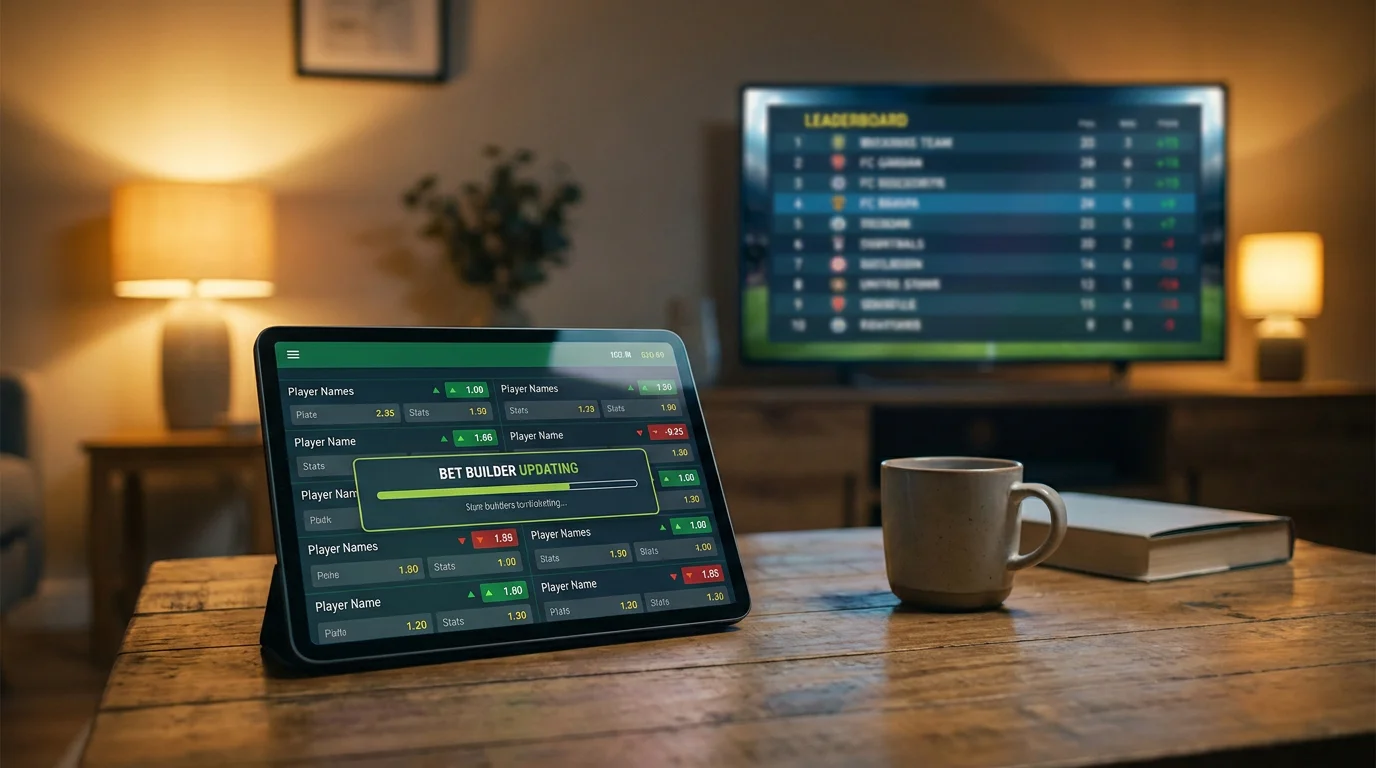
The 2025 Masters provided a textbook case of how live correlation shifts pricing. Rory McIlroy started at +650 to win outright (decimal 7.50), drifted to +1200 after the opening round (decimal 13.00), then climbed back through Saturday before winning a Sunday playoff. A live bet builder at Friday evening combining “McIlroy top-5” + “Justin Rose top-10” had an interesting correlation profile because both players were genuinely in contention but for different scoring reasons. Some operators accepted the combination at 7/1; others rejected it because their correlation model flagged the legs as too tightly coupled for their tolerance.
The most useful live bet builder leg is often the FRL or round-leader market — FRL is a common bet builder leg because it settles within a single round and clears the parlay’s first node within hours of placement, reducing the cumulative risk of late-week disruptions.
Live bet builders also suffer from “leg suspension” issues. If one leg’s market suspends mid-round (a player withdraws, weather suspends play on a specific group, a prop bet’s underlying event has not yet happened), the builder shows as pending until the leg resolves. Most operators settle a builder with a voided leg by recalculating the parlay price with that leg removed. A few cancel the entire builder. Check operator terms before placing.
Request-a-Bet Features and What They Accept
Does Paddy Power’s #WhatOddsPaddy accept live golf request-a-bet? The feature is available for golf, including live golf, though not for every combination. The general pattern across the operator’s request feature is that requests are reviewed within 5-30 minutes by an actual trader, with acceptance contingent on the trader’s ability to price the combination within their margin tolerance.

Requests that get accepted most often: specific finish-position combinations across 2-3 players (e.g., “Hatton top-10, Fleetwood top-20, McIlroy top-5”), opening-round-score combinations (e.g., “any British player under 70 on Thursday”), and prop-style combinations involving birdie counts or specific-hole events.
Requests that get rejected most often: combinations including correlated legs (as described in the previous section), combinations with implied prices the trader cannot justify against their model, and “creative” combinations that don’t fit standard market types (e.g., “any player to make all four cuts at the next four majors”).
The accepted request typically comes back with a quoted price that includes a wider margin layer than a standard pre-built market — typically 8-12 per cent against 4-8 per cent on standard parlays — because the trader is bearing the model uncertainty of pricing a non-standard combination.
The discipline with request features is the same as with any bet builder: only request combinations where you have a clear edge thesis you can articulate in one sentence. “I think these two players are negatively correlated and the book is pricing them as independent” is a coherent edge. “These two players are friends and might both play well” is not.
Why does my builder get rejected when I add an outright leg and a top-10 for the same player?
Because the two legs are perfectly positively correlated — if the player wins, they finish top 10 by mathematical necessity. The book detects the correlation and rejects the combination because they would effectively be paying you twice for the same outcome.
Does Paddy Power’s #WhatOddsPaddy accept live golf request-a-bet?
The feature is available for golf including live golf, though not for every combination. Requests are reviewed within 5-30 minutes by a trader, with acceptance contingent on whether the combination can be priced within their margin tolerance. Specific finish-position and prop combinations get accepted most often.
