

 Available in US
Content
The Major That Punishes the Wrong Read More Than Any Other
The 2025 Masters lives in my notebook as the single most volatile live-betting day of my career. Rory McIlroy opened the tournament at +650 to win outright. By Thursday afternoon, after a stumbling opening round, he had drifted to +1200. By Friday evening, he had climbed back to +400. By Sunday afternoon he was the clear favourite. He duly won in a playoff against Justin Rose, completing the career Grand Slam — and the live-pricing trajectory across those four days was a textbook demonstration of how Augusta rewrites the board faster than any other major venue.

Augusta does this for reasons specific to the course. The back nine is genuinely different from the front, the Amen Corner stretch (holes 11, 12, 13) carries variance that no other three-hole stretch in golf can match, and Sunday’s pin placements turn 67-shooters into 75-shooters within a single round. Live-betting models that work at the other three majors get tested at Augusta in ways the trading desks struggle to fully model.
What follows is what makes Augusta’s variance specific, how Amen Corner reshapes the implied probabilities, why Sunday back-nine swings dominate the live card, and which prop markets are actually available during the event.
Augusta-Specific Variance: Why the Course Defeats Models
The standard live-betting model relies on Strokes Gained baselines from the previous 20-25 tour rounds for each player. That works well at venues where the scoring conditions are statistically similar to recent tour events. It works poorly at Augusta because the course’s scoring distribution is unlike anywhere else on tour.
Augusta’s par-5 scoring is genuinely birdie-or-better territory for elite players, with a tour-average score on the par-5 13th hovering around 4.78 in recent Masters. The par-3 12th averages 3.30, the par-4 11th averages 4.30 (one of the hardest par-4s on tour), and the back nine as a unit produces a scoring distribution heavily skewed by these specific holes.
The model has to account for course-specific scoring profiles, but the calibration is imperfect because the sample size of Augusta-specific data is small (one tournament per year, against 30+ tour events for most courses). Players whose long-iron approach play matches Augusta’s demands score well above their baseline; players whose game doesn’t translate score below. The trading desks know this, the public-side prices reflect it imperfectly, and the value tends to live in the gap.

The specific player profile that wins at Augusta — high-launch iron play, soft hands around the greens, comfort on undulating fast surfaces — is well-documented but rare. Recent winners (Scheffler 2022 and 2024, Rahm 2023, McIlroy 2025) all share elements of this profile, and live-pricing models weight Masters course history heavily for this reason. The names that consistently outperform their pre-tournament baselines at Augusta are the names whose prices contract most sharply during the round when they are in contention.
The Amen Corner Effect: Three Holes That Reshape Everything
Amen Corner — the stretch from the second shot at 11 to the tee shot at 13 — is the most consequential three-hole sequence in tournament golf. The variance generated across those three holes during Sunday’s round at the Masters has produced more leaderboard shifts than any equivalent stretch at the other majors combined.

The live-betting consequence is that most UK operators close their outright markets entirely from the moment a leader steps onto the 11 tee until they have signed for the 13th green. The window can be 30-40 minutes for the lead group, during which the model is recalibrating with each shot but the punter cannot place a wager.
The market reopens after Amen Corner with prices that reflect the just-completed scoring. A double-bogey at the 12 by a leader can shift their implied probability from 65 per cent to 30 per cent during the closed window, and the reopened price will reflect that shift immediately. There is no opportunity to “buy the dip” in real time because the dip happens during the suspended window.
The strategic implication is that pre-Amen Corner positioning matters more than reactive trading. If your read is that the current leader has a vulnerability at 12 (they have shot bogey or worse on 12 in their previous three Masters appearances, say), the price at the 10th tee is the price that captures your read. Waiting for confirmation across 11, 12, 13 means waiting through a 35-minute window where the trade is not available.
Sunday Back-Nine Swings and What They Look Like
How do Sunday back-nine swings compare with Saturday on the Masters in-play card? The data is unambiguous: Sunday swings are roughly 2-3 times the magnitude of Saturday equivalents.
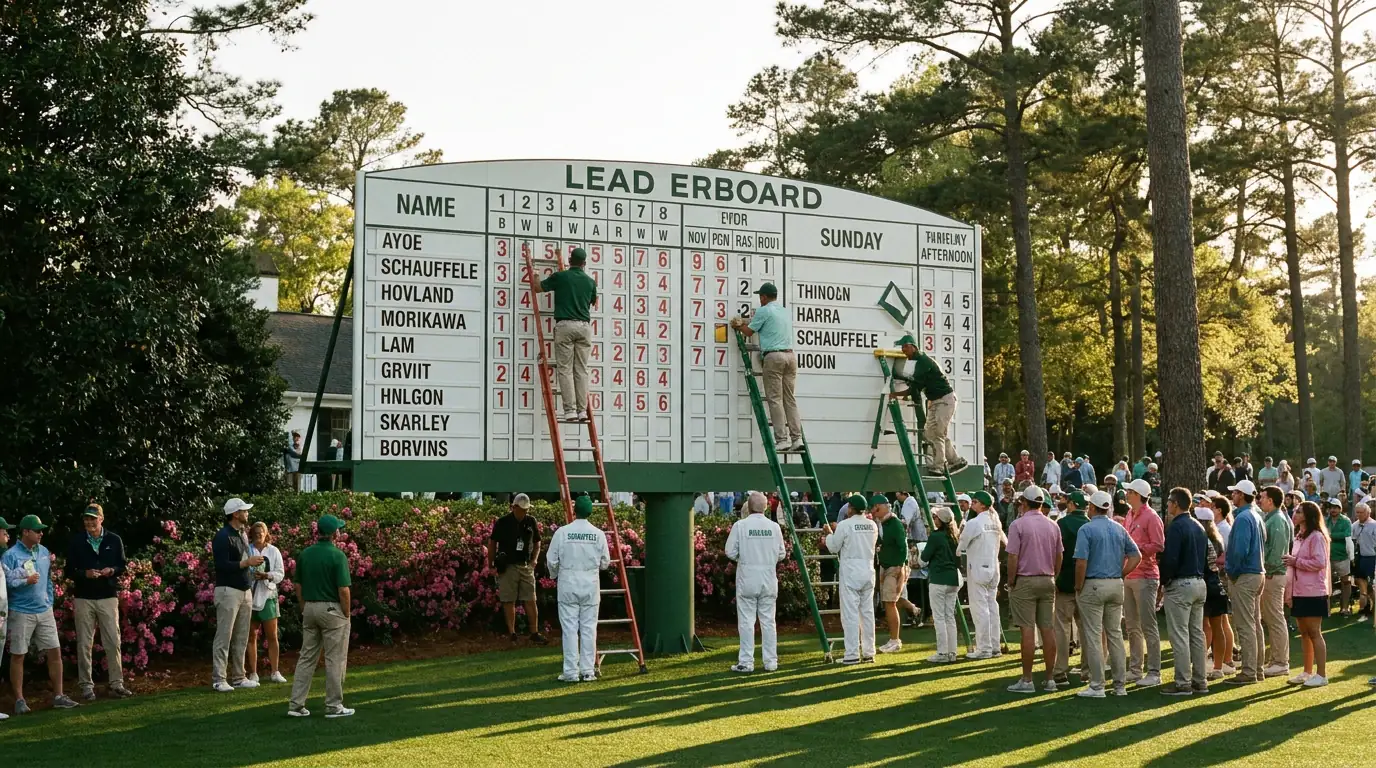
The 2025 McIlroy trajectory captures the dynamic. His pre-tournament outright price was +650, drifting to +1200 after round one, then climbing back to +400 by Friday evening as he posted a strong round two. By Sunday morning he was 9/4. Across the Sunday round itself, his price contracted from 9/4 at the first tee to 2/1 at the back nine turn, then to 5/2 after a back-nine swing involving Justin Rose closing the gap. Final settlement came in a playoff at returns the playoff-spec’d at 2/1 outright (effectively even-money on the playoff itself).
The Sunday back nine specifically — holes 10 through 18 — typically sees implied probabilities shift by 50-70 per cent across the stretch for any player in the top 5 entering the round. The 15 (par-5, reachable in two for most of the field) and the 16 (par-3, water short and right) are the two holes that produce the largest individual implied-probability shifts.
The Sunday back nine is also where the live SG: Putting reads matter most, because putting under maximum pressure on Augusta’s greens is genuinely different from putting at any other tour event. The SG: Putting profile that wins at Augusta is specifically a profile that stays statistically stable under pressure — players whose putting variance increases under tournament conditions tend to lose strokes here in ways that are invisible in their season-long SG: Putting numbers.
Live Prop Availability During the Event
The Masters attracted approximately 12.7-13 million viewers on CBS for the 2025 Sunday final round, against a tour-average final round of 2.16 million on CBS during the 2025 season — a 21 per cent year-on-year growth on the regular tour broadcast number. The viewership matters for live betting because the operator-side decision on which prop markets to list correlates directly with the audience size.
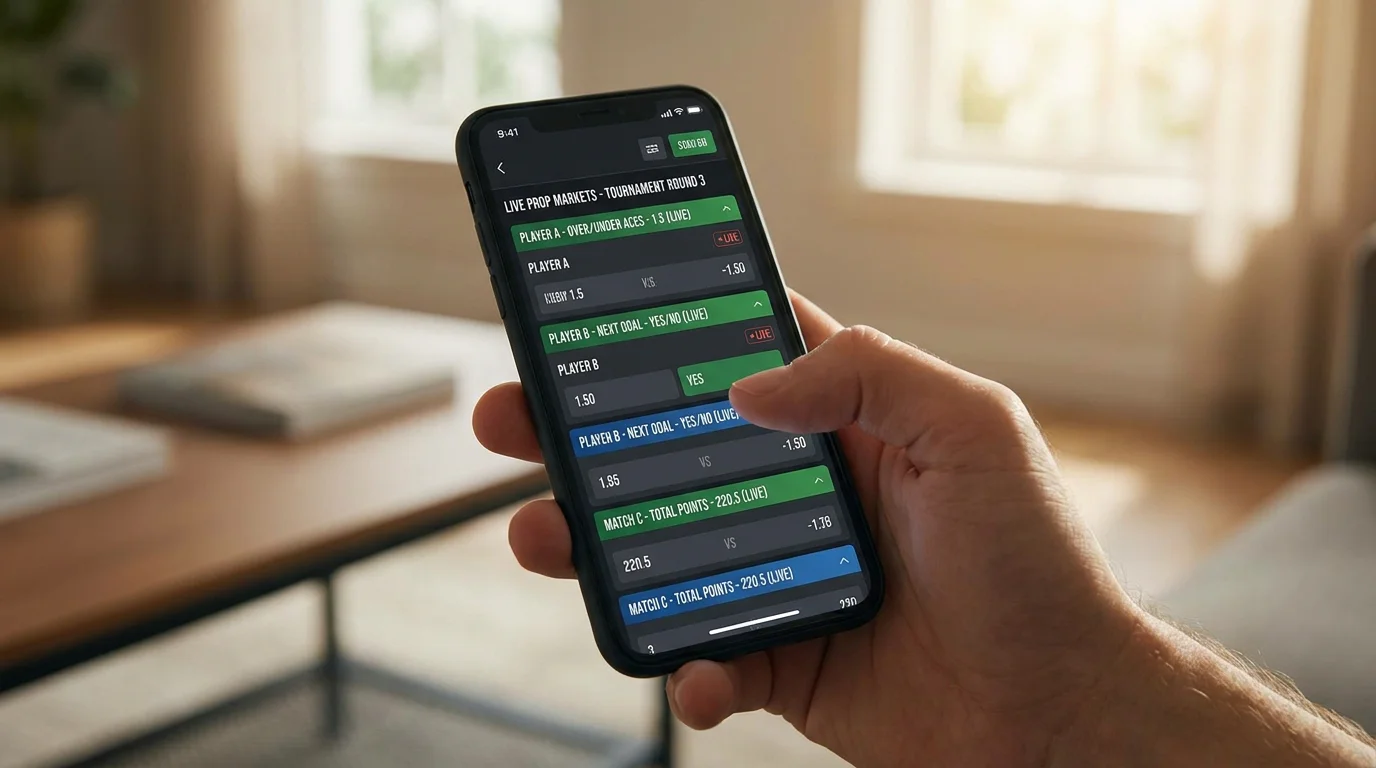
Markets typically available live during the Masters: outright, top-5/10/20, head-to-head matchups between any two players in the field, three-ball during the early rounds, leader-after-round prop (FRL on Thursday, LAR-2 on Friday, etc.), hole-in-one specials on the par-3s, and birdie-count props on specific holes.
Markets typically not available live during the Masters: bet builders that include specific Augusta-only holes as legs (the operators tend to lock these to pre-tournament construction only), live cash-out during the Amen Corner window, and request-a-bet features for prop combinations that the trading desk cannot price within their margin tolerance during the high-volatility window.
Does Augusta’s no-press-on-fans rule affect live odds liquidity? Indirectly, yes. The lack of broadcast cameras inside the gallery and the strict rules around mobile devices on the course mean that information flow during the round is more bottlenecked than at other majors. The trading desks rely heavily on the television broadcast feed, and the broadcast cadence (Sunday’s coverage is famously selective about what shots it shows) means trader information can lag what a punter watching the live ShotLink feed can see. The information asymmetry is small but real, and it favours the punter with the patience to read the data feed rather than the broadcast.
Does Augusta’s no-press-on-fans rule affect live odds liquidity?
Indirectly, yes. The limited mobile-device access on-course and the bottlenecked information flow mean trading desks rely more heavily on the television broadcast than at other majors. The Sunday broadcast is famously selective about which shots it shows, which creates small information asymmetries that favour punters who watch the live data feed directly.
How do Sunday back-nine swings compare with Saturday on the Masters in-play card?
Sunday swings are roughly 2-3 times the magnitude of Saturday equivalents. Implied probabilities for top-5 players typically shift 50-70 per cent across the back nine on Sunday, against 20-30 per cent shifts on Saturday’s back nine. The 15 and 16 are the highest-variance holes.
