

 Available in US
Content
The Cup That Trades on One-Eighth the Volume and Twice the Edge
I keep two Solheim Cup memories in the front of my notebook. The first is the 2019 event at Gleneagles where Suzann Pettersen holed the winning putt on the 18th green of the final singles match — a result I caught at live prices that had drifted to evens by mid-Sunday because the trading desks could not get sharp money in fast enough. The second is the 2023 event at Finca Cortesin where the tie result voided most of my pre-event hedge tickets and taught me how loose the “tie” pricing actually is across UK operators.
The Solheim Cup uses the same foursomes/fourballs/singles format as the Ryder Cup, with the same broad scoring patterns and a similar Sunday-singles climax. What it does not have is the betting-volume base that funds aggressive trading-desk staffing during the event. The Solheim Cup attracts roughly one-eighth of the live betting volume of the Ryder Cup at UK operators, which means market depth is thinner, spreads are wider, and the windows of genuine mispricing are larger and more available to disciplined punters.

The R&A’s global participation data shows 108 million people engage with golf, of whom 43.3 million play 9 or 18 holes on a course. Women’s participation has been the fastest-growing segment of that base in recent years, and the betting markets are slowly catching up — but the gap between Solheim and Ryder Cup liquidity is still wide, and that gap is where the value tends to live.
Format Differences from the Ryder Cup
The Solheim Cup format mirrors the Ryder Cup closely: 28 total points, foursomes and fourballs sessions across Friday and Saturday, 12 singles matches on Sunday, retention of the Cup on a tied result going to the holders. The competing sides represent Europe and the United States, with European players drawn from the LET (Ladies European Tour) and LPGA, and American players drawn primarily from the LPGA.

The differences from the Ryder Cup matter for live betting. The Solheim Cup uses the same scoring system but plays slightly faster on average — the rounds tend to complete 15-30 minutes earlier than the equivalent Ryder Cup session, partly because of green speeds and partly because of slightly tighter group dynamics. The live trading windows therefore close earlier, and the day’s final-session pricing wraps up before the European evening peak.
The other meaningful structural difference is the player pool depth. The Ryder Cup draws from the top 30-40 PGA Tour and DP World Tour players for each side, where the depth of competitive talent is extreme. The Solheim Cup draws from the top 20-25 LPGA and LET players for each side, where the depth is real but the gap between the top 5 and players 15-20 is wider than at the Ryder Cup. The live-betting consequence is that individual match outcomes are slightly more predictable, which produces tighter implied probabilities on most live H2H matchups.
Pricing LET vs LPGA Strength
The relative strength of LET vs LPGA players is the single most important model input at the Solheim Cup, and it is the input that the public-side market gets most wrong on average. The LPGA is consistently the deeper tour, with stronger fields, higher prize money, and more rigorous qualification. The LET is the European tour, with smaller fields, lower prize money, and a heavier emphasis on regional events.

The implication is that an average-LPGA player typically has 0.5-1.0 strokes per round advantage over an average-LET player at the same world ranking. The trading desks weight this in their pre-event models, but the public-side market often anchors on “they’re both at world ranking 35, so they should be roughly even” — producing live prices on European LET players that are systematically too short against American LPGA opposition.
Live football betting accounts for around 5 per cent of the UK adult sample with live horse racing at 3 per cent — the underlying baseline shares for live formats give some sense of how niche the Solheim Cup live betting volumes really are by comparison. The smaller liquidity means the spread between sharp money and public money does not get arbitraged away during the round; it sits there as a tradeable gap.
The pattern in my recent notes: live H2H pricing on European LET players in foursomes/fourballs sessions tends to be 5-8 per cent too short against LPGA-based American opposition. The value sits in backing the American side in those specific matchups, particularly during the Friday morning foursomes when the European players have not yet adapted to the course setup.
Live Foursomes on Day One
Friday morning foursomes at the Solheim Cup is the highest-volatility session of the week and the session where the trading desks have the least in-play data. The pre-event prices are essentially priced from pure player ratings, the captains’ pairing selections are revealed within 24 hours of tee-off, and the live pricing kicks in cold the moment the first tee shot is struck.
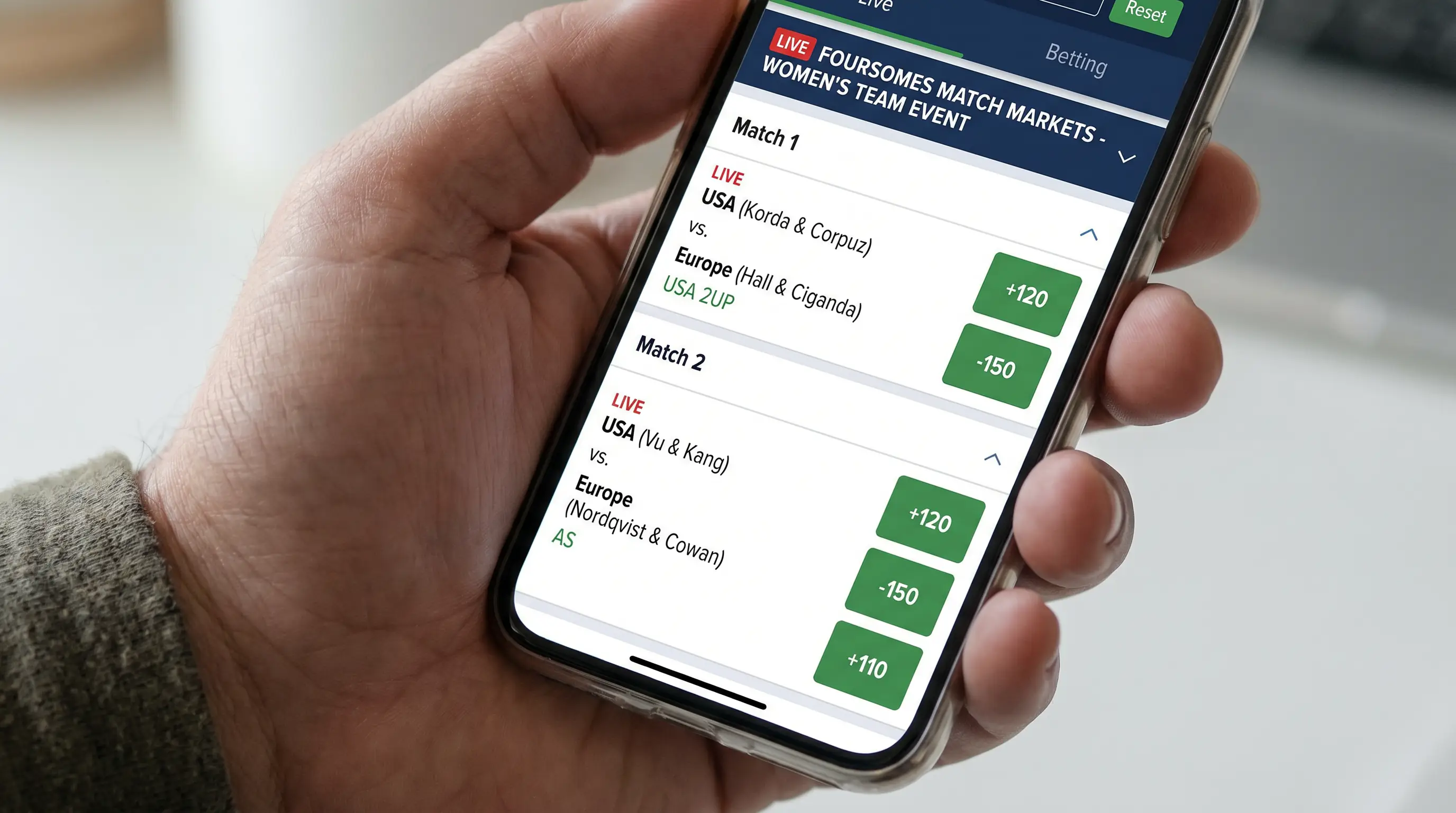
The pricing window I look hardest at is the first 4-6 holes of the Friday foursomes session. By then the trading desk has ingested the first quarter of each match, but the desk’s model is still running on lighter prior data than it would at the Ryder Cup equivalent. The implied probabilities on each match update slowly compared to Ryder Cup pricing, and the gap between displayed price and updated model probability widens to 8-15 per cent in some matchups.
This is why the Ryder Cup playbook applies with caveats rather than directly. The match-play maths is the same. The format is the same. The live-pricing rhythm is similar. The difference is that the Solheim Cup model is running on thinner data, the desks are less aggressively staffed, and the spreads stay wider for longer. The same edge logic produces larger price gaps to exploit, but the volumes you can move are also lower.
The disciplined approach is to size positions smaller than at the Ryder Cup (because the books will limit you faster if you trade aggressively) and to spread tickets across multiple matches rather than concentrating on one read. The variance management is structurally different, even though the underlying maths is shared.
Historical Singles Results and What They Tell Us
Sunday singles at the Solheim Cup has produced more dramatic comebacks per recent event than the Ryder Cup equivalent, partly because the depth gap between top players and trailing players is wider on the women’s side, and partly because the typical European-American matchup at singles slot 7-12 is more lopsided than at the Ryder Cup.
The historical pattern across recent Solheims: the team trailing 8.5-7.5 entering Sunday has won approximately 30 per cent of singles sessions outright, which is a higher comeback rate than the Ryder Cup’s 18 per cent equivalent. The implied probability that the underdog can salvage a comeback in singles is consistently underpriced in pre-Sunday Cup-result markets, with the trailing team often available at 4/1 to 5/1 when the true probability sits closer to 3/1.
Are individual point-scorer markets available live on the Solheim Cup? At a smaller number of UK operators than at the Ryder Cup, yes — typically the top 3-4 books that run a full Solheim Cup card will offer “top individual European” and “top individual American” point-scorer markets. The prices are wider than the equivalent Ryder Cup markets because the volumes are thinner, but the underlying probabilities are easier to read because the pool of contributing names is smaller.
The Cup-retention rule (a tied result retains the Cup for the holders) creates an asymmetric pricing dynamic in late-Sunday live markets. When the score is locked at 13-13 with one match still on the course, the holders’ Cup-retention price tightens to 1.40 or shorter while the challengers’ Cup-win price drifts to 3.50 or longer. The maths is honest — the tie outcome adds probability to the holders — but it means late-Sunday live entries favour the challengers if your read says they will win the deciding match.
Why do Solheim Cup live odds move slower than Ryder Cup?
Because the trading desks are less aggressively staffed and the in-play data flow is on smaller volumes. Solheim Cup live betting attracts roughly one-eighth of Ryder Cup volume at most UK operators, which means the market depth is thinner, the spreads stay wider, and the time between actual price-relevant events and the displayed-price adjustment is longer.
Are individual point-scorer markets available live on the Solheim Cup?
At a smaller number of UK operators than at the Ryder Cup, yes. The top 3-4 books that run a full Solheim Cup card typically offer ‘top individual European’ and ‘top individual American’ point-scorer markets. The prices are wider than the Ryder Cup equivalents because the volumes are thinner.
