

 Available in US
Content
- Why the UK Live Golf Book Looks Smaller Than You Think
- What a Live Golf Book Has to Do Well
- How I Read an Operator's Live Golf Product
- The Operator Walk-Through
- Live Streaming Versus Data Feed: What You Are Actually Watching
- UKGC Essentials Every Live Golf Bettor Should Know
- Quick answers on UK operator depth and rules
Why the UK Live Golf Book Looks Smaller Than You Think
The first time you open the live betting menu of a major UK book on a Thursday morning at Augusta, the operator landscape looks enormous. By the second cup of coffee, it has shrunk. The UK Horse and Sports Betting market in 2026 sits around £3.7 billion in size, with 499 companies in the sector — a number that has been declining at roughly a 3.9% compound annual rate over the last five years. The wider gambling industry in the UK still employs 93,759 people as of the 2025 update, up about 1.5% on the prior year. Those are the headline figures. The figure that actually matters for a live golf bettor is much smaller: five to seven operators run a full in-play golf product through all seventy-two holes, with three-balls held open to the back of each round, cash-out live across markets, and meaningful prop depth.
Everyone else technically offers golf. Many of them carry an outright market on every event. Some publish a top-five or top-ten line. A few hold a head-to-head on the marquee Sunday pairings. But “carries a live golf section” and “runs a competitive live golf book” are not the same thing. The first is a checkbox on the operator’s product spec. The second is a four-day operational commitment that not every UK book makes.
What follows is the working inventory I have built over seven years of trading these markets. The aim is not a ranking or a recommendation. The aim is to describe, as accurately as I can, what each of the operators that actually invests in the live golf product is known to do, where the observable strengths sit, and where the in-play menu tends to fall short. The right book for you is a function of which markets you trade most often. There is no single answer.
What a Live Golf Book Has to Do Well
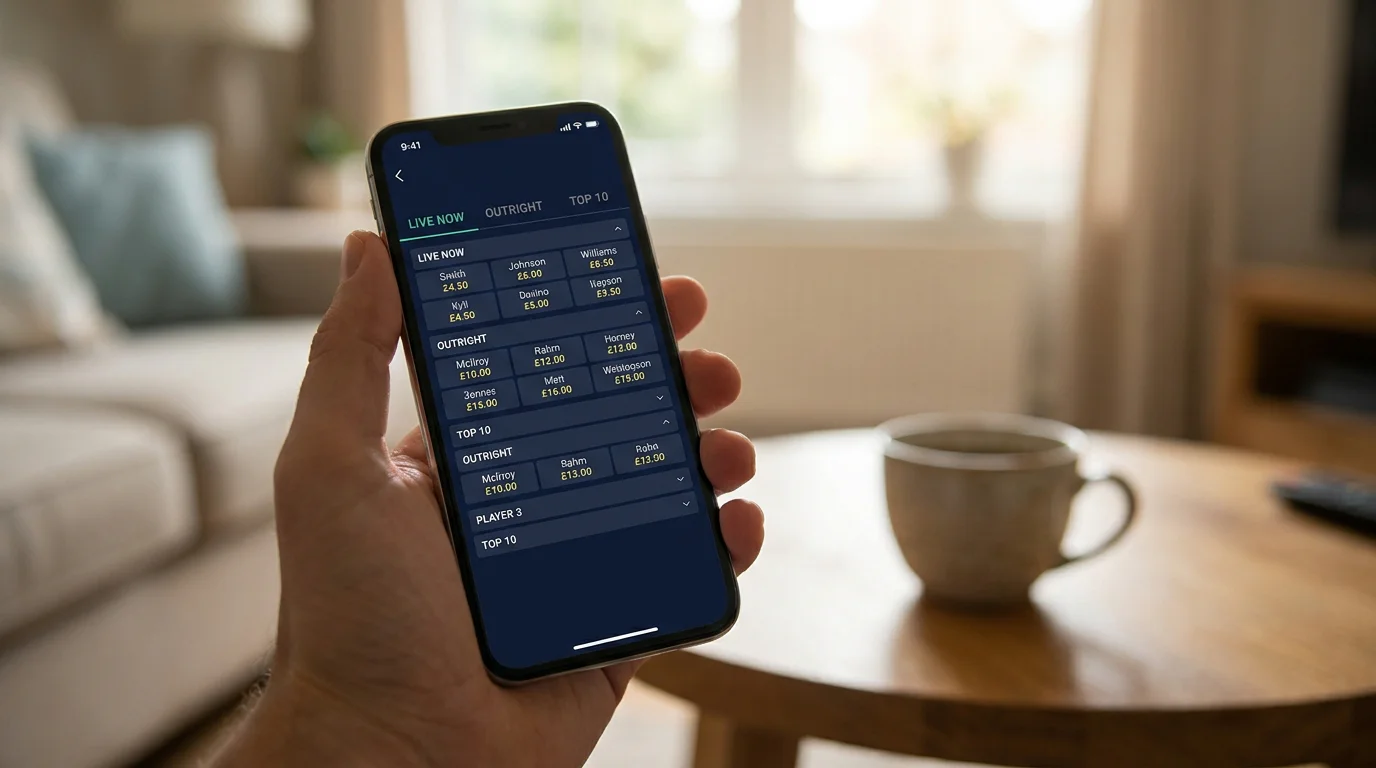
A competent live golf book has to do six things, and most UK operators do four of them well. The six are: keep outright markets open through the cut at honest prices, run three-balls deep into each round rather than closing them at the turn, carry meaningful top-finish depth (top-five, top-ten, top-twenty) all the way to Sunday afternoon, offer cash-out on a wide range of markets at prices that are at least defensible against the implied probability, publish hole-by-hole props for at least the featured groups, and maintain stable prices across the between-holes windows without freezing more than the data feed actually requires.
The UK remote betting market posted £2.6 billion in gross gambling yield across the 2024 to 2025 financial year, with football pulling £1.3 billion and horse racing £766.7 million; golf sits beneath both, which means most operators allocate their best engineering and trading resources to the larger sports first. The consequence is that the operators who actually take golf seriously do so as a structural commitment, not as a default carry. You can tell which operators are committed within fifteen minutes of opening their live menu on a Thursday morning of a major.
The two things I look for first. One: is there a three-ball market on every featured group, and does it stay open past the fifteenth hole. Two: when a leader birdies a par-5, how quickly does the entire outright menu re-price, and how stable are the new prices across the next four minutes. Those two checks tell you nearly everything about whether the operator is running an actual live golf book or a marketed-as-live skin over a pre-tournament product.
The third check, which I added to my routine after the 2023 Open at Hoylake: does the operator settle weather-suspension cases the same way the rules tab says they will. Not every UK book does. Reading the published rules on suspension, withdrawal and dead heat before placing the first stake of the week is the single most boring piece of work in live golf trading, and it has saved me more money than any single read.
How I Read an Operator’s Live Golf Product
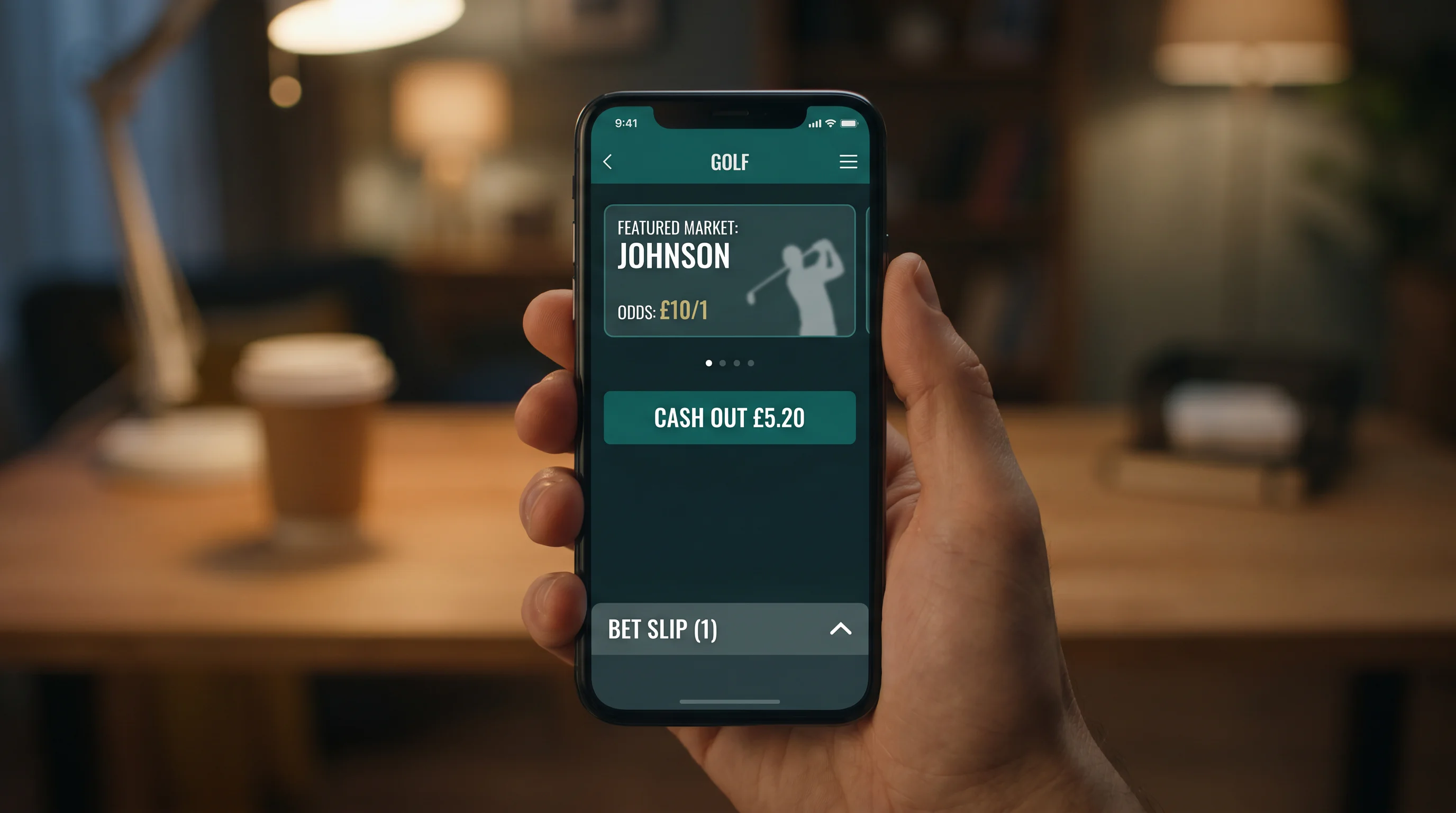
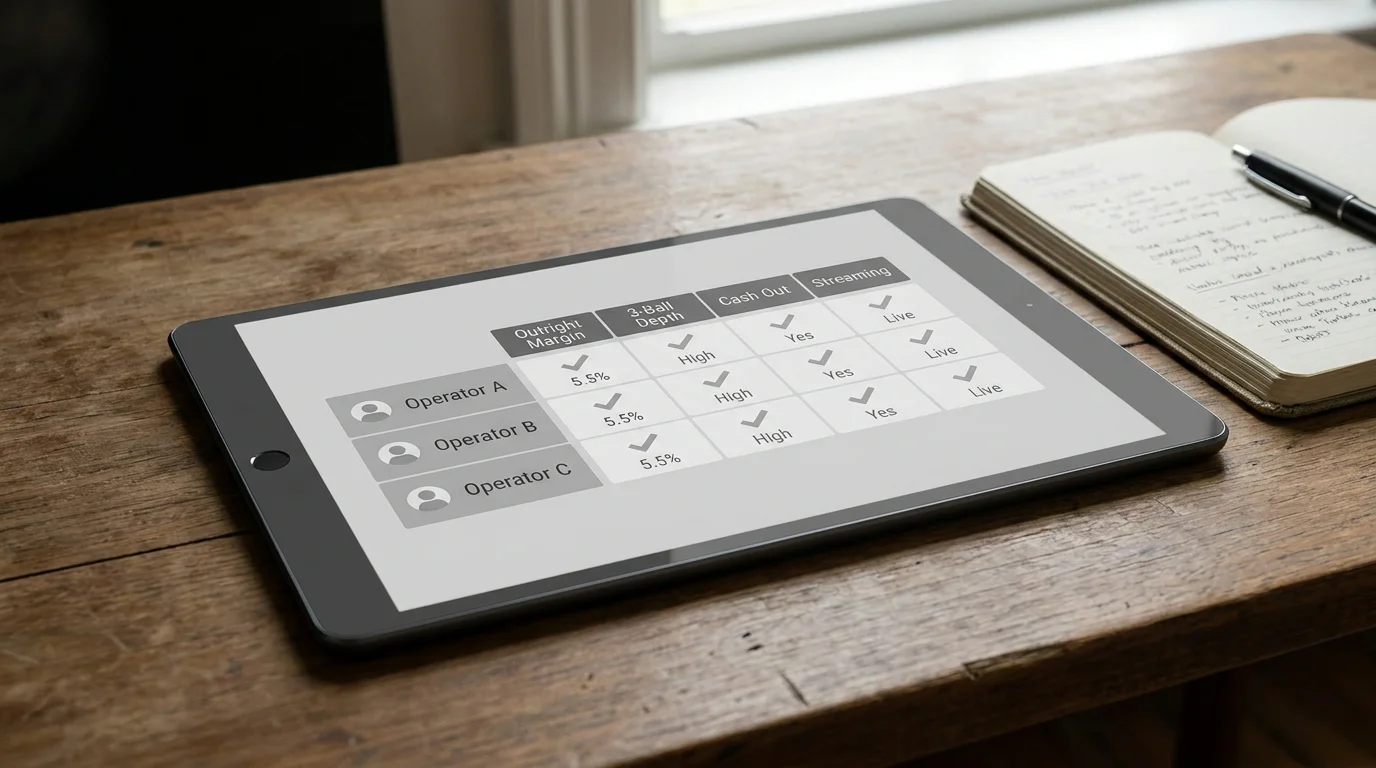
The evaluation framework I run has five axes, and I weight them by how often I actually act on each one. Market depth carries the heaviest weight, because a thin menu means there are simply fewer trades to find. Price stability through between-holes windows comes second — a book that re-prices cleanly and holds the new price for four minutes is a book I can trade against. Three-ball longevity, top-finish depth, and cash-out generosity round out the five.
What I deliberately do not weight: welcome bonuses, free-bet promotions, retention offers and accumulator boosts. None of those have anything to do with the operational quality of a live golf product. The marketing reads as if they do; the maths says they do not. A 20% margin on a prop bet survives any welcome bonus you can imagine. Pick the book by the product, then pick the promotion if it happens to align.
The other axis worth flagging is account behaviour. UK books vary substantially in how they handle accounts that win regularly on live golf — restrictions on stake sizes, refused bets, slower settlement on certain markets. I do not have a clean measurement for this because it is necessarily idiosyncratic, but it is real, and any serious live golf bettor should expect to spread action across multiple operators rather than concentrating with one. The seven described below are the seven I have found to invest meaningfully in the live golf product over the last three years.

The Operator Walk-Through
Each of the operators below holds a UK Gambling Commission licence and runs an in-play golf product across the major weeks and at least the headline DP World Tour and PGA Tour events. The descriptions are observational, not promotional, and they reflect what I see in the product rather than what the brand pages claim.
bet365
bet365 carries the deepest live golf menu of any UK book I trade with. Outright, top-five, top-ten, top-twenty, make-the-cut, first round leader, three-balls, head-to-head matchups, hole props, six-shooter group markets, lowest round, top continental player — the menu reads more like a major-sport coupon than a niche product. Pricing on the headline markets sits inside the tightest band on the UK market, with outright margins on majors typically around 5%.
The observable strengths are the menu breadth and the price stability through between-holes windows. The observable weakness, in my notes, is that the cash-out values on top-finish markets are not always as generous as they could be — the buffer the book applies on a Sunday afternoon top-ten ticket tends to be wider than at some smaller competitors. That is a real cost over time but it is also the price of having every market on the same screen.
Round outrights, where you bet on a single round’s lowest score, are a bet365 staple and one of the better trades for someone who has read the morning weather and the wave draw. Player markets — to make X birdies, to record Y bogeys — are deeper here than almost anywhere.
BetVictor
BetVictor is the operator I trade three-balls with most often, and the reason is operational: BetVictor keeps three-ball markets open materially deeper into rounds than most UK competitors, often through the fifteenth and sometimes through the seventeenth. That timing matters because the value in a three-ball is often in the back-nine swing, not the front-nine read. A three-ball that closes at the turn is a different product than one that holds to the last putt.
BetVictor also runs what the operator calls “mythical balls” and lucky-dip three-ball variants — different configurations of three players who are not necessarily in the same playing group, priced at a single lowest-round line. The maths on those is more variable than a standard three-ball, but the prices occasionally drift on Thursday mornings before the trading team catches up with the draw.
The live menu overall is narrower than bet365’s, particularly on prop and special markets, and the in-play head-to-head depth is shallower. For three-ball traders specifically, the longevity of the markets compensates.
Paddy Power
Paddy Power is best known to UK bettors for #WhatOddsPaddy, a feature that lets users submit custom bet requests on golf and other sports and receive a published price. That is a genuinely useful feature for live golf if you have a thesis the standard menu does not support — a specific three-player combination, a player to record N consecutive pars, an unusual cross-tournament parlay. The feature is rate-limited and depends on the trading team having capacity, but I have used it to place trades that no other UK book would have hosted.
The standard live golf menu at Paddy Power is solid: outright, top finishes, three-balls (typically closing at the turn rather than running deep), head-to-heads on featured groups, and a developed special-and-prop card around majors and the Ryder Cup. The brand is heavier on marketing than most, and the live golf section gets significant promotional attention through major weeks.
The observable cost: in-play prices on Paddy Power can lag the bet365 reference by a few seconds during volatile windows, which makes the book a poor fit for fast-trading approaches. For the request-line bettor, it is one of the few UK operators that genuinely offers the service.
Sky Bet
Sky Bet’s live golf product is anchored in the broadcast crossover with Sky Sports. The integration with Sky Sports Golf gives the operator a structural reason to invest in the product, and the in-play markets reflect that, particularly on DP World Tour events where Sky holds the UK broadcast rights. Outright margins are reasonable, top-finish markets are well-staffed and head-to-heads cover the featured groups consistently.
The menu is shallower than bet365’s, but the prices on the DP World Tour specifically — including end-of-season events in Dubai and the Race to Dubai outright — are competitive enough that Sky Bet is a book worth keeping open on Sundays of those events.
The observable limitation is that hole props and three-ball longevity sit closer to the UK median than the leaders. For a bettor whose action is largely outright and top-finish on DP World Tour events, the Sky Sports integration and the broadcast-synchronous live tracker are genuine product strengths.
William Hill
William Hill operates one of the longest-running UK retail and online sportsbook brands, and the live golf product reflects that scale: broad menu coverage, stable pricing, consistent settlement. Outright, top-finish, three-balls, head-to-heads and matchups are all present, with margins broadly in line with the UK competitive set.
What I notice in my own trading logs is that William Hill’s strengths are in liquidity at scale rather than in any single niche feature. The book does not run the deepest three-balls or the broadest prop menu, but the in-play prices on the headline markets are reliable across the four days of a major and the cash-out values are generally honest.
If you are spreading action across several books, William Hill is one of the operators that consistently shows up as a viable second or third home for outright and top-finish exposure.
Ladbrokes
Ladbrokes runs a live golf product that overlaps substantially with the Coral product, given their shared ownership, and the in-play menus on the two brands are nearly identical. Outright, top-five, top-ten, three-balls (closing typically at the turn), head-to-heads and a moderately developed prop card on major weeks.
The observable strength is in-play margins on outright markets, which sit at the tighter end of the UK competitive set during majors and Ryder Cup weeks. The observable limitation is depth on smaller events — DP World Tour events outside the marquee weeks and PGA Tour events outside the FedEx Cup playoffs sometimes carry shallower in-play menus than at bet365 or William Hill.
For outright and top-finish trading at majors, Ladbrokes is a serviceable book. For three-ball longevity or prop depth, the menu does not lead the field.
BoyleSports
BoyleSports is the Irish-headquartered operator with a substantial UK presence and a live golf product oriented around Ryder Cup, Solheim Cup and the Players Championship, where its in-play markets tend to be deeper than at smaller events. Outright and top-finish menus are present across the season, and the operator carries a developed each-way and place-only product on a small subset of events.
The Ryder Cup product specifically is one of the more developed in the UK market, with deep head-to-head depth across all sessions and an unusually deep card on session-level outcomes. Outside Ryder Cup weeks, the broader live golf menu sits closer to the UK median than the leaders.
For a bettor whose primary live golf action is match play, BoyleSports is worth an account. For a bettor whose primary action is stroke-play prop depth across the regular Tour calendar, it is unlikely to lead the field.
Live Streaming Versus Data Feed: What You Are Actually Watching
The streaming versus data-feed distinction is the most consequential operational detail in UK live golf, and almost nobody trading the product gets it right on first encounter. The live stream on an operator’s app — where you can watch the broadcast inside the betting interface — is the standard TV broadcast, typically delayed by six to ten seconds against the actual shot. The data feed the operator uses to price markets is collected on the ground and pushed straight to the trading desk, running ahead of the broadcast.
That gap matters in two ways. First, the prices you see during a shot have already absorbed the result before the stream shows it to you. Trying to fade the stream is trying to bet against the past. Second, the operator’s freeze logic — the moment the price stops accepting bets — is keyed to the data feed, not to the stream. You will see a market suspend on your screen before the broadcast shows you why.
Streaming availability varies by operator and by event. bet365 carries the broadest streaming menu on golf, with DP World Tour and PGA Tour events typically available to UK account holders. Sky Bet integrates with Sky Sports Golf for events on Sky’s broadcast schedule. Other UK operators rely on third-party feeds or do not stream golf at all. None of this affects the quality of the underlying betting product, but it affects how you watch — and watching the broadcast as if it were the truth of the market is a category error I see new live golf bettors make repeatedly.
The practical workaround I use on Sundays at a major is two screens running side by side. The broadcast carries the colour, the slow-motion replays, the crowd reactions that tell you whether the leader has just steadied himself or is about to unravel. The operator app carries the price. When the price moves three or four ticks against a player before the broadcast cuts to him, that is the trading desk telling you something the producer has not shown you yet — usually a missed green, a wayward drive, or a ball plugged in a bunker. Treating the operator app as the live wire and the broadcast as the texture lets you trade the gap rather than be victimised by it.

UKGC Essentials Every Live Golf Bettor Should Know
The UK Gambling Commission regulates every operator in the index above, and the regulatory environment shifted materially through 2025 and into 2026. The statutory levy introduced in 2025 requires online operators to pay 1.1% of revenue toward gambling-harm prevention and treatment, with the projected budget on the order of £100 million per year flowing into NHS-aligned treatment services. That is a structural change to the cost base of every UK operator, and one of the reasons the operator landscape has been thinning.
Andrew Rhodes, who served as chief executive of the UK Gambling Commission through that transition before stepping down, framed his tenure plainly: “It has been a privilege to lead the Gambling Commission through such an important period of change. I am proud of the progress we have made to strengthen regulation, improve consumer protections, and ensure gambling is safer and fairer.” Whatever your view on the direction of UK regulation, the structural reality is that operators have to invest meaningfully more in compliance, in affordability checks, in safer-gambling tools, and in transparent settlement than they did five years ago.
For the live golf bettor, the practical consequence is that the operators running competent live golf books are also running competent regulatory infrastructure — affordability prompts, deposit limits, time-out tools, self-exclusion via GamStop. If you want a precise read on what the regulator actually requires of an in-play product, I have written up what UKGC actually requires of a live golf market in dedicated detail.

Quick answers on UK operator depth and rules
Which UK bookmaker keeps its 3-ball golf markets open the longest?
BetVictor is the operator most consistently associated with running three-ball markets deep into rounds, often holding them through the fifteenth and sometimes through the seventeenth hole. Most other UK operators close three-balls at the turn or shortly after. Always check the rules tab for the specific event, as three-ball longevity policy can vary by tournament.
Do all UKGC-licensed operators offer cash out on live golf bets?
No. Cash-out is operator-specific and event-specific. Most of the larger UK books offer cash-out on outright and top-finish markets across the major weeks, but coverage on three-balls, head-to-heads and prop bets is uneven, and cash-out can be withdrawn for specific markets during volatile windows. The published cash-out terms in the operator’s rules tab are the authoritative reference for each book.
How does live streaming availability differ between bet365 and Sky Bet for the DP World Tour?
bet365 carries broad streaming on DP World Tour events to UK account holders subject to the operator’s funding and account criteria. Sky Bet integrates directly with Sky Sports Golf for events on Sky’s broadcast schedule, which covers most DP World Tour events but follows the broadcast calendar rather than the betting calendar. The underlying data feed is independent of the stream in both cases, so betting prices are not affected by streaming availability.
