

 Available in US
Content
The Tournament Where the First Hole Is Already Several Shots In
The first time I tried to live-trade the Tour Championship without understanding the starting-strokes format, I lost £180 on what looked like a straightforward Sunday outright play. The player I had backed was leading the field on the actual round-four scoring through 12 holes, and I read that as “leading the tournament.” He was not. The starting-strokes format had the top seed beginning at -10 against the bottom seed’s level par, and my player’s leaderboard position was a function of where he started, not just where he had played to. The £180 was the cost of learning to read the format properly.

The FedEx Cup Playoffs is the PGA Tour’s season-ending three-tournament playoff series, culminating in the Tour Championship at East Lake. The Tour Championship uses a starting-strokes format unlike any other event on the calendar: the player ranked first in FedEx Cup points entering the event starts at -10, the second-ranked at -8, third at -7, fourth at -6, fifth at -5, sixth at -4, seventh at -3, eighth at -2, ninth at -1, and players 10 through 30 starting at even par.
The PGA Tour’s audience signal supports the structural importance of the playoffs — 2025 Sunday viewership on CBS and NBC averaged 3.1 million per round, against LIV Golf’s 175,000 on Fox properties, a 17.78× gap that explains why the playoffs attract the heaviest live-betting volume of the regular season. What follows is how the starting-strokes format actually works for pricing, how to read live outright prices that incorporate the format, and where the playoff-week margin differs from regular-season events.
The Starting-Strokes Format
The starting-strokes mechanic, introduced for the 2019 Tour Championship and refined since, replaces the previous bonus-points system with a direct scoring head start for higher-ranked players. The intention is to ensure the FedEx Cup champion is the player who wins the Tour Championship on the modified scoreboard, eliminating the previous quirk where a player could win the on-course tournament but lose the FedEx Cup.

The practical implication for live betting is that the live outright price for the Tour Championship is fundamentally a price on “who finishes lowest on the modified leaderboard after 72 holes” — not on “who shoots the lowest actual score over 72 holes.” A player starting at -10 needs to maintain a relatively neutral round-by-round performance to win, while a player starting at even par needs to shoot something like -12 over 72 holes (a 3-shot-per-round pace) to overtake.
The model takes each player’s expected scoring relative to the East Lake field, then computes the probability of their actual score combined with their starting-strokes lead being the lowest in the field. The math is a convolution of expected scoring distributions with a fixed handicap structure, and the trading desks rebuild this model every year with the previous Tour Championship results as calibration data.
The result is that pre-event outright prices at the Tour Championship cluster much tighter than they would at a normal tour event with the same field. The top-seeded player typically prices around 3/1 to 4/1 (implied 20-25 per cent), the second seed at 6/1 (implied 12-13 per cent), and so on down to roughly 25/1 for the lowest-seeded names — a much flatter distribution than at a regular tour event where the favourite often prices at 7/1 to 10/1 with the field much longer.
Live Tour Championship Pricing
Live pricing at the Tour Championship has to handle two simultaneous signals: the actual round-by-round scoring against the field, and the starting-strokes lead that decays in proportion to how the round is unfolding. The trading model updates the implied probability after every completed hole, factoring in both the absolute score and the modified scoreboard position.

Scottie Scheffler’s 2025 season demonstrated how dominant SG-based metrics shape the playoff pricing model. He led the PGA Tour in SG: Approach, SG: Tee-to-Green, and Greens in Regulation, with a birdie-or-better rate of 25.78 per cent. Going into a playoff event with that profile, his pre-event price is consistently the shortest in the field. Whether his actual ranking entering the Tour Championship is first or third, the live outright price reflects the model’s confidence that he can absorb modest starting-strokes deficits and still finish first on the modified board.
The live pricing during Sunday’s final round at East Lake follows a recognisable pattern. Players starting with substantial starting-strokes leads (-8 to -10) price very short on Sunday morning if they have not significantly underperformed through 54 holes — their live outright at 1.30 to 1.45 decimal implies 70-77 per cent probability, which is honest pricing given the format. Players who started at even par with strong opening rounds may have climbed the modified leaderboard but typically remain priced at 5/1 or longer on Sunday morning because the starting-strokes structure still favours the top seeds.
The most-tradable Sunday entry windows tend to be the front-nine completion (the model has now ingested 9 holes of fresh data and any opening-round momentum has been digested) and the back-nine turn (the format-specific implications of the closing holes become clearer).
Top-30 East Lake Implications
The 30-player field at East Lake is the smallest of any PGA Tour event, and the player profile that succeeds there is genuinely distinctive. The course rewards SG: Approach and SG: Tee-to-Green heavily — the SG: Approach metric drives East Lake fits in ways that pre-event pricing does not always fully internalise.
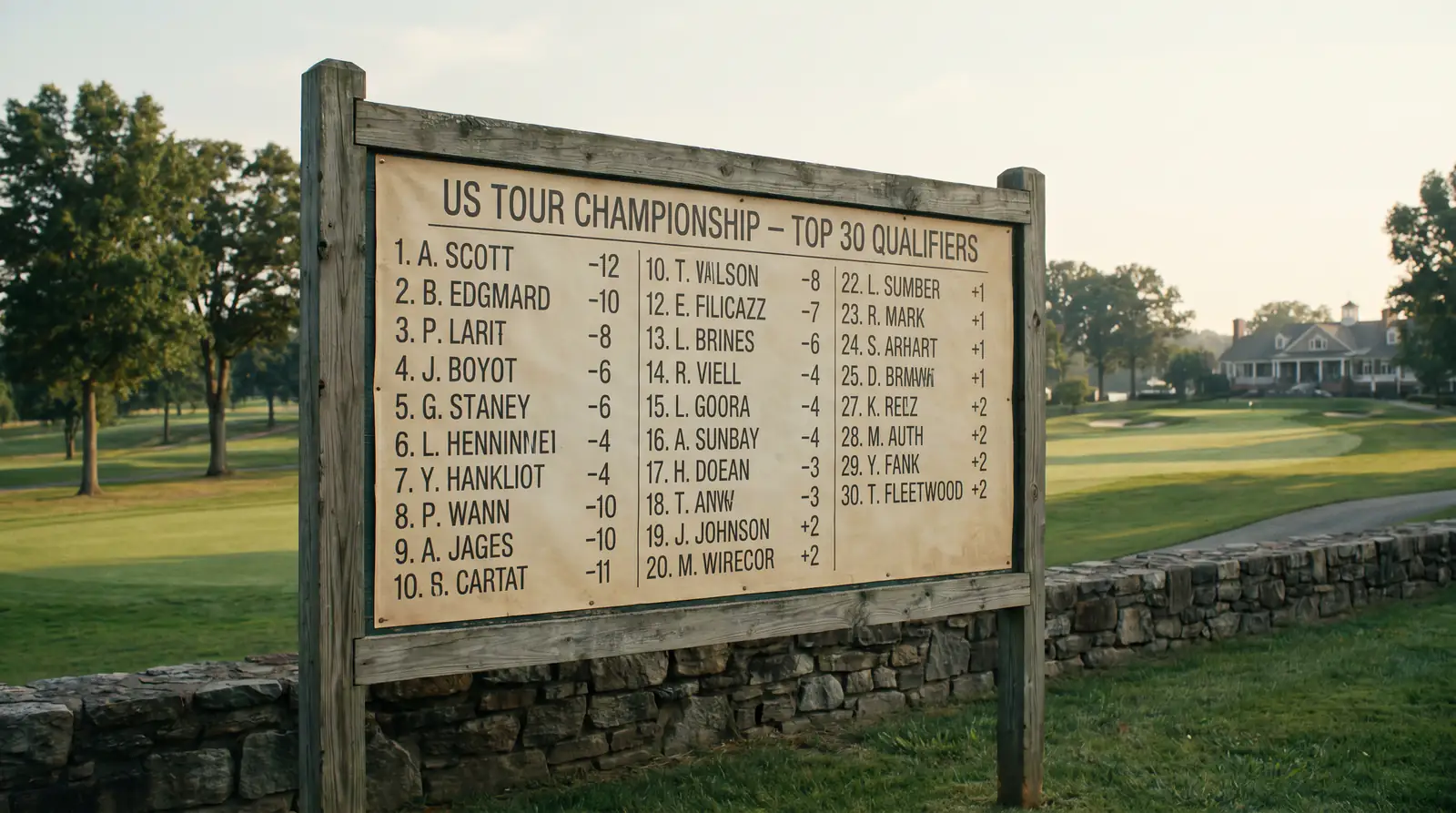
The historical East Lake patterns matter for live betting decisions. Winners over the past 8 events have consistently ranked inside the top 10 in SG: Approach for the season; none has ranked outside the top 15. The Strokes Gained: Putting profile of recent winners shows wider variance — putting performance on Sunday at East Lake can swing the outcome materially even when the approach play is strong.
Are FedEx Cup standings still relevant for live-betting decisions after East Lake starts? Yes, but for a specific reason: the standings determine the starting-strokes structure, which is fixed once the event begins. A player who finished second in the regular season but is currently at -3 in the round needs to understand that their effective tournament score is -3 plus their -8 starting-strokes lead, equals -11 modified — and the live outright price reflects this composite, not just the round score.
The mid-round live trading consideration is that any player ranked 10-30 entering East Lake starts at even par modified, which makes their live outright probability much more sensitive to their first 18 holes of play than the top-seeded names. A player ranked 25th who opens with a 65 can shift from 25/1 to 8/1 in a single round, while a top-seed who opens with a 72 only drifts from 4/1 to 6/1. The relative volatility favours late-seeded names for high-multiplier upside trades.
Playoff vs Regular-Season Margin
The playoff weeks (BMW Championship, Tour Championship, with the FedEx St. Jude opening the series) carry tighter margins than regular-season events because the volumes are higher and the trading desks are fully staffed for the season’s culminating action.

The pattern in my notes: outright margins at the Tour Championship run 4-5 per cent total across the 30-player field, against 6-8 per cent at a regular-season PGA Tour event. H2H matchup margins at playoff events run 3-4 per cent total, against 5-6 per cent at regular-season events. The narrowing reflects the trading desks’ confidence in their pricing — the 30-player field is small enough to model thoroughly, the players’ season-long stats are well-known, and the format structure is fixed.
For UK punters, the tighter margins at playoff events mean that sharp reads convert into smaller per-ticket profit than they would at regular-season events, but loose reads also lose less per ticket. The net effect favours patient punters who can wait for clear value signals and let the margin compression work in both directions.
The “playoff narrative” public-side bias is the most identifiable mispricing pattern. Players with recent regular-season wins tend to attract heavier public-side money during the playoffs, pulling their live outright prices shorter than the model probability would support. Players who finished strong through August but haven’t won in 3-4 months tend to drift longer than honest. The disciplined punter looks for the latter group, especially the names whose Strokes Gained metrics through the playoff opener have remained elite even without recent victories.
How does a starting-strokes lead change the live-outright pricing curve?
Significantly. The Tour Championship’s top seed at -10 has live outright implied probability around 70-77 per cent on Sunday morning when their through-54-holes round score is reasonable; a player ranked 30th starting at even par would need to outscore the field by 12+ shots over 72 holes to win, producing live prices around 50/1 even when their round-by-round form is strong. The format compresses the favourite’s price and stretches the field’s price.
Are FedEx Cup standings still relevant for live-betting decisions after East Lake starts?
Yes, because the standings determine the starting-strokes structure that remains fixed throughout the event. A player’s effective tournament score is their round score plus their starting-strokes lead, and the live outright price reflects this composite. Reading the standings is reading the handicap structure that drives the live pricing model.
