

 Available in US
Content
The Metric That Tells You What Just Happened, Not What Will
The mistake I have made with SG: Putting more than with any other golf metric is reading a “hot putting week” as predictive rather than descriptive. A player who gains 4 strokes putting at Augusta in April is genuinely hot for that week — the data is real, the makes are real, the trophy may follow. But that same player at Pebble Beach in February will not, on the evidence of seven years of tracking, have repeated the hot putting week. SG: Putting is the least stable of the SG metrics, and the live betting traps are built on the assumption it is more stable than it actually is.

The metric matters — putting still wins tournaments, and players who consistently rank top-20 in SG: Putting season after season do enjoy a real edge. But the week-to-week variance is large, the course-specific variance is even larger, and the correlation between current SG: Putting form and next-event putting performance is much weaker than the equivalent correlations for SG: Approach or SG: Off-the-Tee.
What follows is what SG: Putting actually measures, the specific fallacy that catches most live punters, how green type changes the metric’s stability and predictive value, and the specific live trigger events that should and should not move SG: Putting into your live trading decisions.
What SG: Putting Actually Measures
Strokes Gained: Putting measures how many strokes a player gains or loses against the field average on putts of a given starting distance from the hole. The reference is the tour’s empirically-derived expected putts-to-hole from each starting distance — 1.4 putts from 8 feet, 1.7 from 15 feet, 1.9 from 25 feet, and so on. A player who consistently holes putts from distances where the field averages do not is gaining strokes against the field.
The metric does not measure putting “skill” in the abstract sense, despite the public-facing presentation. It measures putting outcomes against a baseline that itself reflects tour-wide putting performance. A player can rank top-10 in SG: Putting for a season by holing one or two extra long putts per round above field expectation, which is a small absolute number of strokes but compounds into a significant rank over a 40-event sample.
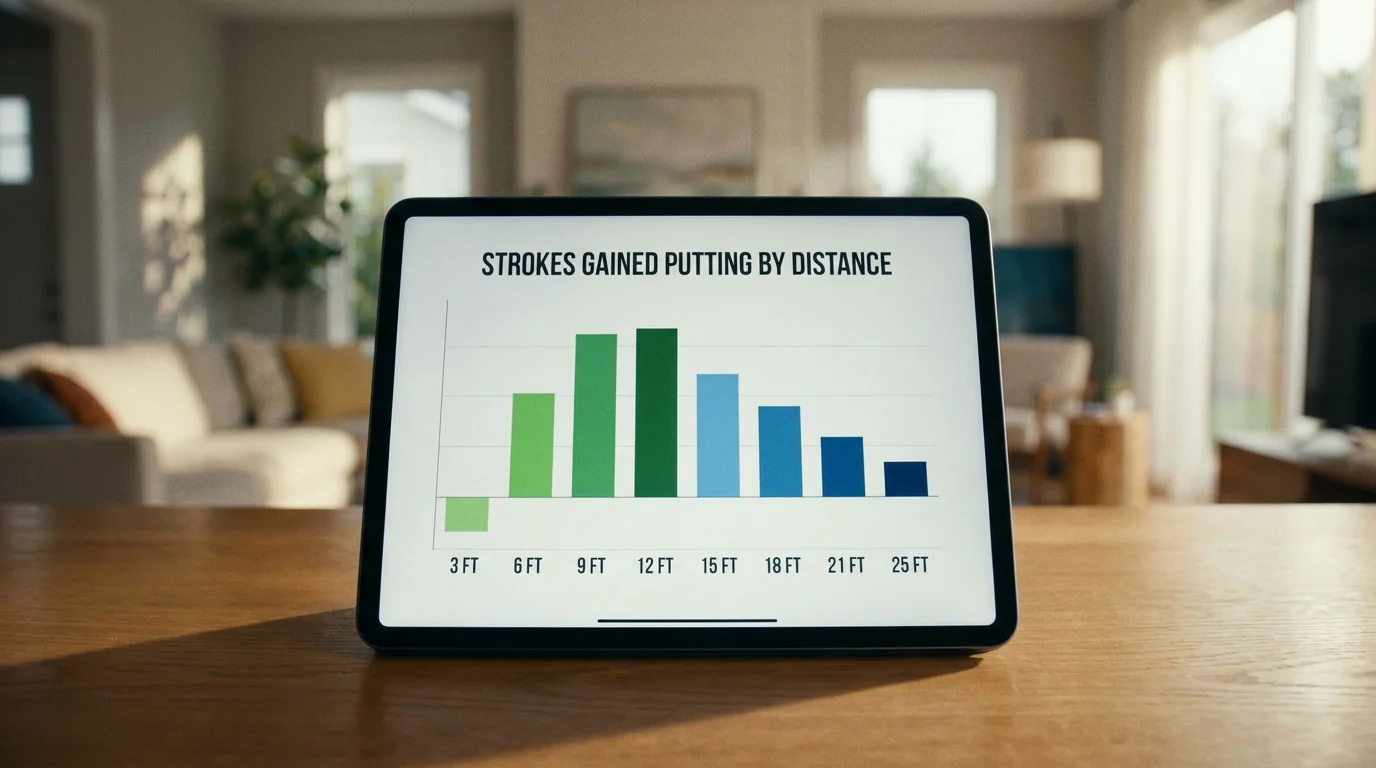
The tour-average baseline is 0.000 strokes per round by definition. The top of the season-long leaderboard runs +0.5 to +0.8 strokes per round; the bottom runs -0.5 to -0.7. The full-season range between top and bottom is roughly 1.3 strokes per round — slightly narrower than the SG: Approach range, but still significant across a four-round tournament.
Scottie Scheffler’s 2025 birdie-or-better rate of 25.78 per cent illustrates the indirect relationship between approach play and putting outcomes. His SG: Approach was elite (he led the tour), and his SG: Putting was middle-tier — but his birdie rate was extraordinary because the approach play put the ball close enough to the hole that even average putting converted into birdies at unusual rates.
The Hot Putter Fallacy
The single most expensive mistake in live golf betting tied to SG: Putting is the “hot putter” extrapolation. A player has a +2.5 SG: Putting round on Thursday. The public reads this as “he is putting well this week” and the live price tightens accordingly. Friday’s putting performance, on the evidence of seven years of my own data, regresses heavily toward that player’s season-long mean — not because the data is wrong, but because single-round putting variance is huge relative to single-round putting “skill.”

Pamela Maldonado, who covers sports betting for ESPN, summed up the broader behavioural trap exactly: “Golf betting is a slow-burn panic. Throwing darts at the board and hoping for a bullseye is a good way to run out of funds before the weekend.” The hot-putter chase is a specific variant of that pattern. The punter sees one good round, projects it forward, sizes up the stake, and watches the regression destroy the ticket.
The maths underneath the regression: SG: Putting round-to-round correlation within the same player at the same tournament is roughly 0.15 to 0.25. SG: Approach round-to-round correlation at the same tournament is 0.45 to 0.55. The putting signal is genuinely noisier than the approach signal, and the live trading models reflect this — putting-driven prices move quickly but should not be trusted as forward indicators in the way approach-driven prices can be.
The practical implication: a player who has just shot +2 SG: Putting in round one should have his round-two live MTC and top-finish prices treated cautiously. If the public has pushed the price shorter on the hot-putter narrative, the value play is often to fade rather than follow.
Green Type and SG: Putting Stability
SG: Putting stability varies substantially by green type. The reason is that different grass types (bentgrass, Bermuda, Poa annua) interact differently with the putter face and the ball, and players develop genuine skill-splits on different surfaces over their careers.

Bermuda vs Bentgrass changes the SG: Putting baseline meaningfully for individual players. A player whose career SG: Putting average is +0.3 strokes per round across all surfaces might be +0.6 on bentgrass and -0.1 on Bermuda — a 0.7-stroke split that materially changes their expected performance at the next tournament.
The trading desks track these surface splits explicitly. Live pricing models at the major UK operators include green-type baselines for every player with sufficient career data, and the SG: Putting weighting adjusts according to the venue. A player ranked top-10 season-long in SG: Putting but historically weaker on Bermuda greens will have a discounted SG: Putting weight at a Bermuda venue like the Players Championship.
The course-distance baseline of 303-304 yards on the 2025 PGA Tour gives some context for how the metric weighting interacts with course setup. Longer courses tend to have larger greens, which slightly destabilises SG: Putting because more putts come from outside 20 feet (where variance is highest). Shorter courses tend to have smaller greens, which slightly stabilises SG: Putting because the distance distribution favours shorter putts where the metric is more reliable.
Live SG: Putting Triggers for Side Bets
Specific live triggers worth tracking for SG: Putting-related side bets, where they exist at UK operators:
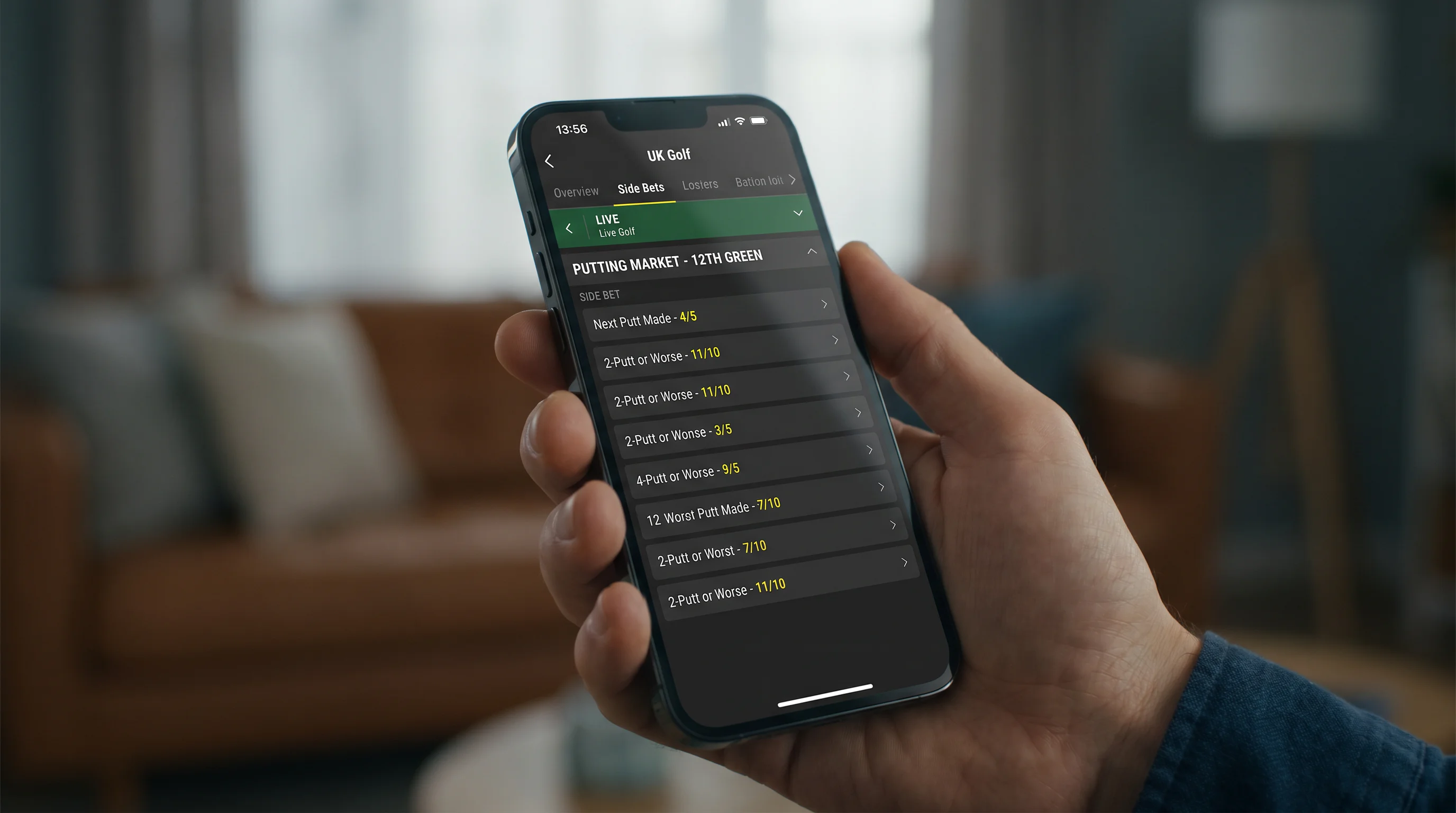
A player who gains +1.5+ SG: Putting in a single live round, with the corresponding leaderboard climb, often produces live “best round of the day” market opportunities at the smaller books. The market typically prices these moves more slowly than the leaderboard updates, and the lag creates short windows where the implied probability of holding a +2 SG: Putting round can be exploited.
A player who has lost -1.5+ SG: Putting in a single round, where the leaderboard reflects the deterioration, often gets overcorrected by the public-side money. The “missed-the-cut” live market on a +5 player after 24 holes (with the cut projected at +3) can be available at honest probability 65 per cent against displayed price implying 75 per cent. The fade play is then to back the player making the cut against the public.
The recurring pattern across both triggers is that putting-driven leaderboard moves get overprocessed by the public market and underprocessed by the model. The trading desks know this. The competent live punter who treats SG: Putting as descriptive rather than predictive can find regular small edges in the side markets, while avoiding the lottery-ticket variance of treating hot putters as forward signals.
Does SG: Putting predict make-the-cut better than top-finish?
Marginally better for make-the-cut, because the cut-line outcome is more sensitive to single-shot decisions where putting matters most. Top-finish outcomes (especially top-10 and top-20) depend more heavily on SG: Approach and SG: Tee-to-Green, where the round-to-round predictability is higher and the variance is lower.
Should I weight last-3-rounds SG: P higher when betting live during Sunday?
No, in general. The last-3-rounds SG: Putting is too small a sample to override the season-long mean — putting variance round-to-round is too large for a 3-round window to be predictive. The trading desks weight trailing-13-events SG: Putting more heavily than season-long, but rarely weight last-3-rounds higher than either.
